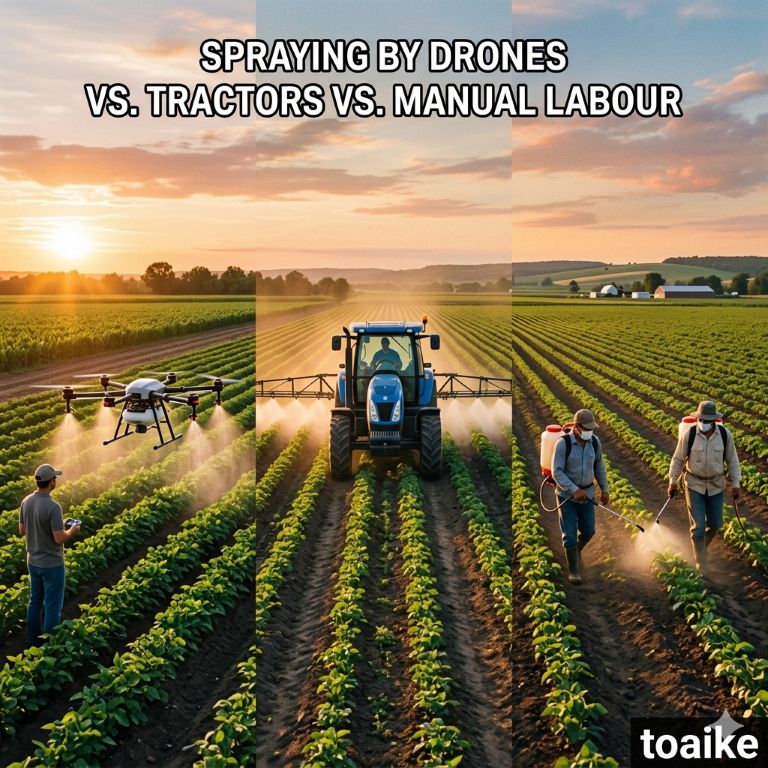
Drones vs. Tractors vs. Manual Labour: Who wins your farm’s money?
A no-nonsense financial breakdown of every spraying method in Indian agriculture today.
😄 True story: a farmer once hired three labourers to spray his 40-acre cotton field. By day two, one had a backache, one had “urgent family business,” and the third had simply evaporated. If you’ve lived this, welcome — you’re in the right place.
The question everyone’s really asking
Traditional spraying is expensive in ways that don’t show up on an invoice — lost labour, chemical waste, trampled crops, and days lost to muddy fields after rain. Meanwhile, agricultural drones are making big promises. But do the numbers actually hold up?
This guide breaks down the hard economics of all four methods: manual knapsack sprayers, motorized power sprayers, tractor-mounted boom sprayers, and commercial agricultural drones — across capital cost, running cost, and real-world ROI.
Daily Coverage Capacity (acres / day)
🏠 Manual knapsack sprayer
1.5 – 2 acres / day
Hard human limit — exhausting and inconsistent
⚙️ Motorized power sprayer
5 – 6 acres / day
Needs 2 operators; hose-length limited
🚁 Agricultural drone
20 – 25 acres / day
Battery swaps + mixing time included in estimate
🚜 Tractor boom sprayer
30 – 40 acres / day
Fastest on paper — but weather and terrain dependent
Capital expenditure: what you pay upfront
The barrier to entry climbs steeply with every level of mechanization. Here’s what each setup costs before you spray a single drop.
🏠
Manual knapsack sprayer
₹2,500 – ₹5,000
Standard 16L unit. Lowest barrier to entry.
⚙️
Motorized power sprayer
₹15,000 – ₹35,000
4-stroke engine + 50–100m hose + spray gun.
🚜
Tractor boom sprayer
₹71,000 – ₹2,35,000
Assumes you already own the tractor. Add ₹6L+ if not.
🚁
Agricultural drone (10L)
₹6,50,000 – ₹8,50,000
Before subsidies. Govt. covers up to 80% (₹8L) under Namo Drone Didi Scheme.
Running costs per acre: the real scorecard
Once you’re in the field, here’s what every acre actually costs you across each method. Green = drone advantage. Amber = watch out.
| Parameter | Manual Knapsack | Motorized Sprayer | Tractor Boom | Agricultural Drone |
|---|
| Labour / pilot fee | ₹150 – 250 / acre | ₹200 – 300 / acre | ₹50 / acre | ₹100 / acre |
| Water required | 150 – 200 L / acre | 200 – 250 L / acre | 250 – 300 L / acre | 10 L / acre only |
| Fuel / power cost | Negligible | ₹80 – 120 / acre | ₹110 – 160 / acre | ₹40 – 60 / acre |
| Chemical waste | 15 – 25% | 20 – 30% | 25 – 35% | ~0% (ULV atomization) |
| Avg. net cost | ₹250 – 350 / acre | ₹300 – 450 / acre | ₹110 – 155 / acre | ₹350 – 500 / acre (service rate) |
Drone service rate varies by acreage — see sliding scale in the verdict section below.
The hidden financial leaks no one talks about
OpEx numbers only tell half the story. These are the structural costs that silently bleed your returns — especially with tractor-based systems.
A tractor boom sprayer consumes 300 litres per acre. Spray a 40-acre field and you need 12,000 litres hauled to the site — that means dedicated support vehicles and delays. Drones use ultra-low volume nozzles at just 10 litres per acre, with micro-droplets that penetrate the canopy and coat the underside of leaves where pests actually live.
Tractor → High volume → Over-saturation → Chemical drips into soil
Drone → Rotor downwash → Micro-droplets → Full canopy coverage
A multi-ton tractor through cotton, maize, or groundnut rows creates permanent ruts and broken branches. This quietly destroys 3% to 7% of your total crop yield every spray cycle. On a 40-acre farm at 3 cycles a season, that’s a significant hit. Drones don’t touch the ground — at all.
Tractor → Heavy tyres → Soil compaction + crushed crops → ~5% yield loss
Drone → Zero ground contact → No field damage → 100% crop preserved
Post-rain muddy soil? Tractor stuck. Tall mature sugarcane? Boom too low. Wet season pest outbreak at its peak? Your most powerful sprayer is sitting in the shed. Drones operate entirely independent of soil moisture and crop height, giving you instant response exactly when an infestation needs to be contained. The season doesn’t wait for dry weather.
The bottom line: what’s right for you
Forget the marketing brochures. Here is what the numbers actually tell us — by farm type.
Smallholder · Under 5 acres
Don’t buy a drone. Hire one — but do it together.
At ₹600–₹700 per acre, drone hire is a premium over manual labour. Solo, it’s hard to justify. But pool your acreage with 4–5 neighbouring farmers and your collective 20+ acres immediately drops the rate into the ₹400–₹500 bracket. You get drone-quality results — zero trampling, 20–30% less chemical spend — without a single rupee of hardware debt. This is the smartest move a smallholder can make right now.
Medium to large farms · 20+ acres
Tractor boom is cost-efficient — until it isn’t.
On broadacre row crops with firm soil, a tractor boom is a genuine workhorse. But add water logistics, yield loss from compaction, and 25–35% chemical waste, and the cost gap versus drone service narrows fast. For high-value crops like cotton, turmeric, or vegetables, the drone wins on net revenue even at a higher service rate. Run the full math before you decide.
CHC operators & agritech entrepreneurs
This is one of the best agricultural businesses you can start in India today.
The economics are compelling and the window is open. A subsidized drone setup under the Namo Drone Didi Scheme costs a fraction of the sticker price. At a conservative 20 acres per day at ₹500/acre, you generate ₹10,000 in daily gross revenue. After pilot wages, transport, and battery replacement reserves, a subsidized setup pays back in just 6 to 9 months of active seasonal operation. No other agricultural equipment on the market achieves that payback curve. The farmers are ready, the government subsidy is active, and the per-acre economics beat every competitor once you hit volume. The only question is who builds the business first — you, or someone else in your district.
📊 20 acres × ₹500 = ₹10,000 gross daily revenue
Drone service rate sliding scale (market rates, 2025)
| Farm size | Rate per acre |
|---|
| 1 – 5 acres | ₹600 – ₹700 Premium |
| 5 – 20 acres | ₹500 – ₹600 |
| 20+ acres | ₹400 – ₹500 |
| Bulk contracts | ₹300 – ₹400 Best value |
References
1
2
Journal of Scientific Research and Reports — Technical and Economic Assessment of a Tractor Operated Boom Sprayer
journaljsrr.com →3
National Institute of Plant Health Management (NIPHM) — Pesticide Application Techniques and Volume Classifications
niphm.gov.in →4
5