
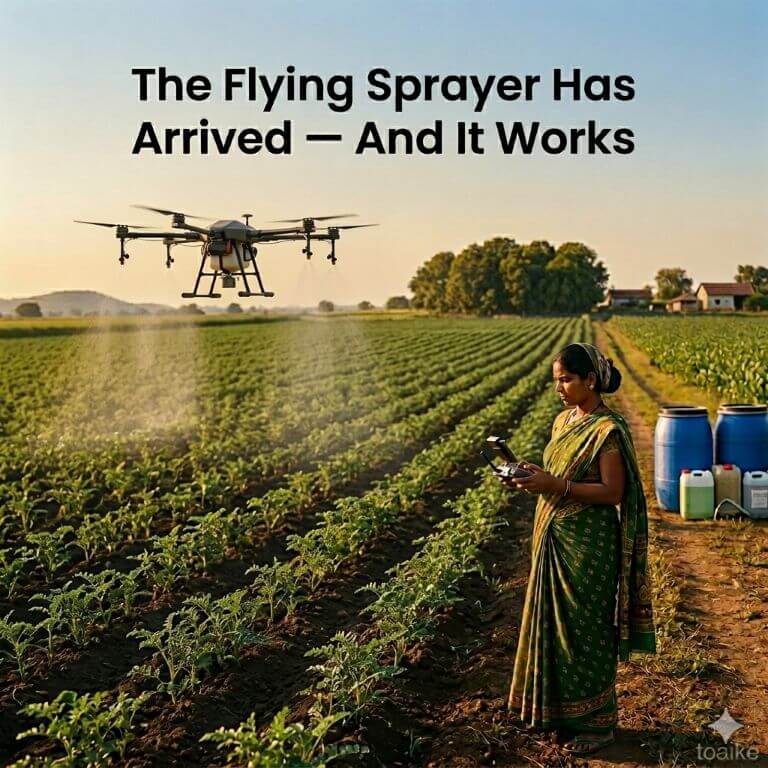
At the edge of a field, just after sunrise, the air often carries a faint, bitter smell. It drifts over rows of crops before you notice the man behind it. He moves steadily, almost mechanically, a tank of chemicals strapped to his back, a fine mist trailing from the nozzle in his hand. There is no ceremony to his work—only urgency. The crop cannot wait, the pests will not pause, and the day is always shorter than the task ahead.
Season after season, the routine repeats itself. Different crops, different weather, same method. The chemicals change, the risks don’t. Exposure is part of the job, inefficiency is accepted, and precision is mostly a guess. For decades, this has been the invisible backbone of crop protection in India—labour-intensive, uncertain, and quietly hazardous.
But this long-standing rhythm is beginning to shift. A new presence is entering the fields—not on foot, but from above. Small, hovering machines are starting to take on the job, promising something agriculture has rarely had at scale: accuracy without exposure, speed without exhaustion. And in doing so, they may finally change one of farming’s most overlooked stories.
The Machine Itself: What Is This Thing, Exactly?
An agricultural spraying drone — sometimes called an agri-drone or UAV sprayer — is an unmanned aerial vehicle specifically engineered to carry and dispense liquid pesticides, herbicides, fungicides, and liquid fertilizers over farmland.
The most commonly used configurations in India today are hexacopter (six-arm) or octocopter (eight-arm) drones, although four-arm quadcopters are used for smaller operations. Both international and Indian-manufactured models are now commercially available and DGCA-approved for agricultural use in India.
The anatomy of a spraying drone breaks down simply. The frame is made from carbon fibre and aerospace-grade aluminium — light enough to fly, strong enough to carry a full liquid tank without vibrating itself to pieces. The propulsion system consists of brushless electric motors, each spinning a carbon fibre blade. These motors are rated in kilowatts, and together they generate the lift needed to carry the machine, its battery, and its chemical payload skyward.
The tank — the heart of the spray operation — typically holds between 10 and 40 litres of mixed spray solution depending on the drone model. For the average Indian farm operation, 10–16 litre tanks are most practical given typical field sizes and the need to move between multiple small plots.
The spray system consists of centrifugal atomising nozzles or hydraulic flat-fan nozzles, positioned on a boom beneath the body. These nozzles rotate at high speed or operate under pressure to break the liquid into tiny droplets and fling them across the canopy below.
The Battery: The Real Boss of the Operation
Here is where many farmers ask the right question. A drone this powerful — how long does it run?
The answer: not long enough to impress anyone at a dinner party, but perfectly adequate for the job.
Most agri-drones run on high-discharge lithium polymer (LiPo) or lithium-ion (Li-ion) battery packs, rated between 12,000 mAh to 30,000 mAh, operating at 44.4V to 57.6V. In practical terms, a fully charged battery on a standard 10-litre drone provides 10 to 15 minutes of operational flight time per charge.
This sounds short. It is short. But consider that a 10-litre tank covers roughly one acre in 7–10 minutes. So one battery, one tank — one acre. Swap the battery (2 minutes), refill the tank (3 minutes), and you are airborne again. Operators typically carry 4–6 battery sets in rotation, using a rapid charger that brings a dead pack back to full charge in 25–30 minutes. A large-tank drone (40-litre capacity) with a two-person ground crew managing batteries and chemical refills can cover 40 to 50 acres in a single working day.
One caution worth noting: battery packs do not last forever. A quality agri-drone battery typically survives 200 to 400 charge cycles before its capacity begins to degrade meaningfully. For an operator covering 10 acres a day, that translates to battery replacements roughly every one to two seasons — a recurring cost that is easy to overlook when calculating the economics of drone adoption, but important to budget for. In remote villages where reliable electricity is unavailable, battery charging itself becomes a logistical obstacle. A diesel generator can become part of the spray kit, adding both cost and complexity to every operation.
The Physics of the Spray: Droplet Size and Why It Matters More Than You Think
This is where the science gets genuinely interesting — and where the drone earns its keep far beyond the novelty factor.
When you spray a pesticide, the chemical only works if it reaches the target: the leaf surface, the insect body, the fungal spore. The size of the droplet determines whether it gets there efficiently or drifts away into the atmosphere, evaporates in mid-air, or bounces off the leaf and falls into the soil.
Droplet size is measured in microns (µm) — one micron being one-millionth of a metre.
In conventional knapsack sprayer operation, droplet size typically ranges from 300 to 500 µm — large, heavy droplets that fall fast, run off leaf surfaces, and require large volumes of water to carry the chemical to the field.
Agricultural drones, using centrifugal atomising nozzles (also called rotary atomisers), produce droplets in the range of 50 to 150 µm — classified as fine to medium spray in international nozzle standards (ASABE S572.1).
These finer droplets offer three critical advantages.
First, coverage. A 100-µm droplet covers significantly more surface area per millilitre of chemical than a 400-µm droplet. More coverage means better pest and disease contact with less chemical.
Second, canopy penetration. The downwash from drone rotors — the powerful column of air pushed downward by spinning blades — actively forces the fine spray mist into the crop canopy, reaching the underside of leaves where pests like aphids, whiteflies, and spider mites actually hide. No ground sprayer achieves this without a dedicated air-blast mechanism.
Third, drift control. While very fine droplets below 50 µm do drift, the controlled operating height of agricultural drones and the rotor downwash keeps the effective spray within the canopy zone, minimising off-target movement.
A word of honest caution here, though. Drift is controlled under ideal conditions — not eliminated. When wind speeds exceed 15 km/h, fine droplets begin moving sideways faster than they move downward. At that point, your chemical is not going where you want it. Spraying must stop. A neighbour’s field, a beekeeper’s hives, or a water body nearby can receive unintended chemical if the wind rises and the operator is not paying attention. This is not a flaw unique to drones — all fine-spray systems face the same physics — but it is a real operational limit that cannot be ignored.
The Height Question: How Low Does It Go?
The operating height of an agricultural drone during spray application is a carefully calibrated number — not something the pilot decides based on what feels comfortable.
Standard recommended operating height for agri-drones is 1.5 to 3 metres above the crop canopy. Most drone flight management systems default to 2 metres above canopy height as the operational standard.
At this height, the rotor downwash — moving at approximately 8–12 metres per second directly below each rotor — creates a penetrating air column that pushes spray droplets down through the leaves. Flying too high (above 4–5 metres) weakens this downwash effect and increases drift. Flying too low (below 1 metre) causes the downwash to physically damage soft crops and creates uneven spray distribution due to turbulence.
For tall crops like sugarcane or maize, the drone adjusts to fly 2–3 metres above the top of the canopy. For short crops like paddy, wheat, and vegetables, 1.5 metres is typically optimal.
Modern drones use terrain-following radar which automatically adjusts flight height in real time as the terrain rises and falls, maintaining a constant distance from the crop canopy even on undulating farmland. This is not a luxury feature — on Indian farms with bunded fields and irregular terrain, it is essential for spray consistency.
How Much Chemical Does a Drone Actually Use?
This is the number that makes farmers put down their chai and pay attention.
In conventional knapsack sprayer application, the standard spray volume is 200 to 500 litres of mixed solution per acre, depending on crop, pest pressure, and operator habits. Think about what that means on the ground: every litre of that water has to be sourced, carried to the field, poured into the tank, and pumped through the system. In water-stressed regions — most of India’s dryland farming belt — this is not a small ask.
Agricultural drones operate at Ultra-Low Volume (ULV) application — typically 8 to 15 litres per acre, with 10 litres per acre being the standard recommendation for most Indian crop conditions as per ICAR and DGCA guidelines.
From 300 litres hauled, pumped, and carried — to 10 litres lifted quietly into the air. That is not just an efficiency number. That is labour, water, and time collapsing into a single transformation.
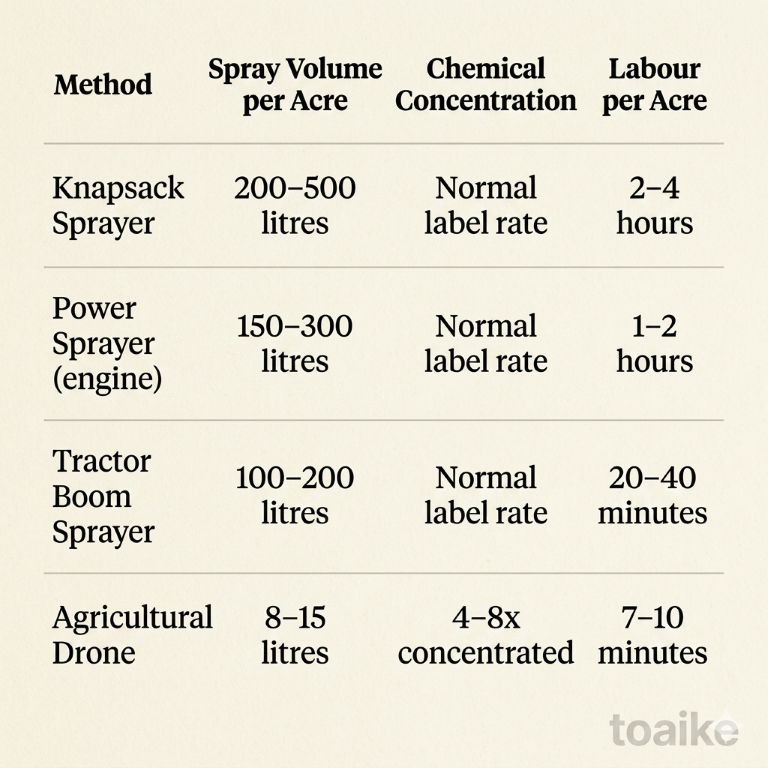
Because the drone uses far less water, the pesticide active ingredient (a.i.) per acre remains the same — the chemical is simply mixed at a higher concentration to compensate for the lower volume. This is critical to understand: the drone does not use less chemical per se; it uses less water. The chemical dose per acre, as per label recommendations, must be maintained.
This higher concentration, however, introduces a handling risk that deserves honest mention. The mixing still happens on the ground, by human hands. A solution that is 6x concentrated is 6x more hazardous if it splashes on skin or is mishandled during preparation. The drone reduces field exposure for the operator — but the mixing stage remains a point of chemical risk that requires proper protective equipment, careful measurement, and trained handling. The aerial application is cleaner; the ground preparation is not automatically safer.
Several field studies from ICAR and state agricultural universities have shown a 15–25% reduction in total pesticide quantity with equivalent or better pest control outcomes using drone application — but this efficiency gain is only realised when the operator is trained, the concentration is correctly calculated, and the drone is calibrated for the specific nozzle type and flight speed in use.
Time on the Field: One Acre in Under Ten Minutes
A 10-litre spray drone, flying at a standard speed of 4–6 metres per second, with a spray swath width of 4 to 5 metres, covers approximately one acre (0.4 hectares) in 7 to 10 minutes of active flight.
By contrast, a single labourer with a knapsack sprayer covers one acre in 3 to 4 hours. A two-person power sprayer team takes 45 minutes to an hour. A tractor boom sprayer, where it can access the field, takes 15–20 minutes.
But speed is only half the story. The more important question is: what does the farmer do with the time just saved?
The answer is more consequential than it appears. Timely spraying — applying a fungicide at the exact onset of disease pressure rather than two days later when labour was finally available — can mean the difference between a controlled outbreak and a field lost. Many pest and disease situations in Indian agriculture are not lost because the farmer did not know what to spray. They are lost because the spray happened too late. A drone that covers four acres in 40 minutes removes that bottleneck entirely.
Beyond the single farm, saved time allows a farmer managing multiple fragmented plots — common across central and eastern India — to cover all his land in a single morning rather than spreading the operation over three days. It also reduces dependence on the increasingly scarce and expensive agricultural labour that every farmer knows is harder to find each season. Time, in Indian farming, is not just convenience. It is yield.
High-capacity drones with 40-litre tanks and dual spray systems can cover 10–15 acres per hour under ideal conditions, making it entirely feasible for a single service operator to cover an entire village’s critical spray window in one day.
Which Crops Can Use Drones?
- In India, agricultural drone spraying has regulatory approval and demonstrated efficacy across a wide range of crops.
- Paddy (rice) is the largest use case nationally, particularly in Punjab, Haryana, and Andhra Pradesh. The Namo Drone Didi scheme has deployed most of its fleet on paddy fields. The flat topography and flooded field conditions are ideal for drone operation.
- Wheat and other cereals — drone spraying for yellow rust, aphids, and foliar nutrition is well-established across north India.
- Cotton — significant uptake in Maharashtra and Telangana for bollworm management and defoliation spraying pre-harvest.
- Sugarcane — used for early shoot borer control and ratoon crop management, though the tall canopy requires higher flight adjustments.
- Vegetables and horticulture — tomato, chilli, onion, and grape vineyards are increasingly using drones, particularly for fungicide application.
- Orchards — mango, citrus, and guava orchards are being sprayed by drone in Maharashtra and Uttar Pradesh, with careful height adjustment for canopy structure.
- Where drones face real limitations is equally important to acknowledge. GPS signal degradation near large trees, power transmission lines, and mobile towers can cause the drone to lose positional accuracy mid-mission. Very fragmented plots below half an acre, scattered across a village with bunds and structures between them, reduce the efficiency of automated flight paths considerably. And wind, as discussed, is a firm operational ceiling — not a suggestion.
The Regulation You Cannot Skip
Here is the part of the drone story that does not make it onto posters at the kisan mela, but matters enormously in practice.
Every agricultural drone operating in India must be registered on the Digital Sky platform managed by DGCA. The drone must carry a Unique Identification Number (UIN), and a Remote Pilot Licence (RPL) is mandatory for the operator. The RPL is issued after completing a training programme at a DGCA-approved Drone Training Organisation (DTO) — typically a 5 to 15-day course combining ground theory and practical flight hours.
Beyond registration and licensing, operators must navigate no-fly zones — which in India include areas within 5 km of airports, near international borders, military installations, and increasingly near state highways and urban fringes. A farmer operating near a town boundary may find that portions of his field fall within restricted airspace without realising it.
This compliance layer is the honest friction of a technology transitioning from demonstration to mainstream. It is not designed to stop farming. But it is real, and it is one of the reasons the service model — rather than individual ownership — has become the practical path of adoption for most farmers.
Who Actually Pays for This? The Real Economics
This is the question every farmer asks before any other. Kitna lagega?
An agricultural spraying drone in India currently costs between ₹4 lakh and ₹10 lakh, depending on tank capacity, sensor capability, and build quality. Add a set of 4–6 batteries (₹15,000–₹50,000 each), a rapid charger, a carrying case, and mandatory insurance. The total cost of ownership for a basic operational setup sits between ₹6 lakh and ₹15 lakh before a single acre is sprayed.
For a farmer with 2–5 acres, buying a drone outright is not a rational investment — and does not need to be.
The model that actually works at scale is the service model: a trained operator — working through a custom hiring centre, an FPO, a state agricultural department, or the Namo Drone Didi programme — charges ₹300 to ₹800 per acre for spraying services. The farmer pays for the service, not the machine. His capital investment is zero. His benefit is full.
This is how agricultural mechanisation has always reached the small farmer in India — not through individual ownership, but through shared access. The tractor did not reach every smallholder because every smallholder bought a tractor. It reached them because someone in the village owned one and hired it out. The drone is following the same path, only faster, with government policy actively accelerating it.
Government subsidy schemes currently offer up to 40–50% capital subsidy on drone purchase for eligible entities including FPOs, cooperatives, and agricultural graduates setting up drone service enterprises. Under Namo Drone Didi, Women Self Help Groups receive up to 80% subsidy. These are not peripheral incentives. They are the financial architecture that makes the service model viable at the grassroots level.
The Man with the Leaky Tank — A Different Future
Now let us return to that pesticide man.
He does not disappear. He transforms.
The same person who walked those fields every season with a leaking tank strapped to his back — coughing through the mist, absorbing chemical through his skin — can become the drone operator. A certified training programme at a DGCA-approved centre earns him a Remote Pilot Licence. Add calibration training, battery management, field mapping, and basic maintenance, and that man is now a skilled, licensed service provider. He covers 40 acres a day instead of four. He charges ₹500 per acre. He earns ₹20,000 in a good week. He is not breathing pesticide anymore. He is flying above it.
This is not a policy brochure fantasy. It is already happening through the Drone Didi programme, through FPO-operated fleets in Andhra Pradesh and Maharashtra, and through young men and women from agricultural families who have enrolled in drone pilot training since the rules were formalised in 2021. The technology changes the tool. The economics change the access. The training changes the person.
The Data Layer: What the Drone Sees That You Cannot
We have spoken of the drone as a sprayer. It is worth pausing to note what else it can become.
Modern agri-drones can be fitted with multispectral cameras that capture crop reflectance data invisible to the human eye. From this data, NDVI (Normalized Difference Vegetation Index) maps are generated — field images that show, with clarity, which patches are healthy, which are stressed, which are nutrient-deficient, and which are under early pest or disease pressure, days before visible symptoms appear on the ground.
The drone that sprays your paddy in the morning can survey it in the afternoon, generating a map that tells you exactly where the next spray needs to go — and where it does not. Over seasons, this data builds into a field health record of genuine agronomic value.
India is in the early chapters of this story. Most agri-drone operations today are pure spray missions. But the infrastructure — the licensed pilots, the registered machines, the FPO-owned fleets — is being built right now. The data layer is the next bead on the necklace.
The Complete Picture: What a Season Looks Like Now
Sunrise, kharif season. The field has been mapped. The operator — a 26-year-old from the same village who trained last year and now runs a drone service covering three panchayats — marks boundaries on a tablet. Flight path auto-calculated. Battery in, tank filled with a precisely measured concentrated mix (gloves on, mask on — the mixing is still a careful job). Nozzles checked.
The drone rises to two metres above the paddy. The rotors build a downwash column. The nozzles spin at 6,000 RPM, atomising the solution into a fine, controlled mist that falls precisely — not aimlessly — into the canopy. The chemical reaches the leaf undersurface where the brown planthopper is feeding. The drone completes its path, returns, and lands itself.
One acre. Nine minutes.
The farmer watches. He was the one, not so many seasons ago, walking this same field with that leaking tank on his back. He knows what nine minutes means. He knows what four hours felt like.
Next season, he does not buy a new knapsack sprayer. He calls the operator instead. The season after that, his son enrols in a drone pilot training programme in the district town. The knapsack stays in the corner of the storage room, rusting quietly, leaking nothing on nobody.
That is what a technology transition actually looks like in Indian agriculture. Not a press conference. Not a subsidy announcement. Just one farmer calling another, saying: yeh kaam karta hai.
