
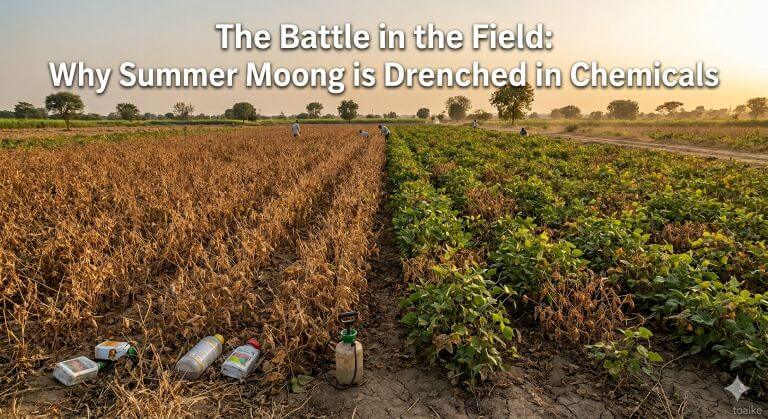
A Tiny Bean with a Big Role
Picture a small green seed, barely the size of a peppercorn, sitting in the palm of a farmer’s hand somewhere in Madhya Pradesh. It doesn’t look like much. But that little seed — moong, or green gram, known to botanists as Vigna radiata — carries enormous weight for millions of Indian farmers and the families that depend on them.
Moong is a sprinter among crops. It matures in as little as 60 to 70 days and can be grown across all three seasons — kharif, rabi, and the summer Zaid — as a sole crop or an intercrop. Entomoljournal That makes it precious in a country where every square metre of farmland has to work overtime. It packs roughly 24% easily digestible protein into its grain, is low in flatulence-causing compounds, and is rich in iron at 40–70 ppm PubMed Central — the kind of nutrition that quietly prevents malnutrition in millions of households across South Asia.
India accounts for about 54% of world mungbean production, and Madhya Pradesh alone contributes roughly 14% of India’s output. Entomoljournal In the Zaid or summer season (March to June), farmers sow it the moment the wheat is harvested — turning what would otherwise be fallow land into an income-earning, nitrogen-fixing, food-producing opportunity.
But here is where the story takes a complicated turn.
Summer: The Season That Never Goes Easy
When the summer sun beats down at 40°C and the irrigation channels are running, the moong field looks like paradise. Warm, moist, well-lit — perfect for the crop. Unfortunately, it is equally perfect for every pest, pathogen, and weed that has ever troubled a farmer.
Unlike the kharif season, where monsoon rains offer some natural buffering, the summer crop faces relentless, uninterrupted pest pressure. Scientists have recorded over 250 insect species feeding on pulse crops, with roughly a dozen — including pod borers, stem borers, jassids, aphids, and whiteflies — causing the most damage. Academia.edu
And then there is the invisible enemy: a virus. Mungbean Yellow Mosaic Disease (YMD) remains one of the biggest single threats to mungbean production worldwide, and managing it is still described by researchers as the “biggest challenge” facing the crop. Frontiers If plants are infected early, YMD — caused by the Mungbean Yellow Mosaic Virus transmitted by whiteflies — can reduce yield by up to 100%. Academia.edu Entire fields can turn yellow and barren within days.
The farmer watching this happen has a 60-day window, maybe less. There is no time to wait and watch. The chemicals come out.
The Tiny Insects Causing Giant Problems
Walk into a summer moong field in April and crouch down near the leaves. Look closely. Those barely-visible specks crawling on the undersides — some no larger than a dust particle — are not harmless. They are thrips (Caliothrips indicus), jassids (Empoasca kerri), and whiteflies (Bemisia tabaci), and together they form a trinity of destruction that keeps farmers across Madhya Pradesh and beyond reaching for their spray pumps day after day.
Each pest plays a different but devastating role in the unravelling of a moong crop.
The whitefly is perhaps the most dangerous of the three — not just because of what it eats, but because of what it carries. It pierces the leaf with its needle-like stylets, sucks cell sap directly from the tissue, and in doing so acts as the vector of the deadly Yellow Mosaic Virus. ResearchGate A single infected whitefly moving from plant to plant can condemn an entire field. If Yellow Mosaic Virus takes hold early in the season, it can reduce green gram yield by up to 100%. Academia.edu The plants don’t just underperform — they simply stop producing.
The jassid (Empoasca kerri) works differently. It is a leafhopper — agile, fast, and equally destructive. It punctures leaf veins and injects toxic saliva as it feeds, causing a condition called “hopperburn” — leaves curl, yellow, and dry from the margins inward. Studies from Rajasthan show jassid populations peaking at temperatures around 36°C with moderate humidity Entomoljournal, precisely the conditions that define April and May in central India’s moong fields.
And then there are thrips — the flower killers. Thrips feeds on tender buds and flowers, causing extensive flower shedding in summer mungbean. ResearchGate No flowers means no pods. No pods means no yield. A thrips outbreak at flowering time is a financial catastrophe measured not in percentages but in empty gunny bags.
Recent researches have mapped just how dramatically the chemical arsenal deployed against summer mungbean’s tiny adversaries has grown over the years — and the picture it paints is one of escalating dependency. What began as occasional applications of broad-spectrum organophosphates like dimethoate and monocrotophos has evolved into a sophisticated, multi-molecule rotation involving neonicotinoids, diamides, spinosyns, and insect growth regulators — each new generation of chemistry arriving in response to the resistance and resurgence that the previous one eventually failed to prevent. What this accumulation of research reveals is not scientific progress in isolation — it reveals a crop that has become a battleground, and a farming community that has had little choice but to keep adding weapons to fight an enemy that never fully retreats.
But here is the problem that no single spray can solve: the pests keep coming back. Field research on thrips management in summer green gram confirms that imidacloprid at 0.006% concentration performed effectively across both the first and second spray cycles, demonstrating consistent suppression across multiple observation windows. ResearchGate Yet consistent suppression is not elimination. Whitefly and thrips populations from neighbouring fields, fallows, and weed hosts reinvade within days of a spray. Studies show that untreated plots recorded whitefly populations of up to 14.44 per plant at the vegetative stage — nearly three times the count in the best chemically managed plots. Sciendo
The result is a rhythm that any moong farmer knows by heart: spray, wait ten days, spray again. Spray at vegetative stage, spray at flowering, spray at pod formation. Repeat applications every 10 to 15 days become not a choice but a calendar obligation. And with each round, another layer of chemistry settles onto a crop that will eventually be threshed, bagged, transported, and cooked in someone’s kitchen — often with no idea of what it took to get there.
The Residue Nobody Talks About
Here is what doesn’t make the news: the insecticides being used to fight these pests aren’t just surface sprays that wash off in the rain. Many of them — particularly neonicotinoids like imidacloprid and thiamethoxam — are systemic. They enter the plant’s vascular system and travel through its tissues, including into its seeds and pods.
Scientists recommend seed treatment with Imidacloprid 60 FS at 5 ml/kg combined with a foliar spray of Thiamethoxam at 25 days, specifically because this systemic approach reduces whitefly populations and, through them, MYMV disease incidence. ResearchGate The logic is sound agronomically. But it means the chemistry is inside the grain — and surface washing alone cannot remove it.
The farmer is not doing anything wrong. He is following science-backed recommendations. But the system — the tight timeline, the unrelenting pest pressure, the need to protect an economically critical crop in a compressed window — makes heavy pesticide use almost structurally inevitable.
When It's Time to Harvest: The Paraquat Problem
Now we come to the most controversial chapter in this story.
The moong is ready. Or almost ready. The paddy nursery needs to go in. The clock is ticking. Sun-drying the standing crop would take days, and the weather can be unpredictable. So a farmer reaches for a different kind of chemical — not a pesticide this time, but a herbicide used as a desiccant. And the one most commonly used across India for this purpose is paraquat dichloride.
Paraquat is a broad-spectrum, non-selective contact herbicide — in fact, the third most widely used herbicide in the world — known for killing all exposed green plant tissue within one to three days. Iuf Applied to a standing moong crop, it rapidly desiccates the plants, the pods brown, and the field is cleared in 48 to 72 hours. Clean, quick, efficient. On the surface.
But pre-harvest use of paraquat is particularly controversial because it dramatically increases the risk of chemical residues ending up in the food product itself — and if applied before the crop has reached full physical maturity, it can also reduce yield and seed nutritional quality. PubMed Central
The chemistry of paraquat’s action is elegant and terrifying in equal measure. It works by hijacking the plant’s own photosynthesis machinery, generating reactive oxygen species — unstable molecular fragments — that tear through cell membranes and chloroplasts like shrapnel, causing the plant to desiccate from the inside out.
And it doesn’t stay in the field when the crop is gone.
What Happens When Paraquat Enters the Body
Paraquat is one of the most toxic agricultural chemicals used worldwide. Even a small amount — a teaspoon, an accidental splash absorbed through broken skin, a breath of drift during spraying — can set off a chain of events inside the human body that medicine has no way to stop.
The moment it enters the bloodstream, paraquat begins its silent, systematic destruction. It circulates through the body and accumulates in three organs that cannot afford to fail: the lungs, the liver, and the kidneys. Inside these tissues, it does what it does to plant cells — it generates toxic oxygen radicals, unstable molecular fragments that attack cell membranes and tear through living tissue from within. The cells don’t die all at once. They degrade. Slowly. Relentlessly.
The lungs bear the worst of it.
Over days and weeks, the delicate air sacs that allow us to breathe begin to stiffen and scar. The body, trying desperately to repair the damage, lays down fibrous tissue in the lung walls — a process called pulmonary fibrosis. It is, in effect, an internal burning. The lungs become less and less elastic. Breathing, once effortless, becomes laboured. Then difficult. Then agonising. Patients describe the sensation of slowly suffocating while fully conscious, their bodies intact but their ability to draw breath fading with every hour.
Once ingested, paraquat is absorbed into the bloodstream and reaches the kidneys, liver, and lungs. Inside the body, it produces oxygen free radicals — unstable molecules that damage and kill cells — resulting in prolonged injury usually leading to death, which can occur anywhere between a few days and a few weeks after exposure. Scroll.in
There is no antidote.
A six-year study at CMC Vellore of patients who ingested paraquat with suicidal intent found that 80.9% of them died during their hospital admission. Scroll.in These were not cases of massive overdose. Many had consumed small quantities. It didn’t matter. Across Indian hospital data, overall mortality from paraquat poisoning stands at 90.47%, with pulmonary fibrosis and acute respiratory distress syndrome as the primary causes of death, followed by acute kidney injury. Countercurrents
A Poison That Outlives the Harvest
The danger doesn’t end with the farmer or the farm worker. Paraquat has a half-life of up to 20 years in soil and in water it can persist for 2 to 820 years depending on sunlight and depth. National Medical Journal of India A study of Delhi’s agricultural fields found paraquat residues in wheat grain exceeding the 0.1 mg/kg threshold — and the control crop that had received no paraquat application at all still showed background residue at 3.1 mg/kg. National Medical Journal of India The chemical had seeped into the soil, into the water table, into the grain that eventually reaches someone’s kitchen.
More than 70% of paraquat self-poisonings result in death — a statistic that has driven nearly 60 countries to ban it entirely, with South Korea, Sri Lanka, and Taiwan each recording 37–50% drops in pesticide-related suicides in the years immediately following their bans. Pesticide Action Network UK
There Is Another Way
This story doesn’t have to end here. And many researchers, agronomists, and farmers are already rewriting it.
The first and most powerful tool is genetics. Using resistant mungbean varieties is the single most effective strategy for managing MYMV — directly cutting the need for repeated whitefly-targeting insecticide sprays. Academia.edu Varieties like IPM 02-03, PDM-139, and Meha have shown strong field resistance and are available to farmers today. One may contact the district Krishi Vigyan Kendras and the district officials of the Department of Agriculture for the varieties suitable for their region.
Natural predators — including the seven-spotted ladybird beetle (Coccinella septempunctata) — are already present in mungbean fields, preying on thrips, aphids, and leafhoppers. Entomoljournal Reducing broad-spectrum sprays that kill these beneficial insects is both an ecological and economic win for the farmer.
At the same time, simple agronomic adjustments can significantly reduce the dependence on chemical interventions. The adoption of short-duration moong varieties — maturing within 55 to 60 days — allows the crop to complete its lifecycle naturally before the paddy sowing window, reducing the perceived need for forced drying. Aligning sowing dates also plays a critical role; early sowing in late February to early March ensures that the crop matures in time, avoiding the last-minute rush that often drives chemical desiccation. Even irrigation practices matter — carefully controlled irrigation at pod maturity can accelerate natural drying, while preventing excessive vegetative growth that delays harvest readiness.
The type of fertilizer applied can be just as consequential as the pest management strategy itself. Heavy reliance on synthetic nitrogen sources such as Urea drives rapid, succulent vegetative growth — and this lush, soft tissue is precisely what sap-sucking pests like whiteflies, jassids, and aphids seek out. Numerous field studies have recorded significantly higher whitefly populations in plots where the full Recommended Dose of Fertilizer was met entirely through chemical sources, compared to plots where organic inputs supplemented or partially replaced them. The reason lies in plant chemistry: elevated nitrogen levels in plant tissues tend to suppress natural defense mechanisms while raising concentrations of free amino acids and sugars in the sap — effectively turning the plant into a high-quality, readily available food source that accelerates pest reproduction. Organic fertilizers — neem cake, vermicompost, farmyard manure — work differently. They release nutrients gradually, avoiding the sudden surge that makes plants vulnerable. Incorporating these organic sources into the nutrient management plan for summer moong can meaningfully reduce the incidence of sucking pests over the course of the season.
Equally important are the physical and mechanical alternatives that farmers have relied on for generations. Sun-drying in the field — where plants are cut at physiological maturity and left under the summer sun for two to three days — remains a simple yet effective method in hot climates. Similarly, windrowing, where plants are cut and laid in rows to dry before threshing, helps reduce moisture content without the use of chemical desiccants. These methods may require planning and labour, but they offer a viable path away from chemical dependence.
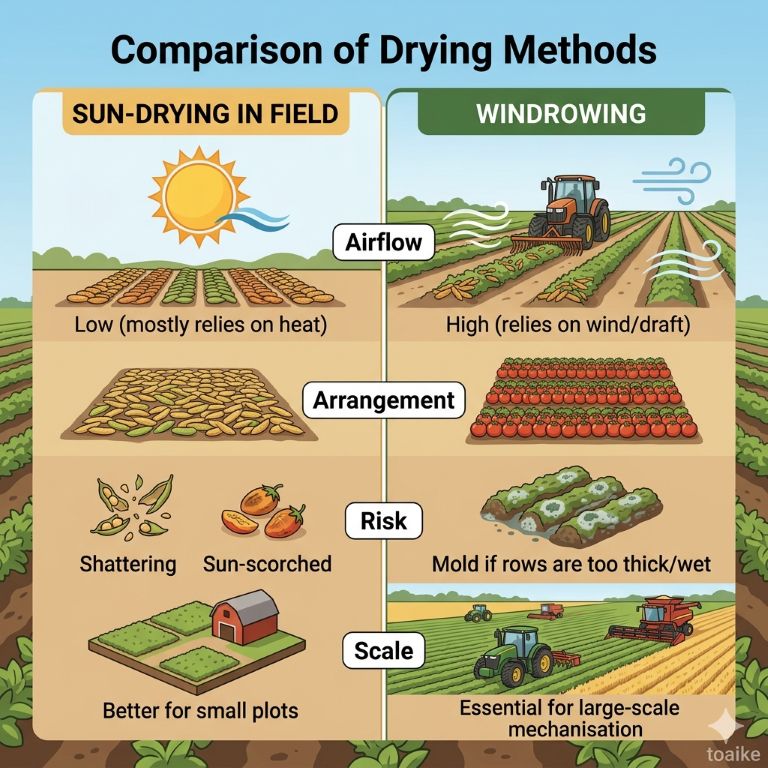
And perhaps most importantly, crop planning — sowing moong slightly earlier to ensure it reaches natural maturity before the paddy window — can eliminate the urgency for chemical desiccation entirely. An agronomic calendar adjustment that costs nothing.
The Bigger Picture
That small green seed in the farmer’s palm at the beginning of this story carries more than nutrition. It carries a system — a web of economic pressure, biological vulnerability, chemical dependency, and regulatory gaps that has been decades in the making.
The farmer spraying his field at dawn is not the villain of this story. He is doing what the system — and sometimes the science — has told him to do, within a timeline that leaves no margin for error. The chemicals are a symptom, not the disease.
The real solution is upstream: better varieties, smarter IPM, smarter nutrient management, strict regulation of the most dangerous chemicals, and farmers who are supported enough — especially with the right information — to choose safer paths when those paths exist.
Because that little mungbean, with its 24% protein and its 60-day turnaround, has the potential to feed millions. It just shouldn’t come soaked in poison to do it.
References
- Pests of Green Gram and Black Gram & Their Management Comprehensive review of insect pest species, damage patterns, and chemical/biological management strategies for pulse crops. https://www.academia.edu/64577392/Pests_of_Green_Gram_and_Black_Gram_and_Their_Management
- Insect Pests of Mungbean and Natural Enemies — Journal of Entomology and Zoology Studies (2024) Study on pest species composition, sap-sucking insects, foliage feeders, and associated natural enemies in mungbean fields of Sidhi district, Madhya Pradesh. https://www.entomoljournal.com/archives/2024/vol12issue3/PartB/12-3-19-347.pdf
- Seasonal Incidence of Sucking Insect Pests of Green Gram Population dynamics of jassid, whitefly, and thrips in relation to abiotic factors including temperature, humidity, and rainfall. https://www.entomoljournal.com/archives/2019/vol7issue2/PartL/7-2-134-383.pdf
- Efficacy of Different Insecticides Against Thrips Infesting Summer Green Gram Comparative field evaluation of imidacloprid, thiamethoxam, dimethoate, spinosad, and other molecules against thrips in summer green gram. https://www.researchgate.net/publication/270786911_Efficacy_of_different_insecticides_against_the_thrips_infesting_summer_green_gram
- Screening of Mungbean Varieties Against Whitefly and MYMV Field screening of 52 mungbean genotypes against Bemisia tabaci and Mungbean Yellow Mosaic Virus; insecticide recommendations for vector management. https://www.researchgate.net/publication/319124568_Screening_of_Mungbean_Vigna_radiata_L_Wilczek_Varieties_against_Whitefly_Bemisia_tabaci_Genn_and_Mungbean_Yellow_Mosaic_Virus_MYMV
- Yellow Mosaic Disease of Mungbean — Current Status and Management Opportunities Frontiers in Plant Science (2020). Comprehensive review of MYMV and MYMIV biology, resistance mechanisms, and integrated management strategies. https://www.frontiersin.org/journals/plant-science/articles/10.3389/fpls.2020.00918/full
- Screening Mungbean Genotypes for MYMV Resistance Under Natural Conditions BHU Varanasi field screening of 25 mungbean genotypes during summer season; identification of resistant lines including IPM 02-03, PDM-139, and HUM-16. https://medcraveonline.com/APAR/screening-mungbean-vigna-radiata-l-wilczek-genotypes-for-mungbean-yellow-mosaic-virus-resistance-under-natural-condition.html
- Agriculture Without Paraquat Is Feasible Without Loss of Productivity Environmental Science and Pollution Research, Springer Nature (2023). Multi-country analysis of paraquat phase-outs, alternative desiccation methods, and crop yield outcomes post-ban. https://link.springer.com/article/10.1007/s11356-022-24951-0
- A Case for Banning Paraquat in India: A Public Health Concern National Medical Journal of India (2024). Analysis of paraquat residue data, health risks, soil and water persistence, and regulatory gaps in Indian agriculture. https://nmji.in/a-case-for-banning-paraquat-in-india-a-public-health-concern/
- Conditions of Paraquat Use in India — Joint Study Report IUF / Pesticide Action Network. Field investigation into paraquat sale, application practices, safety violations, and compliance with the Indian Insecticides Act. https://www.iuf.org/wp-content/uploads/attachments/Joint%20paraquat%20study%20India_0.pdf
- Paraquat Dichloride: Why Doctors Want This Pesticide Banned Scroll.in (2023). In-depth investigative report including CMC Vellore clinical data, patient testimonies, and toxicologist perspectives on paraquat poisoning in India. https://scroll.in/article/1051243/why-doctors-want-this-pesticide-banned
- Impose a Total Ban on Paraquat Dichloride in India Countercurrents (2026). Hospital mortality data, public health arguments, and open letter to Union Health and Agriculture Secretaries calling for a complete ban. https://countercurrents.org/2026/01/impose-a-total-ban-on-the-manufacture-and-use-of-paraquat-dichloride-in-agriculture-and-elsewhere-in-india/
- The Paraquat Problem — Pesticide Action Network UK PAN UK. Global overview of paraquat bans, mortality statistics, Rotterdam Convention listing efforts, and evidence that bans reduce deaths without reducing agricultural output. https://www.pan-uk.org/paraquat/
- Paraquat at 63 — Story of a Controversial Herbicide and Its Regulations PMC / National Institutes of Health. Systematic review of paraquat regulatory status across national, regional, and international jurisdictions; analysis of ban effectiveness on poisoning and death rates. https://pmc.ncbi.nlm.nih.gov/articles/PMC12462389/
- Paraquat Dichloride — US EPA Registration Review United States Environmental Protection Agency. Regulatory history, restricted-use classification, interim decision (2021), and updated mitigation measures for paraquat use in the United States. https://www.epa.gov/ingredients-used-pesticide-products/paraquat-dichloride
- Paraquat Fact Sheet — National Pesticide Information Center (NPIC) Oregon State University / US EPA. Technical fact sheet covering paraquat chemistry, environmental persistence, soil binding, breakdown pathways, and residue behavior on vegetation. https://npic.orst.edu/factsheets/paraquat.pdf
- Thrips efficacy study, ResearchGate — https://www.researchgate.net/publication/270786911_Efficacy_of_different_insecticides_against_the_thrips_infesting_summer_green_gram
- Seasonal incidence of sucking pests — https://www.entomoljournal.com/archives/2019/vol7issue2/PartL/7-2-134-383.pdf
- Whitefly and thrips management in mungbean — https://sciendo.com/2/v2/download/article/10.2478/mjhr-2021-0009.pdf
