
When we walk across a field, beneath our feet lies one of the most complex and important ecosystems on the planet — and when it goes wrong, everything built on top of it suffers.
Soil imbalance refers to the disruption of the natural physical, chemical, and biological properties of soil that are essential for healthy plant growth and ecosystem function. Simply put, when our soil is healthy, our crops thrive, our water stays clean, and our land stays productive. But when something throws that balance off — whether it’s the way we farm, the chemicals we use, or the changing climate — the soil loses its ability to support life the way it should.
Let’s walk through what this really means, why it happens, and why we should all care deeply about it.
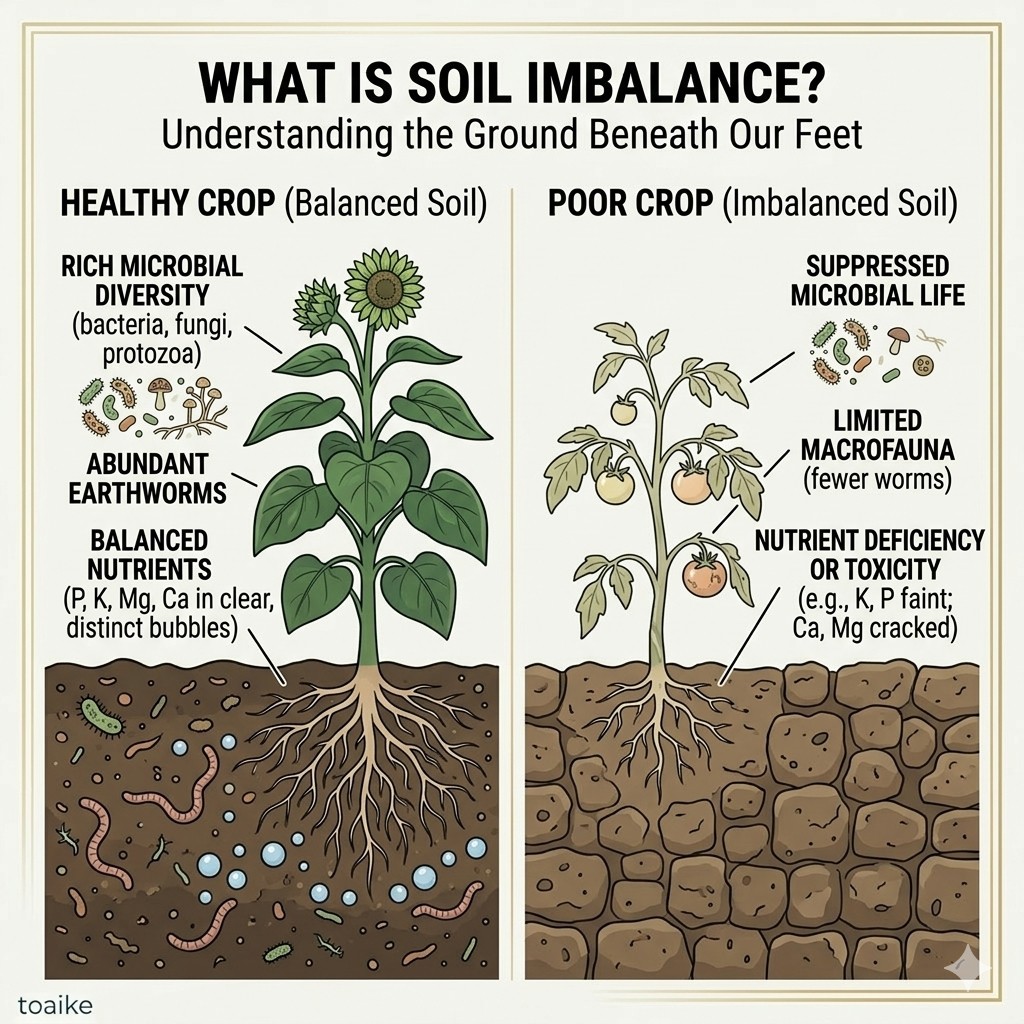
1. What Does "Balanced Soil" Actually Mean?
Think of balanced soil as a perfectly mixed recipe. For soil to work well, it needs the right amounts of:
- Minerals – to provide structure and nutrients
- Organic matter – the decomposed remains of plants and animals that feed the soil
- Water – to carry nutrients to plant roots
- Air – because roots and soil organisms need oxygen to survive
- Microorganisms – billions of bacteria, fungi, and tiny creatures that keep the whole system running
When all of these are present in the right proportions, we have what farmers and scientists call healthy, balanced soil. Plants grow strong, water drains properly, and the land can support life season after season.
But the moment any of these elements go out of range — too much of one thing, too little of another — we start to see the effects of soil imbalance. And once it begins, it rarely fixes itself without our help.
2. Types of Soil Imbalance
Soil imbalance doesn’t come in just one form. We generally see it show up in three ways — chemical, physical, and biological — and often, all three are happening at the same time.
Chemical Imbalance
This is perhaps the most talked-about type of imbalance, and for good reason. Chemical imbalance happens when the soil’s nutrient levels or pH go outside the range that plants need.
When we talk about pH, we’re measuring how acidic or alkaline the soil is. Most crops prefer a pH between 6.0 and 7.5. If our soil becomes too acidic or too alkaline, nutrients get “locked up” — they’re physically there in the soil, but plants simply cannot absorb them.
We also face problems when there’s too much or too little of key nutrients — Nitrogen (N), Phosphorus (P), and Potassium (K) — or important micronutrients like Zinc, Iron, and Boron. And in areas near industries or heavily polluted zones, heavy metal contamination (from lead, cadmium, arsenic, etc.) can make soil not just unproductive but outright dangerous.
Physical Imbalance
Physical imbalance is about the structure and texture of the soil itself. When we over-till our fields, run heavy machinery across them, or allow livestock to graze too intensively, the soil becomes compacted. Compacted soil is dense and hard — water can’t drain through it properly, roots can’t grow deep, and air can’t circulate.
We also see physical imbalance through erosion — where topsoil (the most fertile layer) is washed or blown away — and through poor drainage, which leads to waterlogging that suffocates plant roots.
Biological Imbalance
This is the one we often overlook. Soil is not just minerals and water — it is a living, breathing community. When we overuse pesticides and chemical inputs, we end up killing not just the pests but also the beneficial microbes, earthworms, and fungi that make our soil functional.
A decline in microbial diversity, the loss of earthworms, and the disruption of the soil food web all point to biological imbalance. When this happens, natural processes like nutrient cycling, organic matter decomposition, and disease suppression slow down or stop — and no amount of chemical fertilizer can fully replace what nature was doing for free.
3. What's Causing This?
If we’re honest with ourselves, most of the causes of soil imbalance trace back to the choices we make — as farmers, as communities, and as a society.
Over-farming and monoculture — When we grow the same crop on the same land year after year, the soil gets depleted of specific nutrients while pests and diseases build up. The land never gets a chance to rest or recover.
Excessive use of chemical fertilizers and pesticides — We often apply more than the soil actually needs, thinking more is better. Over time, this destroys microbial life, acidifies the soil, and creates toxic build-ups that harm both the land and the crops we’re trying to grow.
Heavy agricultural machinery — The increasing use of tractors, harvesters, and other heavy equipment puts enormous pressure on the soil beneath. Every pass of a heavy machine compresses the soil layers, creating deep compaction that restricts root growth, blocks water movement, and cuts off the air supply that soil organisms depend on. Unlike surface compaction caused by tillage, machinery-induced compaction often goes several inches deep — making it far harder to reverse and damaging soil structure season after season.
Deforestation and land degradation — When we remove trees and ground cover, we strip away the protection that holds soil together. Without roots and leaf cover, the topsoil erodes quickly and organic matter stops accumulating.
Overgrazing — When too many animals graze on the same land, they compact the soil with their hooves, strip it of vegetation, and leave it exposed to wind and water erosion.
Waterlogging and drought stress — Too much water drowns soil organisms and leaches nutrients away. Too little water dries the soil out, kills microbial activity, and turns the surface hard and cracked.
Industrial and urban pollution — Runoff from factories, construction sites, and urban areas carries heavy metals, chemicals, and waste into our farmland, slowly poisoning the soil over time.
4. How Do We Know Our Soil Is Imbalanced?
The good news is that our soil gives us signals — we just need to know what to look for.
Poor crop yields and stunted growth are usually the first signs that something is wrong. When we’ve been farming the same land for years and suddenly our yields start dropping for no obvious reason, the soil is likely struggling.
Discoloration of leaves — yellowing, browning, or unusual spots — often points to nutrient deficiencies caused by chemical imbalance in the soil.
A hardened or crusted soil surface that water can’t penetrate is a classic sign of physical imbalance. We might notice water pooling on the surface after rain instead of soaking in.
Runoff and waterlogging — when our fields drain poorly or water rushes off the surface carrying soil with it — tells us the soil structure has broken down.
And one of the clearest signs of biological imbalance? The disappearance of earthworms. Healthy soil should be teeming with earthworms. If we dig up a shovelful of soil and find none, it’s a strong signal that the biological health of our land is in serious trouble.
5. What Happens If We Ignore It?
The consequences of ignoring soil imbalance reach far beyond our own farms and fields. They ripple outward — affecting food systems, water quality, biodiversity, and even the climate.
Reduced agricultural productivity is the most immediate impact. As soil health declines, we need more and more inputs to produce the same yields — and even then, the harvests keep shrinking.
This feeds directly into food insecurity. When our soils can no longer produce enough food, communities — especially those that depend on farming — become vulnerable.
Water contamination is a serious downstream effect. When excess nutrients, pesticides, and heavy metals leach out of degraded soils, they end up in rivers, lakes, and groundwater, making water unsafe for people, animals, and aquatic life.
Loss of biodiversity follows closely. Degraded soils can’t support the variety of plants, insects, and soil organisms that make up a healthy ecosystem. We lose species we may not even have fully understood yet.
And we often forget that soil is one of the largest carbon stores on Earth. When soil is degraded, it releases that stored carbon back into the atmosphere — contributing directly to climate change. In other words, how we treat our soil affects not just this year’s harvest, but the future of the planet.
6. How Do We Diagnose Soil Imbalance?
We can’t fix what we don’t understand — and that’s where soil testing comes in. It’s one of the most important investments we can make as farmers and land stewards.
Soil pH testing is the starting point. A simple pH meter or test kit tells us whether our soil is acidic, alkaline, or just right. This guides almost every other decision we make about amendments and fertilizers.
NPK and micronutrient analysis gives us a full picture of the nutrient status of our soil. By sending samples to a lab, we can find out exactly what’s deficient and what’s in excess — so we stop guessing and start managing with precision.
Organic matter content testing tells us how “alive” our soil is in terms of its carbon and nutrient reserves. Low organic matter is almost always at the root of declining soil productivity.
Microbial activity assessment is the most advanced form of soil diagnosis. Techniques like the soil respiration test or microbial biomass carbon measurement tell us how active and diverse the living community within our soil actually is. Even a simple earthworm count in the field gives us a quick and reliable biological health check.
Fixing the Problem
Identifying a soil problem is only half the work — what we do next determines whether our land recovers or continues to decline. Effective remediation is not about quick fixes. It is about making deliberate choices that gradually rebuild the soil’s natural capacity to sustain life and productivity over the long term.
1. Enriching Soil with Organic Amendments
Of all the steps we can take to nurse degraded soil back to health, returning organic matter to the ground delivers the broadest and most lasting benefit. It simultaneously addresses nutrient deficiencies, improves physical structure, and revives biological activity — making it the most well-rounded tool available to us.
- Compost — Regularly incorporating well-matured compost at 3–5 tonnes per hectare each year gradually rebuilds soil texture, stimulates microbial communities, and steadily releases nutrients that crops can actually use.
- Farm Yard Manure (FYM) — One of the oldest and most accessible soil inputs available to Indian farmers. When applied ahead of the sowing season, it gives the soil time to absorb its full nutritive and structural benefit.
- Green Manure Crops — Fast-growing species like Dhaincha (Sesbania), Sunhemp, and Cowpea are cultivated specifically to be turned back into the soil while still green. This practice rapidly boosts nitrogen levels and organic matter content, and it fits naturally into most Indian cropping calendars.
2. Bringing pH Back into Range
Every rupee we spend on fertilizer depends on one condition being met first — our soil’s pH must be within the range that allows plant roots to actually absorb what we are applying. In highly acidic or alkaline conditions, nutrients remain locked in the soil, chemically out of reach no matter how much we add. Getting pH right is not just one step among many — it is the step that makes every other input work.
For Acidic Soils (pH below 6.0) Agricultural lime or dolomite lime is the most widely recommended treatment for bringing acidic soils back into balance. It works gradually — neutralising excess acidity over time rather than in a single application. Because of this slow action, we should apply it well ahead of our planting season to allow it to take full effect before the crop goes in. The quantity we need depends on how acidic our soil is and the type of soil we have — a clay soil needs a different rate than a sandy one. Our soil test report or Soil Health Card will give us the application rate specific to our field.
For Alkaline and Sodic Soils (pH above 7.5) Elemental sulphur helps gradually lower pH in alkaline soils, while gypsum (calcium sulphate) is particularly effective in sodic soils — those with high sodium content that causes structural breakdown and makes nutrients unavailable. Both work best when applied based on the specific sodicity or alkalinity level of our field. Applying the wrong quantity wastes money and can disturb the soil chemistry further — so we should always base our application on our soil test results .
For Both Conditions Regularly returning organic matter to our soil — through compost, Farm Yard Manure, and green manures — naturally buffers pH over time, making it less reactive to the acidifying or alkalising effects of fertilizers and irrigation water. Organic matter is the most reliable long-term stabiliser of soil chemistry available to us.
3. Breaking the Cycle with Crop Rotation and Cover Cropping
When we plant the same crop on the same piece of land repeatedly, we set up a predictable pattern of nutrient depletion, pest build-up, and structural decline. Changing what grows on our land — and when — interrupts that pattern at its root.
- Crop Rotation — Alternating between cereal crops such as wheat and maize and legume crops such as chickpea, lentil, and soybean is one of the most effective low-cost strategies available. Legumes have the unique ability to draw nitrogen directly from the atmosphere and deposit it in the soil, naturally restoring what previous crops consumed.
- Cover Cropping — Rather than leaving fields bare during fallow periods, we can grow fast-establishing species like oats, mustard, or mixed legumes. These cover crops hold the topsoil in place against erosion, crowd out weeds, build organic matter, and shield the soil surface from the drying and hardening effects of direct sun and wind.
4. Letting the Soil Rest — Reduced and No-Till Farming
Each time we plough, we disturb far more than we intend. Frequent and deep tillage breaks apart the fungal networks that connect plant roots to soil nutrients, releases carbon that took years to accumulate, and leaves the soil surface vulnerable to crusting and erosion. Reducing how much we disturb the soil gives it the stability it needs to heal.
- Minimum tillage limits soil disturbance to the immediate planting zone, leaving the rest of the soil profile undisturbed
- No-till farming uses specialised direct seed drills that place seeds into the soil without any prior ploughing
- Farmers who have adopted these methods consistently report better moisture retention, lower input costs, and a measurable increase in organic matter within just two to three growing seasons
5. Restoring Life Through Bioremediation
For soils that have been contaminated — by heavy metals, excess salts, or persistent chemical residues — biology itself offers some of the most promising solutions. Bioremediation harnesses the power of living organisms to detoxify and restore what chemical treatments cannot.
- Microbial inoculants — Beneficial organisms such as Rhizobium, Azospirillum, Trichoderma, and Pseudomonas can be introduced into the soil through seed treatment or direct soil application. These microbes re-establish biological activity, enhance nutrient cycling, and help suppress soil-borne diseases.
- Phytoremediation — Certain plant species, including Sunflower and Indian Mustard, have the capacity to draw heavy metals upward from contaminated soil into their tissue. Grown and removed over successive seasons, they progressively reduce metal concentrations in the root zone.
- Vermicomposting — Introducing earthworms into depleted plots triggers a cascade of biological recovery. As they move through the soil, they accelerate organic decomposition, improve aeration, and create conditions where diverse microbial populations can re-establish themselves.
6. Fertilizing with Purpose — Feed the Soil What It Actually Needs
One of the most common and costly habits in our farming practice is applying fertilizers based on routine rather than actual soil need. We often pour in more than necessary — thinking it will boost yields — while unknowingly neglecting other nutrients our soil is genuinely short of. The result is wasted money, damaged soil, and disappointing harvests.
Start with a Soil Test — A soil test tells us exactly which nutrients are low, which are adequate, and which are already in excess. Once we have that information, we stop guessing and start spending wisely.
Use Soil Health Card. It gives us crop-wise fertilizer recommendations in simple language, telling us exactly how much of which fertilizer to apply for the crop we are planning to grow.
7. Apply Fertilizer in the Right Amount, at the Right Time
Even the right fertilizer gives poor results if applied at the wrong growth stage. Splitting fertilizer applications — giving a portion at sowing, another during early growth, and the rest at a key development stage — ensures the crop receives nutrition exactly when it needs it most. This reduces wastage and increases the efficiency of every rupee we spend.
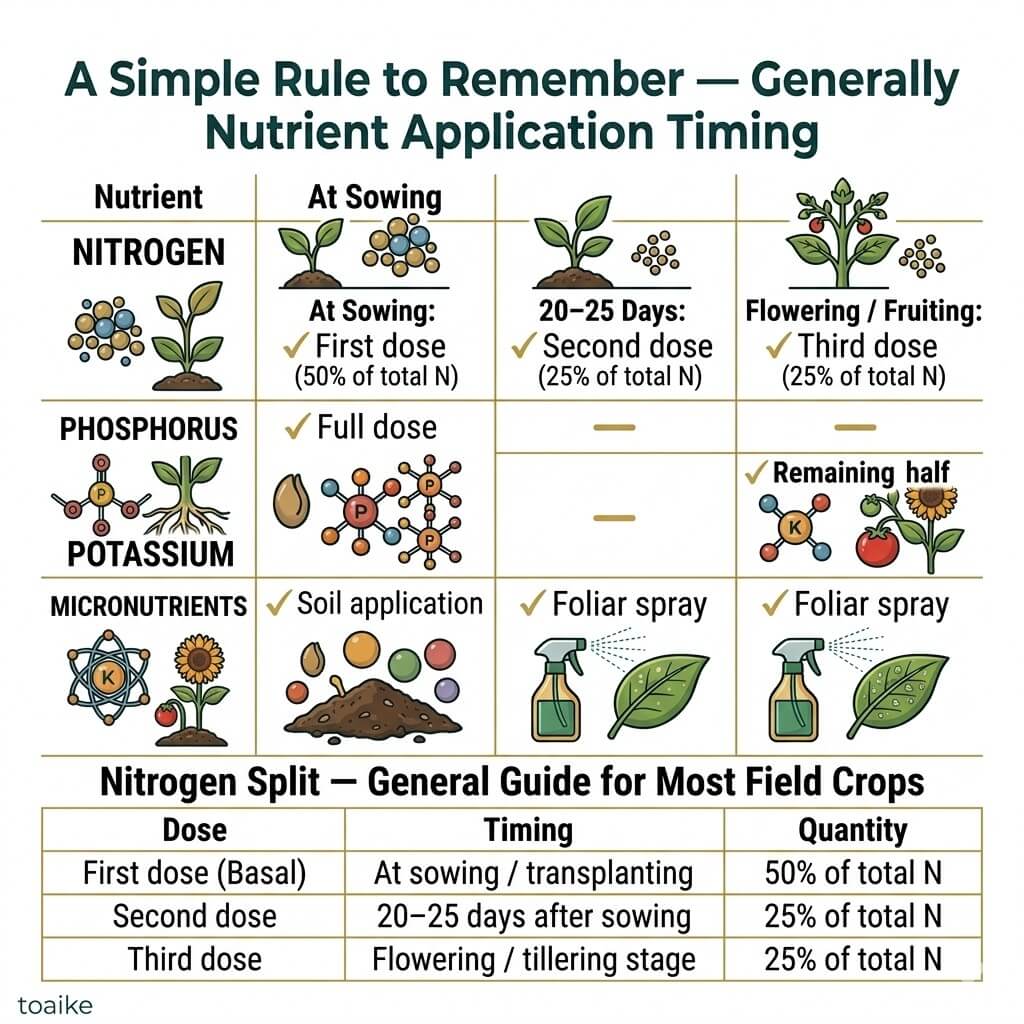
Caution : The exact nitrogen split varies by crop, soil type, and season. Always refer to our Soil Health Card or the Package of Practices recommended for our region for crop-specific guidance.
8. Always Combine Chemical Fertilizers with Organic Inputs
Chemical fertilizers feed our crop. Organic inputs — compost, Farm Yard Manure, green manures — feed our soil. When we use both together, the results consistently outperform either approach used alone.
9. Prevention & Sustainable Practices
Remediation fixes the problem — prevention ensures it doesn’t return. Sustainable soil management is a long-term commitment that pays dividends in yield, cost savings, and resilience.
Soil Health Monitoring Programs
Regular and systematic soil testing is the backbone of preventive soil management.
- Test our soil at least once every two to three years, ideally before each major crop season
- Maintain a record of test results over time to track trends in pH, organic matter, and nutrient levels
- India’s Soil Health Card Scheme provides free soil testing and crop-wise fertilizer recommendations to farmers — make full use of this resource
Agroforestry and Mixed Cropping
Integrating trees and shrubs into farming systems is one of the most powerful ways to protect and enrich soil over the long term.
- Agroforestry systems protect soil from erosion, improve microclimate, add leaf litter organic matter, and support biodiversity
- Mixed cropping reduces pest pressure, improves nutrient use efficiency, and buffers against crop failure
- Boundary planting of trees like Neem, Subabul, or Moringa reduces wind erosion and adds organic matter through leaf fall
Integrated Pest Management (IPM)
Heavy pesticide use is a major contributor to soil biological imbalance. IPM reduces chemical dependency while effectively managing pests.
- Combine biological controls, cultural practices, and targeted chemical use only when necessary
- This protects soil microorganisms, earthworms, and beneficial insects that are critical to soil health
- IPM also reduces input costs and the risk of chemical residues in produce and groundwater
Policy and Farmer Education
Sustainable soil health cannot be achieved by individual effort alone — it requires institutional support and awareness.
- Schemes like the Soil Health Card, Paramparagat Krishi Vikas Yojana (PKVY) support organic farming and soil conservation — farmers should actively access these
- Farmer Field Schools (FFS) and Krishi Vigyan Kendras (KVKs) offer hands-on training in soil management practices
- Community-level watershed management and soil conservation programs help address soil degradation at a landscape scale
- Encouraging a shift from yield-only thinking to soil health and yield thinking is essential for the next generation of farmers
Finally - Where Do We Go From Here?
Soil is not simply the ground we stand on — it is the foundation everything else is built upon. Our food, our water, our biodiversity, and our future as farming communities all begin with the health of the soil beneath our feet.
Soil is resilient. Given the right conditions and consistent care, it recovers. The tools exist. The knowledge exists. What we need now is the willingness to apply both — patiently and persistently. Small, consistent steps compound over time into meaningful, lasting change.
Soil health is not only a farmer’s concern. It is a community responsibility and a generational obligation. Our ancestors farmed this land for centuries and left it capable of feeding the next generation. That same responsibility now rests with us.
Healthy soil is not an inheritance we simply receive. It is one we must actively build — and then pass on.
Pingback: Rhizobium: Symbiotic Nitrogen Fixing Bacteria