
If plants could talk, they would probably complain about nitrogen the most. “It’s everywhere in the air,” they might say, “but we still can’t eat it!” Even though about 78% of the atmosphere is nitrogen, plants cannot use it in its gaseous form. For plants, nitrogen is like food locked inside a sealed container. To be useful, it must first be changed into forms like ammonia or nitrate. This conversion process is called nitrogen fixation — and this is where Rhizobium bacteria become true heroes of the soil.
What is Rhizobium
Rhizobium is a group of beneficial soil bacteria with a special talent: they can capture nitrogen gas from the air and turn it into a form plants can absorb. What makes them even more interesting is the close friendship they form with leguminous plants — crops like chickpea, lentil, soybean, groundnut, mung bean, and field pea. This is not a one-way relationship. It is teamwork. Both the plant and the bacteria support each other in a partnership so well designed that scientists consider it one of the most efficient biological systems in all of nature. The plant gets a steady supply of nitrogen without depending on chemical fertilizers, and the bacteria get a safe, nutrient-rich home inside the root where they can grow and multiply protected from the harsh outside soil environment. Neither partner does as well alone as they do together, which is exactly what makes this relationship so special and so valuable for farming.
How Rhizobium Forms Root Nodules
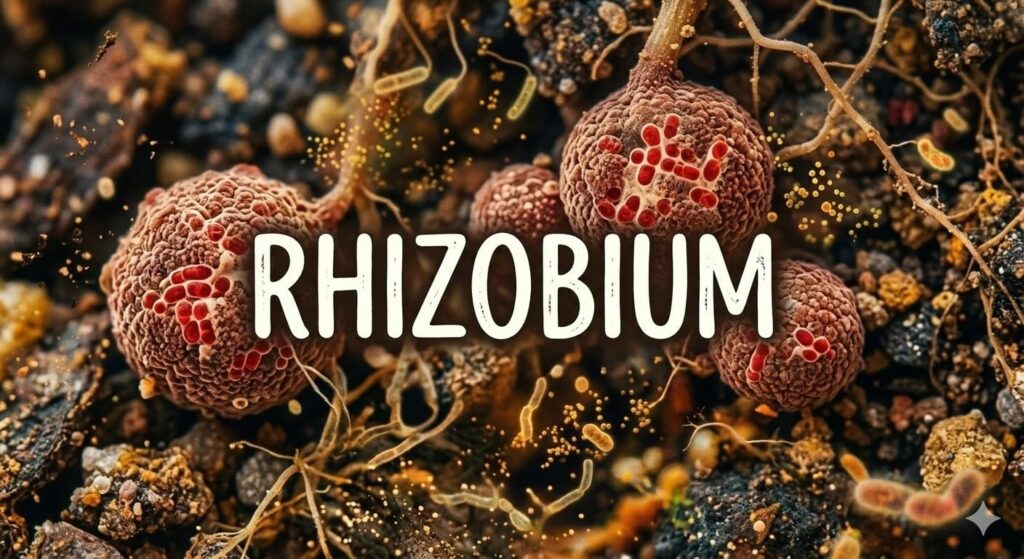
When Rhizobium bacteria in the soil sense the roots of a legume plant, they are attracted by natural chemical signals called flavonoids released by the roots — almost like a biological invitation sent out by the plant. The bacteria respond by producing their own chemical signals called Nod factors, which the plant recognizes and accepts. This chemical conversation between plant and bacteria happens silently in the soil, long before any visible change occurs above ground. Once the bacteria reach the root surface, they enter through tiny root hairs, which curl around them and create a narrow entry channel called an infection thread. Through this thread, the bacteria travel inward, moving deeper into the root tissue. In response to their arrival, the plant begins dividing its cells rapidly in a specific region of the root, forming small rounded structures called nodules.
These nodules are not random growths — they are purpose-built homes created by the plant specifically to house and support the bacteria. Inside them, the plant provides sugars and carbon compounds as food, maintaining a warm, nutrient-rich environment where the bacteria can thrive. In return, the bacteria fix atmospheric nitrogen continuously and supply it directly to the plant in a form it can immediately use. This exchange happens around the clock throughout the growing season, making nodules one of the most productive and efficient biological structures found anywhere in agriculture.
How Nitrogen Fixation Works Inside the Nodule
Within these nodules, nitrogen fixation happens in a carefully controlled environment. The main worker in this process is an enzyme called nitrogenase, produced by the Rhizobium bacteria. Nitrogen gas (N₂) is very stable because its two nitrogen atoms are connected by a strong triple bond — one of the strongest bonds in nature. This makes nitrogen gas almost inactive and difficult for plants to use. Breaking this bond requires a large amount of energy. Nitrogenase manages this challenging task inside the nodule. The plant supplies sugars to the bacteria, which they convert into energy in the form of ATP (adenosine triphosphate). Around 16 ATP molecules are needed to fix a single molecule of nitrogen gas, showing how energy-intensive the process is. Using this energy, nitrogenase transfers electrons to the nitrogen molecule, gradually weakening and breaking its triple bond. Once separated, the nitrogen atoms combine with hydrogen (H⁺) inside the cell to form ammonia (NH₃).
Leghemoglobin: The Oxygen Guardian
However, nitrogenase has one weakness — it cannot tolerate oxygen. Too much oxygen can damage the enzyme and stop nitrogen fixation. To protect it, the nodules contain a special pink protein called leghemoglobin. This protein carefully controls oxygen levels inside the nodule. It provides just enough oxygen for the bacteria to produce energy while keeping the concentration low enough to protect nitrogenase.
From Ammonia to Plant Nutrition
After ammonia is formed, it quickly changes into ammonium (NH₄⁺). The plant then converts it into useful nitrogen compounds such as amino acids like glutamine and glutamate. These amino acids act as building blocks for proteins, enzymes, nucleic acids (DNA and RNA), and chlorophyll. All of these are essential for plant growth, cell development, and photosynthesis.
Benefits Beyond the Growing Season
The benefits of Rhizobium do not end with one crop. When the growing season finishes and the nodules break down, the nitrogen stored inside them is released back into the soil. This naturally improves soil fertility and supports even non-legume crops planted afterward. In addition, Rhizobium can produce growth-promoting substances that encourage better root development and improve nutrient absorption.
Conclusion
In simple terms, Rhizobium is like a quiet partner working underground — capturing nitrogen from the sky, feeding the plant, and leaving the soil richer for the future. What makes it truly remarkable is that this partnership has been going on in nature for millions of years, long before chemical fertilizers were ever invented. Every nodule on a legume root is a tiny nitrogen factory, running continuously, producing no pollution, costing the farmer nothing extra, and improving the soil with every passing season. For pulse and oilseed farmers in particular, Rhizobium offers something no urea bag can match — a living, breathing, self-sustaining source of nitrogen that grows alongside the crop and gives back to the land even after the harvest is done. As fertilizer costs rise and soil health declines under years of chemical use, the value of this small but extraordinary bacterium becomes clearer than ever.
Rhizobium does not just feed one crop in one season — it feeds the soil, supports the next crop, and keeps the cycle of natural fertility alive. For any farmer looking to reduce input costs, improve soil health, and grow better crops naturally, trusting Rhizobium is not just a smart choice — it is a return to the way nature always intended farming to work.