
The story of a farm that feeds itself — from the cow shed to the crop
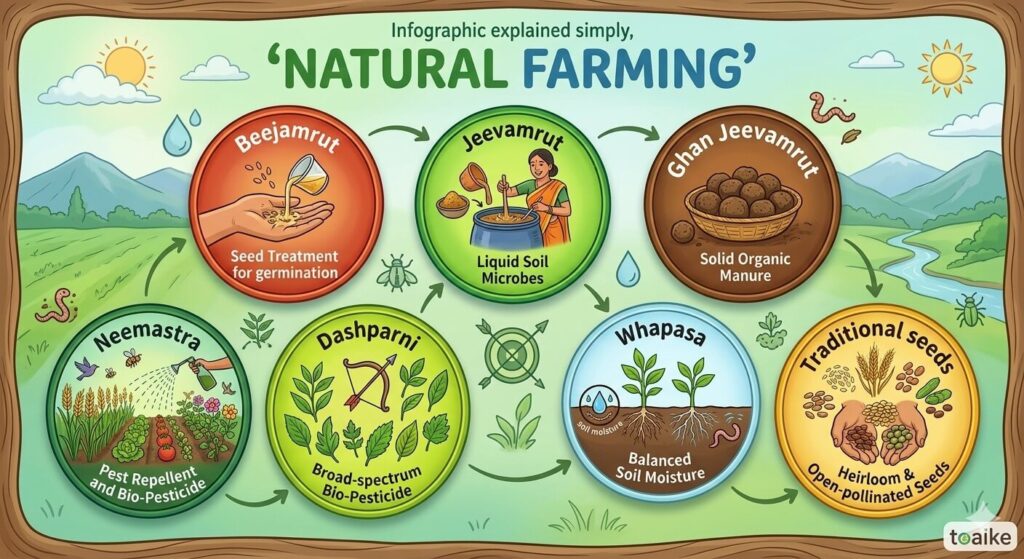
Walk into a natural farm and you will not find a single chemical packet. What you will find is a cow, a mud pot, some jaggery, a handful of leaves — and a farmer who knows exactly what to do with all of it.
Every input has a job. None of it is wasted. And all of it comes from within arm’s reach. This is not coincidence. It is centuries of Indian agricultural wisdom distilled into daily practice — a relationship between the farmer and the land, rebuilt input by input, season by season.
Natural farming is an agroecology-based diversified farming system — one that integrates crops, trees, and livestock to allow the optimum use of what nature already provides. It is not a shortcut. Here is what each of those inputs contributes.
The raw ingredients — where it all begins
The desi cow — the engine of the farm
She is the most important presence on a natural farm. One desi cow produces enough dung and urine every day to nourish a remarkably large area of farmland. What makes her special is not just quantity but quality — the dung of an indigenous Indian breed carries a far richer concentration of beneficial microorganisms compared to exotic or crossbred varieties.
Her body hosts bacteria that fix nitrogen from the air, fungi that unlock phosphorus locked deep in the soil, and organisms that produce natural growth-promoting substances. Science has confirmed what Indian farmers observed for generations: the desi cow’s biology is uniquely suited to regenerating the soils of this subcontinent. In natural farming, she is not merely livestock. She is the farm’s living, breathing fertility factory.
Cow dung — the starter culture
Fresh cow dung is a teeming, invisible world. Packed with billions of soil-friendly bacteria and fungi, it jump-starts biological activity the moment it enters the earth — breaking down organic matter, unlocking nutrients that have been sitting idle in the soil for years, and improving its physical texture so that roots can breathe and travel freely.
Farms where cow dung based preparations are applied regularly show a visible transformation over time: the soil darkens, crumbles easily in the hand, holds moisture longer, and smells of earth rather than chemicals. Think of it as the starter dough of the farm’s entire nutritional system.
Cow urine — the carrier and the cure
Cow urine brings nitrogen, phosphorus, and a wide range of trace minerals to the preparation. But its most valuable role is as a carrier — it helps other nutrients travel deeper into the soil, reaching roots that would otherwise go undernourished. Farmers who once paid dearly for micronutrient sprays discover that consistent use of cow urine preparations quietly does the same work, restoring trace element levels without any of the chemical buildup that synthetic sprays leave behind. It is also a natural pest deterrent; its strong smell and antimicrobial properties make it deeply unwelcoming to many harmful insects and pathogens.
Jaggery — food for the invisible workforce
Jaggery does not feed the plant. It feeds the microorganisms doing the work beneath the surface.
The natural sugars in jaggery dramatically accelerate fermentation — helping billions of beneficial bacteria multiply rapidly within the brew. Remove it from the preparation and the microbial population drops noticeably. Put it back and the culture comes alive within hours. A small lump dissolved in the mixture turns what would otherwise be a simple liquid into a thriving, living elixir within 48 hours. Simple, cheap, and irreplaceable.
Pulse flour — the slow fuel
Ground pulses — typically chickpea or gram flour — bring protein and carbon into the microbial mix, acting as a sustained food source that extends fermentation and makes the final product richer and longer-lasting. Pulse flour also introduces phosphate-solubilising bacteria and nitrogen fixers into the brew. It is the quiet ingredient that gives the preparation its staying power — the difference between a microbial flash in the pan and a culture that keeps working long after it reaches the field.
These raw ingredients come together in specific preparations — each designed for a different job on the farm. Here is what each one does and why it matters.
Beejamrut
Seed treatment
Before a seed even touches the soil, Beejamrut wraps it in protection. Made from cow dung, cow urine, lime, and water, this preparation forms a thin microbial coating around each seed that fights off fungal infections and soil-borne diseases — the kind that silently destroy seedlings before they ever get a chance.
It also carries beneficial microorganisms including nitrogen fixers and phosphate solubilisers that travel with the seed into the soil, giving the germinating plant a ready community of helpers from its very first day. Farmers report noticeably better germination, stronger early root systems, and healthier seedlings. It is the farm’s first line of defence — given before the battle begins, and it costs the farmer almost nothing to prepare.
Jeevamrut
Liquid soil tonic
Jeevamrut is the heartbeat of natural farming. Fermented from cow dung, cow urine, jaggery, pulse flour, and a handful of undisturbed farm soil — which seeds the brew with native microbial strains — it is applied to crops every 15 days, either through irrigation water or as a foliar spray.
Each application delivers a flood of beneficial organisms: Plant Growth Promoting Bacteria, mycorrhizal fungi, nitrogen-fixing cyanobacteria, and organisms that convert locked phosphorus and potassium into forms the plant root can actually absorb. Over seasons of regular application, the soil transforms visibly — it darkens, softens, holds water better, and becomes home to earthworms that are nature’s own ploughs.
Where a chemical fertiliser force-feeds the plant and leaves the soil progressively exhausted, Jeevamrut awakens the living community beneath the surface that sustains the plant naturally. Two kilograms of cow dung. One litre of urine. A lump of jaggery. Forty-eight hours. That is all it takes.
Ghan Jeevamrut
Solid soil enricher
Think of Ghan Jeevamrut as Jeevamrut in solid, concentrated form — dried into a powder or crumble and mixed directly into the soil near the roots.
It releases its microbial and organic load slowly, over weeks, steadily enriching the earth and improving soil structure through sustained organic matter addition. It is especially valuable during basal application at the time of sowing, when roots are young and most in need of a welcoming, biologically rich environment. If Jeevamrut is the daily meal that keeps the soil community fed, Ghan Jeevamrut is the long-lasting supplement that builds the soil’s constitution across an entire growing season — and leaves it better than it found it.
Neemastra
Pest repellent
When insects arrive, Neemastra is the farmer’s answer. Made from neem leaf paste or neem seed pulp fermented with cow dung and cow urine, it works in two ways at once — as a contact spray against larvae and soft-bodied insects, and as a behavioural disruptor that makes harmful insects lose the appetite to eat and the instinct to breed.
This matters enormously because beneficial insects — bees, ladybirds, wasps that prey on caterpillars — are left entirely unharmed. Chemical pesticides make no such distinction. Neemastra does. No residue lingers in the soil. No harm reaches the farmer’s hands. The broader ecosystem stays intact.
Dashparni
Broad-spectrum plant protection
Where Neemastra targets specific pests, Dashparni casts a wider net. Prepared from ten different medicinal and aromatic leaves — including neem, papaya, custard apple, and lantana — it creates a bitter, pungent spray that most insects and pathogens find deeply unwelcoming. It handles everything from caterpillars and whiteflies to fungal lesions, with nothing more than locally gathered leaves, cow urine, and time. For farmers in remote areas far from agro-chemical shops, Dashparni is not just a preparation — it is a form of agricultural self-reliance.
Practices that let the farm breathe
Whapasa
Teaching the soil to breathe
Beneath every healthy crop is a soil that can breathe.
Whapasa describes the ideal condition in which the microscopic spaces between soil particles hold a balance of air and water vapour — the invisible microclimate on which plant roots and soil organisms depend for both moisture and oxygen. Most conventional farming destroys this balance through over-irrigation, pushing air out of the soil and suffocating the very organisms that keep it fertile. Waterlogged roots cannot breathe. Compacted soil cannot support the microbial life that feeds the plant.
Natural farming protects Whapasa through mulching, irrigation only in alternate furrows at cooler times of day, and pre-monsoon dry sowing that allows the earth to receive rainfall gradually and naturally. A soil that breathes uses water far more wisely, sends roots deeper in search of nutrients, and keeps the plant standing through drought and excess rain alike.
Multi-cropping
Nature's insurance policy
In nature, no patch of land grows just one thing. Monoculture exhausts specific nutrients, attracts specific pests, and leaves the farmer placing every bet on a single outcome.
Multi-cropping brings nature’s logic back to the farm. Legumes fix nitrogen that cereals absorb. Aromatic plants confuse and repel the insects that would otherwise concentrate on a single host. Straw from one crop mulches and feeds the microbial activity that benefits the next. Diverse ground cover suppresses weeds without herbicides and steadily returns organic matter to the soil with every passing season. The farm becomes a community of plants, each contributing to the health of the whole.
Traditional seeds
A declaration of independence
Hybrid seeds delivered impressive yields — but only when propped up by chemical fertilisers, reliable irrigation, and fresh seed purchases every single season. Remove any one of those supports and the performance collapses. More troublingly, they cannot reliably reproduce themselves, locking farmers into a permanent dependency on seed companies.
Traditional or desi seeds, shaped by generations of farmers selecting the best performers for their specific soil and climate, ask for far less and adapt far better. They are naturally resilient to local pest pressure and capable of handling dry spells that would devastate a hybrid crop.
And crucially — they reproduce. The farmer saves the best seeds at harvest, stores them carefully, and plants them the following season without spending a rupee. In a natural farming system, traditional seeds are not a step backward. They are the final and most powerful act of a farmer reclaiming his freedom from the input market.
Every input in natural farming comes from the farm, goes back to the farm, and makes the farm stronger. There is no waste — only cycles.
Taken together, these inputs do something no chemical system can replicate. Chemical farming delivers results by overriding nature — loading the soil with synthetic nutrients, eliminating pests with broad-spectrum poisons, and forcing plants to perform on a timetable that suits the market. It works, for a time.
But soil organic matter declines. Microbial life retreats. Water tables drop. Input costs rise season after season. And eventually the land quietly stops cooperating.
Natural farming inputs work in exactly the opposite direction. They build a farm that grows more capable with every passing season. The soil deepens and darkens. Microbes multiply. Earthworm populations — nature’s own ploughs — return. Crops grow stronger roots and more resilient canopies. Yields steadily improve as the land recovers its natural fertility. And the farmer, for the first time in years, finds that the land is genuinely working with him — not waiting to be paid.
Reference
https://naturalfarming.dac.gov.in/uploads/studymaterial/StudyMaterialforMasterTrainers.pdf
Pingback: Potassium Solubilizing Bacteria KSB in Agriculture
Pingback: Blue-Green Algae and Azolla: Natural Nitrogen Fixers
Pingback: CFU Count vs Propagule Count in Biofertilizers