
Measuring the Strength of Biofertilizers
When you pick up a bag of biofertilizer at your local agri-input store, you will probably notice a number printed on it — something like 10⁷ CFU/g or 100 propagules/g. These numbers are not there to impress you with scientific jargon. They are actually telling you something very important: how alive and active the product is. Think of it as a measure of potency — the biological muscle of the product.
Unlike chemical fertilizers where strength means concentration of a nutrient, biofertilizers carry living organisms — bacteria or fungi — that do useful work in the soil. So the ‘strength’ here means: how many living, functional microbes are packed into each gram or millilitre of the product? Two terms are used to express this, depending on whether you are dealing with bacterial or fungal biofertilizers.
What is CFU Count?
CFU stands for Colony Forming Unit. It is used to measure the number of live, culturable bacteria (or fungal spores in some cases) present per gram or per millilitre of the product.
Here is how it works: a small sample of the biofertilizer is diluted and spread on a nutrient agar plate. After incubation, each live bacterium multiplies and forms a visible dot called a colony. Count those dots — and you have your CFU count. Simple and elegant.
The key word here is live. Dead bacteria do not form colonies. So a high CFU count means the product is teeming with active, healthy microbes ready to go to work in your soil. A low count means something went wrong — poor storage, heat exposure, or the product has simply aged past its prime.
What is Propagule Count?
Propagule count is used specifically for Arbuscular Mycorrhizal (AM) fungi — the symbiotic fungi that form a partnership with plant roots to dramatically improve nutrient and water uptake.
Here is the catch: AM fungi are obligate biotrophs. This means they are biologically incapable of completing their life cycle without a living plant root to attach to. You simply cannot culture them in a lab the way you culture bacteria. So CFU count is entirely meaningless for them — and here is why.
When bacteria are tested for CFU count, you take a sample, spread it on a petri dish — a flat plate filled with nutrient agar — incubate it, and count the colonies that grow. This works because bacteria are free-living. They can grow and multiply on artificial growth media, completely independent of any plant or host.
AM fungi simply cannot do this. If you put AM fungal spores on a petri dish with the best nutrient media in the world, they will germinate a little, produce some initial hyphal growth, and then just… stop. And die. They cannot grow further or reproduce because they need carbon and other biochemical signals that only come from a living plant root. No root, no life. It is not a flaw — it is simply how they are wired by millions of years of evolution.
This also explains why producing AM fungi commercially is so much harder and more expensive than producing bacterial biofertilizers. You cannot just grow them in a fermentation tank. You have to actually grow a host plant, allow the fungi to colonise the roots, harvest the colonised root material along with the surrounding soil, and use that entire mixture as your product. The whole propagule count concept exists because of this biological reality.
So instead of CFU, strength is measured as the number of infective propagules per gram — a broader term that includes fungal spores, colonised root fragments, and hyphal networks — essentially any structure capable of infecting a plant root and establishing a mycorrhizal association. A higher propagule count means more infection potential, which translates to better plant establishment and nutrition.
What About Trichoderma — A Fungus That Chose the Easier Life
Trichoderma is also a fungus, but it sits in an interesting middle ground. Unlike AM fungi, Trichoderma is not an obligate biotrophic. It is a free-living soil fungus — it does not need a plant root to survive or complete its life cycle. It naturally thrives in soil and decaying organic matter, and while it does associate with plant roots, it is perfectly capable of growing and reproducing entirely on its own.
This means you can culture Trichoderma on a petri dish. Spread a sample on standard fungal growth media, incubate it, and Trichoderma colonies appear reliably and abundantly. So just like bacteria, its strength is expressed as CFU per gram. No special propagule counting, no host plant required, no complicated harvesting process.
There is one small nuance though. With bacteria, each CFU typically represents a single bacterial cell. With Trichoderma, what germinates and forms a colony on the plate is usually a spore (called a conidia) — not a hyphal fragment or whole organism. Trichoderma reproduces prolifically by producing millions of these tiny green spores, and it is the spores that settle, germinate, and form countable colonies. So technically, CFU in a Trichoderma product reflects viable spore count more than anything else.
You will also notice that the FCO minimum for Trichoderma (10⁶ CFU/g) is one log lower than for bacterial biofertilizers (10⁷ CFU/g). This is because fungal spores are generally larger, more robust, and individually more potent than a single bacterial cell — so fewer units are needed to achieve effective colonisation and biological control activity in the soil.
In short, Trichoderma is the fungus that chose the easier path — happy in the soil, happy in a petri dish, happy in a fermentation tank. AM fungi would find that very pedestrian. But between Trichoderma’s aggressive biocontrol activity and AM fungi’s unmatched nutrient delivery, the two make a rather formidable team — each working very differently, but both firmly on the plant’s side.
Standard Counts as per FCO (India)
The Fertilizer Control Order (FCO), 1985 — the primary regulatory framework for biofertilizers in India — specifies the minimum viable counts that commercial products must maintain throughout their shelf life. These are the benchmarks that quality control labs test for:
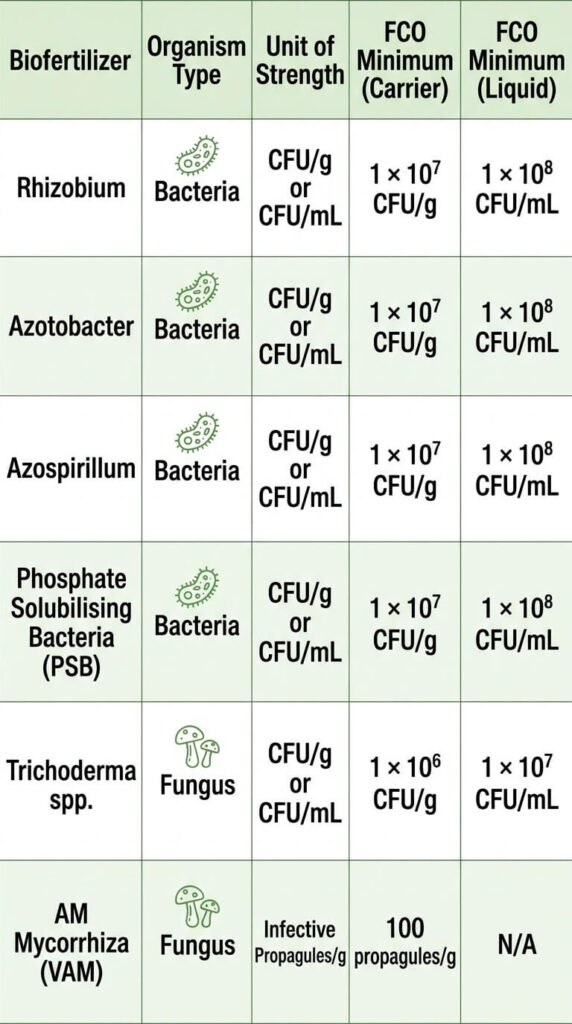
Note: At the time of manufacture, products are typically formulated at counts 10–100 times higher than the minimum, to ensure compliance throughout the shelf life (6 months for carrier-based; up to 24 months for liquid formulations).
Advisory: The standards listed above are based on the Fertilizer Control Order (FCO) as amended up to the time of writing. FCO guidelines are subject to periodic revision by the Government of India. Readers are advised to refer to the latest standards notified by the FCO and any subsequent amendments for the most current and applicable standards before making regulatory or commercial decisions.
Why Does This Matter in Practice?
A product that falls below the minimum count is considered substandard under FCO. This matters enormously to the farmer because a low-count product simply will not deliver the promised benefit — no nitrogen fixation, no phosphate solubilisation, no improved root colonisation. The farmer ends up spending money on what is essentially an inert bag of soil.
This is why storage conditions — temperature, humidity, light exposure — are so critical for biofertilizers. You are not storing a chemical; you are keeping millions of living creatures alive.
Finally
If bacteria could read product labels, the ones in a high-CFU biofertilizer would probably feel very smug. “10 to the power of 9 per gram? Yes, we are kind of a big deal.” Meanwhile, the AM fungi would simply shrug at the whole petri dish exercise — “You want to count us in a glass plate with some jelly? That is cute. We gave up that lifestyle millions of years ago. We live in plant roots now. Very exclusive neighbourhood. No entry without an invitation from a root hair.” And the thing is, they are not wrong — AM fungi genuinely cannot exist outside a living root, which makes them the most high-maintenance, impossible-to-culture, and yet utterly essential members of the soil community.
Bottom line: next time you buy a biofertilizer, flip the bag and check the count. If those numbers are not there — or look suspiciously low — your microbes might have checked out early. And unlike your regular fertilizer, this one absolutely cannot afford to be dead on arrival.