
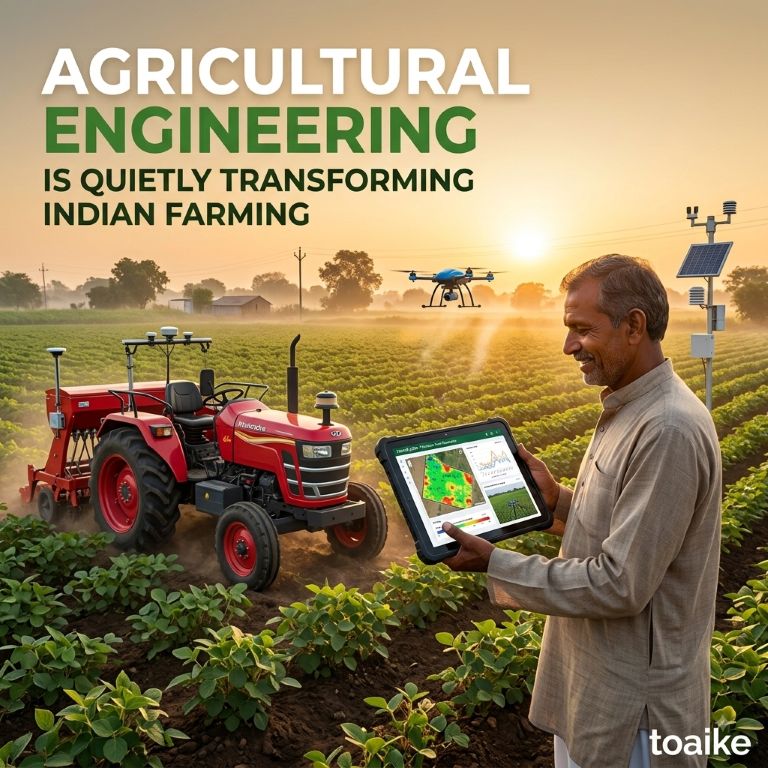
Ask any elderly farmer in your village about the “old days,” and you’ll hear the same story: wooden ploughs pulled by bullocks, irrigation that depended entirely on the monsoon and sheer physical labour, and harvests that took weeks of backbreaking work to bring home.
Then, slowly, tractors arrived. Then power tillers, sprinklers, threshers, combine harvesters, and a wave of new technologies. Step by step, farming changed completely. That quiet, steady transformation is the real achievement of agricultural engineering — it has made Indian farming more modern, more productive, and more profitable, without ever making headlines.
This article breaks down exactly how agricultural engineering is reshaping Indian agriculture — from the numbers behind mechanization, to the machines changing each stage of farming, to real farmer success stories you can learn from.
What Is Agricultural Engineering, Really?
Agricultural engineering isn’t just about machines. It’s about getting every farm task done at the right time, with more precision and more efficiency.
- Mechanization cuts down the labour needed and speeds up every task.
- Micro-irrigation (drip and sprinkler systems) saves water, electricity, and fertilizer while increasing output.
- Soil and water conservation practices protect the long-term health of farmland and keep water available for future seasons.
- Post-harvest technology — dryers, graders, cold storage — reduces crop losses and adds value to produce.
Put together, this means one thing for farmers: more production, lower costs, and better income.
For India’s small and marginal farmers — who make up the vast majority of the country’s farming community — these aren’t just statistics. They’re the real difference between profit and loss, between security and risk. With input costs rising, farm labour becoming scarcer, and climate change creating new challenges every season, agricultural engineering has become one of the most reliable ways to protect and grow farm income.
The Numbers Behind India's Farm Mechanization Story
India’s shift away from animal power has been dramatic. In 1961–62, bullocks and other animals supplied about 91.20% of the country’s total farm power. By 2024–25, that figure had fallen to just 4.45%.
According to ICAR estimates for 2020–21, the average level of mechanization across different farm operations looks like this:
- Seed-bed preparation: 70%
- Sowing/transplanting: 40%
- Weeding: 33%
- Harvesting and threshing: 34%
Taken together, India’s overall farm mechanization level stands at roughly 45%. This shift has been a major driver behind India producing far more food grain today than ever before.
Mechanization also reduces the wastage of seeds and fertilizers, lets farmers grow more crops per year on the same land, and increases both cropping intensity and productivity. In other words, farmer income doesn’t rise only because of better prices — it rises because resources are used more efficiently and land is used more effectively. At a time when rural labour is scarce and wages keep climbing, agricultural engineering has become the most dependable way to protect farm profits.
Machines for Every Stage of Farming
Mechanization today isn’t limited to tractors. There’s a purpose-built machine for almost every stage of farming — from land preparation to sowing, irrigation, weed control, harvesting, and post-harvest handling.
Land preparation and sowing
- A laser land leveler flattens fields perfectly, so irrigation water spreads evenly and less is wasted.
- A rotavator prepares land for sowing quickly and thoroughly.
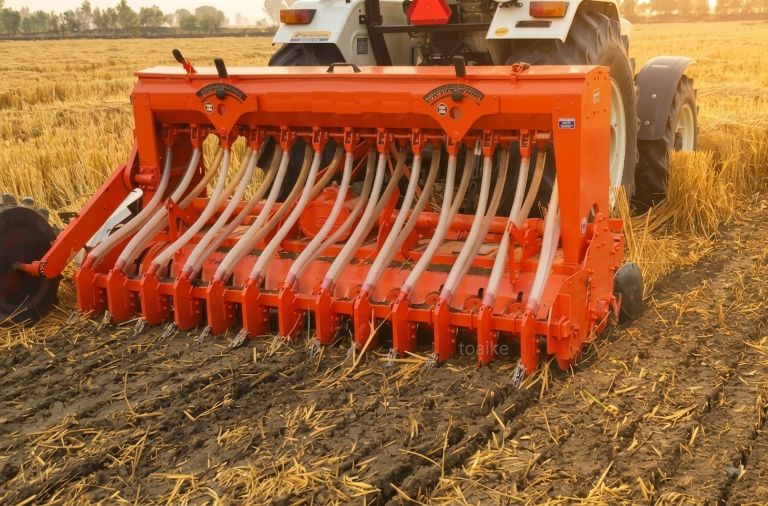
- A zero-till seed drill sows seeds directly without ploughing — saving diesel, cutting costs, and protecting soil structure and fertility.
- Happy Seeders and Super Seeders let farmers sow wheat directly into paddy stubble without burning it, cutting pollution and preserving soil organic matter.
- Mechanical transplanters for paddy and vegetables dramatically reduce the backbreaking labour that usually falls on women farm workers.
Irrigation
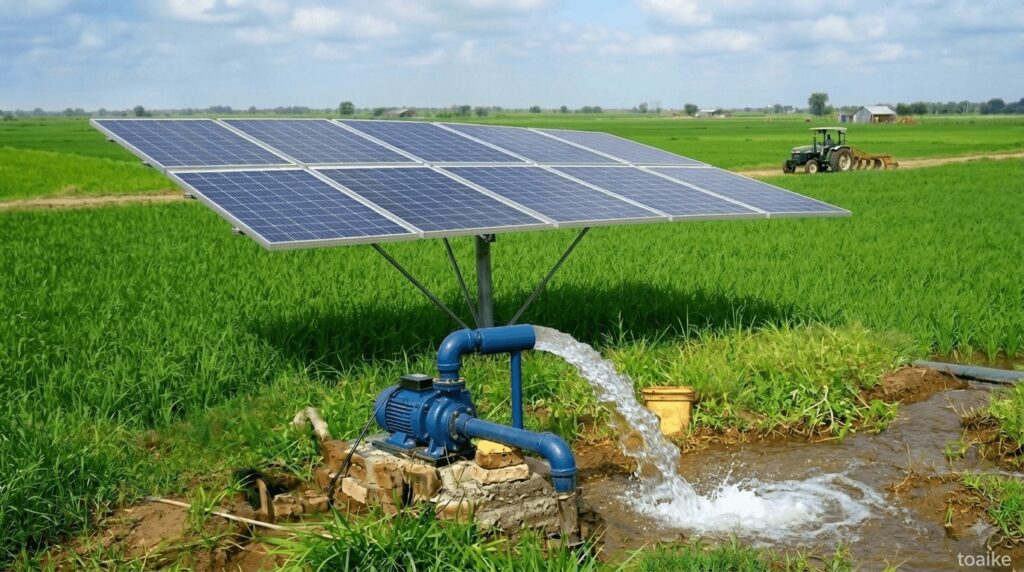
Micro-irrigation — drip and sprinkler systems — is one of agricultural engineering’s most valuable contributions. Instead of flooding the whole field, water goes straight to the plant roots, saving water, cutting electricity use, and making fertilizer use more effective. Combined with fertigation, water and soluble fertilizer reach the roots together, delivering nutrients exactly when plants need them. Solar-powered pumps and soil-moisture sensors are now making irrigation even smarter — giving crops exactly as much water as they actually need.
Intercultural operations
Weeding remains one of the most labour-intensive jobs on any farm, and it’s also one of the least mechanized — only about a third of India’s weeding is currently done with machines. Tools like power weeders, cono weeders, and wheel hoes let farmers clear weeds between crop rows far faster than manual labour, without damaging young plants. This matters more than it might seem: weeds compete directly with crops for water, nutrients, and sunlight, so timely weeding has a direct bearing on yield. Mechanized weeding also cuts down on herbicide use in some cases, since manual and machine weeding can be timed more precisely around the crop’s growth stage.
Pest management and drone technology
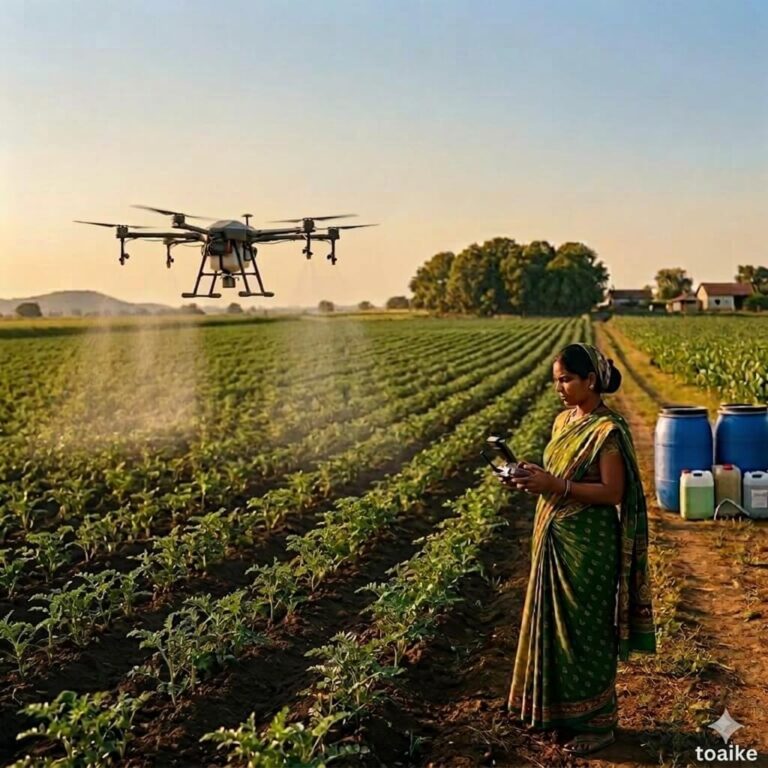
Protecting a crop from insects and disease used to mean farmers walking through fields with backpack sprayers, often getting directly exposed to chemicals in the process. Today, power sprayers and battery-operated sprayers apply pesticides more evenly and with far less physical effort. The bigger shift, though, has come from drone sprayers, which are now being used across India to apply pesticides and micronutrients with much greater precision than manual spraying. Drones cover large areas quickly, use less pesticide and water per acre than conventional spraying, and keep farmers away from direct contact with chemicals altogether. They’re also increasingly used for early pest and disease detection through aerial imaging, letting farmers act before an infestation spreads rather than after.
Harvesting
When a crop is ready, timing is everything. Delays caused by rain, wind, or labour shortages can mean big losses. Reapers and combine harvesters get large areas cut quickly, cutting down grain loss and freeing up the field for the next crop sooner. Specialized harvesters are also now available for sugarcane, maize, and cotton, reducing dependence on hired labour.
Post-harvest
The job doesn’t end at harvest. Threshers, spiral graders, mini dal mills, millet mills, oil extraction units, and small grain dryers let farmers clean, grade, dry, and process their produce right in the village — instead of being forced to sell immediately at low prices. Small silos and hermetic (airtight) storage bags also protect grain from moisture and pests, sharply cutting storage losses.
Precision farming is the next frontier
Robotic planters, precision sprayers, sensor-based irrigation, GPS-guided equipment, and digitally controlled machines are pushing farming toward a more scientific, resource-efficient future — saving not just time, but water, fuel, fertilizer, and labour too.
Affordable Tools for Small and Marginal Farmers
Modern mechanization isn’t only for big farmers with big budgets. A whole range of low-cost, simple tools has been developed for small and marginal holdings, including:
Cono weeders, hand hoes, twin-wheel hoes, hand ridgers, dibblers, manual and multi-crop seed drills, single-row seed planters, vegetable transplanters, dryland weeders, wheel hoes, paddy weeders, maize shellers, groundnut decorticators, paddle threshers, foot sprayers, knapsack sprayers, and bullock-drawn seed-cum-fertilizer drills.
These tools take the hardest, most physically demanding parts of farming and make them easier — saving time and money while significantly reducing the physical strain on women and small farmers. The result: more productive, profitable, and sustainable farming with far less investment.
Whether it’s a drone or a simple hand tool, the goal of agricultural engineering is the same — putting the right technology, at the right cost, in the hands of the farmers who need it.
How Much Does Mechanization Actually Save Farmers?
This isn’t just theory. According to estimates from ICAR–Central Institute of Agricultural Engineering:
- Seed and fertilizer consumption can drop by 15–20%
- Labour and task completion time can fall by 20–30%
- Cropping intensity can rise by 5–20%
- Crop production can increase by 10–15%, thanks to timely and precise farm operations
Doing every operation on time — ploughing, sowing, irrigation, weeding, harvesting — improves germination, keeps plant growth uniform, and makes fertilizer and water use more effective, boosting both crop quality and yield. Timely harvesting also reduces losses from bad weather.
Precise use of seed, fertilizer, pesticide, and irrigation water cuts input waste, lowers costs, and benefits the environment too. And with less physical strain involved, farming becomes safer and more appealing — especially for women and rural youth.
You Don't Need to Own Every Machine — Here's How to Mechanize Smartly
A common misconception is that mechanization means buying every machine available. It doesn’t. The smartest approach is gradual and need-based:
- Start with your biggest pain point. For some farmers that’s land preparation; for others, it’s sowing, irrigation, weeding, harvesting, or post-harvest handling. A machine delivers real value only when it solves a genuine problem.
- See it in action before buying. Krishi Vigyan Kendras, agricultural universities, and the state agriculture department regularly organise machine demonstrations. Use these to check fuel efficiency, maintenance needs, ease of operation, and real-world benefit.
- Rent instead of buy, if it makes sense. For most small and marginal farmers, owning expensive machinery isn’t financially practical — which is exactly where Custom Hiring Centres (CHCs) come in (more on this below).
- Check government schemes and subsidies. Central and state mechanization schemes, subsidies, and bank loans can make ownership far more affordable when you do need to buy.
- Get trained, and keep records. KVKs, universities, machine manufacturers, and the agriculture department run regular training programmes on operation, settings, fuel efficiency, safety, and maintenance. Track your diesel use, labour savings, repair costs, yield gains, and time saved — this record becomes your evidence for the next investment decision.
Custom Hiring Centres: Mechanization Without the Price Tag
Here’s the real question: if most Indian farmers hold less than two hectares of land, how can they possibly afford a tractor, combine harvester, or laser land leveler?
The answer is the Custom Hiring Centre (CHC) model, formally rolled out in 2014–15 under the Sub-Mission on Agricultural Mechanization. CHCs let farmers rent tractors, rotavators, seed drills, harvesters, drone sprayers, and other modern equipment — paying only for the hours, days, or acreage they actually use, with no burden of maintenance, repair, insurance, or depreciation.
The model has taken off. According to the government’s own data, 27,554 Custom Hiring Centres were established between 2014–15 and 2025–26 to widen smallholder access to farm mechanization. Backing this up, SMAM has disbursed ₹9,404.47 crore in financial assistance since its 2014–15 launch, helping put 21.61 lakh agricultural machines into farmers’ hands. CHCs cut costs, reduce dependence on scarce farm labour, enable timely operations that protect yield and quality, and improve precision in input use — all of which directly raises farmer income.
Women farmers are a specific focus of this push: SMAM earmarks 30% of its total funds for women farmers, aiming to improve their access to mechanized farming and ease the burden of labour-intensive tasks that have traditionally fallen on them.
Many CHCs are now going digital too — high-tech equipment hubs, solar-powered centres offering facilities like solar pumps, and mobile-based platforms where farmers can book machinery on demand.
Real Results: Farmer Success Stories
Barabanki, Uttar Pradesh — sprinkler irrigation. According to a Press Information Bureau report dated June 30, 2026, farmers Uma Shankar Verma and Subhash Verma switched from traditional flood irrigation to sprinkler irrigation under the Pradhan Mantri Krishi Sinchayee Yojana back in 2016. The results: crop yield up 25–30%, water/electricity/labour/fertilizer use down by roughly 50%, labour requirement cut by 50–60%, and fertilizer use reduced to a quarter of previous levels — adding ₹60,000–70,000 per hectare in benefit. Their success has since inspired neighbouring farmers to adopt sprinkler irrigation too.
Central India — raised bed sowing for soybean. In the heavy black-soil belt of central India, waterlogging during the monsoon has long damaged soybean root development and cut yields. KVKs promoted the raised bed (broad bed and furrow) method, where crops are sown on raised beds with excess rainwater draining through furrows while enough moisture stays available. Trials by Krishi Vigyan Kendras under Jawaharlal Nehru Krishi Vishwa Vidyalaya (Jabalpur) and Rajmata Vijayaraje Scindia Krishi Vishwa Vidyalaya (Gwalior) showed better germination, healthier root growth, more pods per plant, and protected yields even after heavy rainfall — along with a stronger benefit-cost ratio.
Micro-irrigation, nationwide. A 2014 impact assessment by the Department of Agriculture and Farmers Welfare found that farmers adopting drip and sprinkler irrigation saw irrigation costs fall by 20–50% (averaging 32.3%), electricity use drop by about 31%, and fertilizer savings of 7–42%. Fruit productivity rose by 42.3% and vegetable productivity by 52.8%. Most strikingly, farmer income rose by 20–68%, averaging 48.5%. Micro-irrigation coverage in India has since grown to 167.3 lakh hectares (2023–24) — 54.1% under sprinklers and 45.9% under drip.
Tractor sales are climbing too. India sold 10.9 lakh tractors domestically in 2025 — up roughly 20% from 2024. Including exports, total sales reached 11.9 lakh units, an 18.6% jump. India has now sold more than 10 lakh tractors every year since 2021, and that growth is pulling demand for seed drills, rotavators, sprayers, threshers, and other implements right along with it.
The Bigger Picture: Machines Are the Farmer's Partner, Not a Replacement
Agricultural engineering was never meant to replace the farmer. Its purpose has always been to support them — letting machines handle the hardest, most repetitive, most labour-intensive tasks, so farmers get more out of every hour of effort in the form of higher yields and better income.
India faces two challenges at once: feeding a growing population, and making agriculture more climate-resilient and sustainable. Every timely sowing, every drop of water saved, every kilogram of fertilizer used precisely, and every crop protected from loss doesn’t just boost production — it lowers costs and raises farmers’ income and quality of life.
Today’s farmer isn’t just living in the age of the tractor anymore — they’re stepping into an era of precision agriculture, automation, artificial intelligence, and digital farm technology. But the core purpose of agricultural engineering hasn’t changed: not to replace the farmer, but to multiply what they can achieve.
Looking ahead, India’s agricultural future won’t rest on improved farming practices and climate-resilient crop varieties alone — it will depend just as much on a holistic approach to agricultural engineering: mechanization, precision agriculture, micro-irrigation, soil and water conservation, protected cultivation, post-harvest management, renewable energy, digital technology, and artificial intelligence, all working together.
When better crop varieties, scientific farming practices, and comprehensive agricultural engineering reach the field together, India can use its land, water, and energy resources wisely — pushing crop production and productivity to new heights, while lowering costs, raising farmer income, and building a more resilient, competitive, and prosperous agricultural future.