
When a Drone Sprays, What Actually Reaches the Crop?
Imagine we are standing at the edge of a cotton field on a calm morning. The drone lifts off smoothly, follows its programmed route, and begins spraying. Within minutes, several acres are covered.
From a distance, the operation looks perfect.
But here is the real question:
Did the spray actually reach the crop the way we intended?
Did the droplets land on the leaves? Did they penetrate deep into the canopy? Did they stay on the crop or drift away with the wind?
The success of any agricultural drone spraying operation depends largely on the answers to these questions. And the answers lie in two important concepts:
- Droplet Size
- Spray Coverage
Understanding these concepts helps us improve pesticide efficiency, reduce chemical wastage, minimize drift, and ultimately protect our crops more effectively.
Understanding Droplet Size
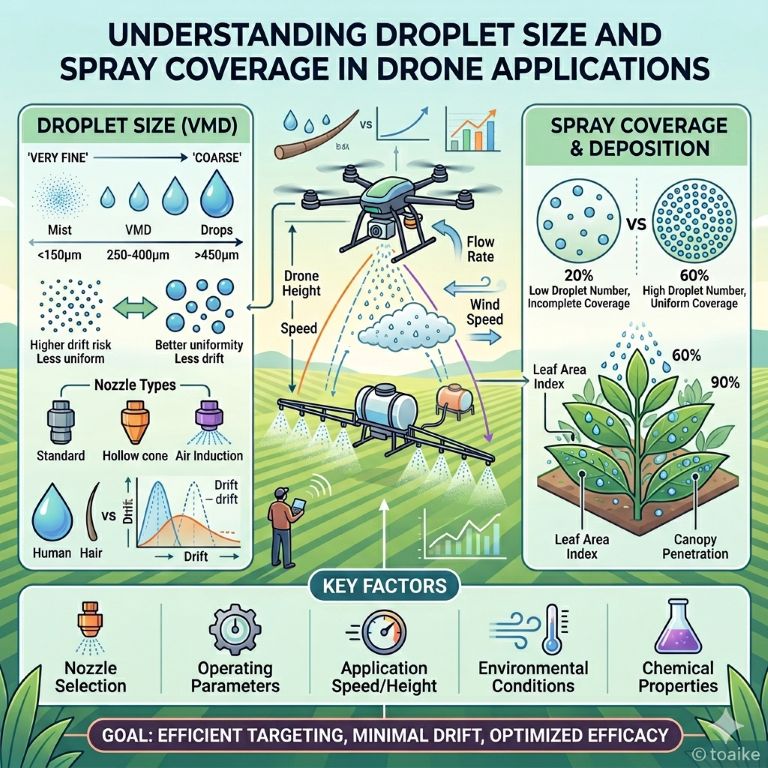
When a drone sprays a pesticide, fungicide, insecticide, or foliar nutrient, the liquid does not come out as a continuous stream. Instead, it breaks into thousands of tiny droplets.
The size of these droplets is measured in microns (μm).
To understand how small that is, consider that a human hair is roughly 70–100 microns thick.
In agricultural drone spraying, droplets are generally classified as:
| Category | Size |
|---|---|
| Fine Droplets | 50–150 µm |
| Medium Droplets | 150–300 µm |
| Coarse Droplets | Above 300 µm |
Each droplet size behaves differently after leaving the drone nozzle.
Fine droplets provide excellent coverage because more droplets are produced from the same amount of liquid. However, they are lighter and more likely to drift away.
Coarse droplets are heavier and less susceptible to drift, but they may provide less leaf coverage.
The objective is not to produce the smallest droplets possible.
The objective is to produce the right droplets for the right crop under the right conditions.
Why Spray Coverage Matters
Now let us imagine two drone operators spraying identical fields with the same pesticide and at the same dose.
One farmer gets excellent pest control.
The other does not.
Why?
Very often, the difference is not the pesticide.
The difference is spray coverage.
Spray coverage refers to how evenly droplets are distributed across the crop surface.
Good spray coverage means:
- More leaf area receives protection.
- More pests come into contact with the pesticide.
- More nutrients are absorbed by the plant.
- Less chemical is wasted.
- Better crop protection is achieved.
Poor coverage leaves untreated zones where pests and diseases continue to survive.
In many cases, it is not the product that fails.
It is the coverage.
The Balance Between Coverage and Drift
Drone spraying is a balance between two competing objectives:
- Achieving maximum coverage.
- Minimizing spray drift.
When droplets become smaller:
Advantages
- Better leaf coverage
- Higher droplet density
- Improved canopy penetration
Challenges
- Greater drift risk
- Faster evaporation
- Higher sensitivity to wind
When droplets become larger:
Advantages
- Reduced drift
- Better deposition
- Greater stability in the air
Challenges
- Lower coverage density
- Reduced canopy penetration
- Possible runoff from leaves
This is why professional drone spraying is always about finding the right balance between coverage and drift.
How We Actually Control Droplet Size During Drone Spraying
Many people assume that the drone automatically determines droplet size.
In reality, we control droplet size through several operational parameters.
1. Nozzle Selection
The nozzle is the most important factor affecting droplet formation.
Different nozzles produce different droplet sizes and spray patterns.
For example:
- Hollow-cone nozzles generally produce finer droplets.
- Flat-fan nozzles provide balanced coverage.
- Air-induction nozzles produce larger droplets with reduced drift potential.
Choosing the correct nozzle is often the first step in achieving effective spray coverage.
2. Spray Pressure
Pressure directly affects droplet formation.
- Higher pressure produces smaller droplets.
- Lower pressure produces larger droplets.
Even small changes in pressure can significantly influence spray quality.
3. Flight Height
The higher the drone flies, the longer droplets remain suspended in the air.
This increases the possibility of drift.
For most agricultural drone operations in India, SOP guidelines generally recommend flying approximately 1.5–2.5 metres above the crop canopy, depending on the crop and growth stage.
4. Flight Speed
Flight speed affects how uniformly droplets are deposited.
If we fly too fast:
- Coverage may become uneven.
- Some areas may receive insufficient spray.
If we fly too slowly:
- Over-application may occur.
Flight speed, spray flow rate, and application volume must work together to achieve optimum results.
5. Weather Conditions
Even a perfectly calibrated drone cannot overcome poor weather conditions.
Wind speed, temperature, and humidity significantly affect droplet behaviour.
That is why professional drone spraying is usually conducted during early morning or late afternoon hours when environmental conditions are more favourable.
What Makes Agricultural Drones Different?
One major advantage of drone spraying is rotor downwash.
As the drone flies, its rotors create a strong downward airflow.
This airflow helps:
- Push droplets deeper into the crop canopy.
- Improve coverage on lower leaf surfaces.
- Increase spray deposition.
- Reduce droplet suspension in the air.
This unique feature allows agricultural drones to achieve effective coverage even at relatively low spray volumes compared to conventional spraying systems.
What Does "Maintain a Droplet Spectrum That Provides Adequate Coverage While Minimizing Drift" Mean?
This phrase appears frequently in drone spraying guidelines and SOPs.
In simple terms, it means:
We try to create droplets that are not too small to drift away and not too large to run off the leaves.
To achieve this balance, we manage:
- Nozzle type
- Spray pressure
- Flight height
- Flight speed
- Weather conditions
Together, these factors determine the droplet spectrum produced by the drone.
The goal is simple:
Maximum spray reaches the crop. Minimum spray leaves the field.
How Do We Know If Spray Coverage Is Good?
One of the biggest advantages of modern drone spraying is that we can measure spray quality scientifically.
We do not have to guess.
Instead, we use Water-Sensitive Papers (WSPs).
These small yellow cards are placed at different locations within the crop canopy before spraying.
When droplets land on them, they change colour and reveal exactly how the spray was deposited.
Using water-sensitive papers, we can evaluate:
- Droplet density
- Coverage percentage
- Spray uniformity
- Canopy penetration
- Untreated areas
This transforms drone spraying from a routine operation into a precision agriculture practice.
Understanding Droplet Density (Drops/cm²)
A term frequently used in drone spraying is:
Droplet Density (Drops/cm²)
This simply means the number of droplets landing within a one-square-centimetre area.
Imagine drawing a small square measuring:
1 cm × 1 cm
on a leaf.
Now imagine counting how many droplets land inside that square.
That number represents the droplet density.
For example:
| Droplet Density | Interpretation |
| 10 drops/cm² | Low coverage |
| 20–30 drops/cm² | Moderate coverage |
| 30–50 drops/cm² | Good insecticide coverage |
| 50–70 drops/cm² | Good fungicide coverage |
The exact requirement depends on:
- Crop type
- Canopy structure
- Pest target
- Pesticide formulation
The objective is not simply to spray more liquid.
The objective is to place the right number of droplets evenly across the crop.
A simple way to understand this is to think about rainfall.
If only a few raindrops fall on a roof, large portions remain dry.
If enough raindrops fall evenly across the roof, complete coverage is achieved.
Drone spraying works in much the same way.
Drone Spraying SOP: Best Practices for Droplet Size and Spray Coverage
SOP Guidelines for Drone Spraying in Indian Conditions
Farm Machinery Training & Testing Institute (FMTTI), Budni, Ministry of Agriculture & Farmers Welfare, Government of India has issued Standard Operating Procedures (SOPs) for agricultural drone applications. These guidelines help ensure safe, effective, and uniform spraying.
Before Spraying:
Inspect the drone, battery, pump, filters, hoses, and nozzles.
Ensure all nozzles are functioning uniformly.
Filter the spray solution before filling the tank.
Use only approved pesticides and recommended doses.
Conduct a water-only trial run.
Verify GPS connectivity and mission planning.
During Spraying:
Maintain the recommended flight height above the crop canopy.
Maintain a consistent flight speed throughout the operation.
Ensure proper swath overlap between adjacent passes.
Monitor wind speed and weather conditions continuously.
Avoid spraying during strong winds, high temperatures, or when rainfall is expected.
Ensure uniform spray discharge throughout the operation.
Spray Coverage Verification:
Place water-sensitive papers at the upper, middle, and lower canopy levels.
Check droplet density and coverage uniformity.
Evaluate canopy penetration and droplet distribution.
Adjust nozzle settings, flight speed, or flight height if coverage is inadequate.
Drift Management:
Avoid excessive flight heights.
Avoid producing extremely fine droplets during windy conditions.
Spray during favourable weather windows, preferably during early morning or late afternoon.
Use nozzle types appropriate for drift control.
After Spraying:
Clean the spray system thoroughly.
Inspect nozzles for wear, damage, or clogging.
Dispose of leftover spray solution according to recommended guidelines.
Record operational data for future reference and performance analysis.
The Real Benefit of Getting It Right
When we properly manage droplet size and spray coverage, we achieve:
- Better pest and disease control
- Improved nutrient-use efficiency
- Reduced pesticide wastage
- Lower environmental impact
- Better crop health
- Improved yields
- Higher profitability
In short, we obtain more value from every litre sprayed.
Conclusion
Whenever we see an agricultural drone flying over a field, it is easy to focus on the drone itself.
But the real success of drone spraying is determined by what happens after the droplets leave the nozzle.
The right droplet size, proper spray coverage, correct flight parameters, favourable weather conditions, and adherence to SOP guidelines together determine whether a spraying operation succeeds or fails.
As drone technology becomes an integral part of Indian agriculture, understanding these fundamentals will help us achieve safer, smarter, and more productive crop protection.
References
Directorate of Plant Protection, Quarantine & Storage, Ministry of Agriculture & Farmers Welfare, Government of India. Standard Operating Procedure (SOP) for Use of Drone Application in Agriculture.
https://fmttibudni.gov.in/files/SOP_Drone_Application_English_cdr.pdf
Ministry of Agriculture & Farmers Welfare, Government of India. Crop-Specific SOP for Application of Pesticides with Drones.
https://fmttibudni.gov.in/files/Crop_Specific_SOP_2023_cdr.pdf
