
She is not just livestock. She is the farm’s living, breathing fertility factory.
Ask any natural farmer what the single most important element of their farm is, and the answer is rarely a seed, a tool, or a technique. It is the cow. Specifically, the indigenous desi cow — a breed shaped over thousands of years by the Indian subcontinent’s soils, climate, and farming traditions.
When modern agriculture arrived with its bags of urea and bottles of pesticide, the desi cow was quietly sidelined. Exotic breeds like Holstein Friesian and Jersey — imported for their high milk yield — took centre stage. The result was more milk, yes. But also soils stripped of life, input costs that never stopped rising, and a farming system that grew more fragile with every passing season.
Natural farming puts the desi cow back where she belongs — at the heart of the farm. Not as a symbol, but as a fully functional input system. Her dung and urine, combined with a few common kitchen ingredients, produce everything a natural farm needs: seed treatment, soil tonic, pest repellent, and growth promoter. One cow. Thirty acres. Zero factory inputs.
Here is a closer look at exactly what she contributes — and why no other breed comes close
The eight roles of the desi cow in natural farming
1. The living fertility factory
One desi cow produces enough dung and urine each day to nourish approximately 30 acres of farmland. No other input — synthetic or organic — comes close to this output-to-cost ratio.
The desi cow is not a supplement to the natural farm. She is its engine. Where a chemical farmer budgets thousands of rupees every season for fertilisers, a natural farmer with one desi cow has all the raw material he needs — freely and endlessly replenished.
2. Superior microbial richness
The desi cow’s dung carries a far richer and more diverse community of beneficial microorganisms than exotic breeds. These include nitrogen-fixing bacteria, phosphate-solubilising microbes, mycorrhizal fungi, Lactobacillus, Bacillus subtilis, Pseudomonas, and yeasts such as Saccharomyces cerevisiae — the invisible army that rebuilds depleted soils season after season.
A 2025 study by CSK HP Agricultural University confirmed that indigenous Himachali Pahari lactating cows showed the highest microbial count among all breeds tested — desi, crossbred, and exotic. The gap is not marginal. It is decisive.
3. Higher mineral content in dung
A comparative study published in the International Journal of Cow Science found that desi cow dung contained significantly higher levels of calcium, phosphorus, zinc, and copper compared to crossbred cow dung. Zinc alone was higher by over 84% — a critical micronutrient that modern Indian soils are severely deficient in.
For farmers spending money on micronutrient sprays season after season, the desi cow dung quietly solves the same problem — naturally, without any residue.
4. The source of all key natural farming preparations
Every major preparation in natural farming — Beejamrut, Jeevamrut, Ghan Jeevamrut, Neemastra, Dashparni, and Panchagavya — uses desi cow dung and/or urine as the primary base ingredient. Without the cow, the entire preparation system collapses.
Her dung acts as the microbial inoculate that seeds the brew with life. Her urine acts as the carrier that helps nutrients travel deeper into the soil. Together, they make the farm self-sufficient.
5. Natural plant growth-promoting capacity
Bacteria found in desi cow dung produce natural plant hormones — auxins, cytokinins, and gibberellins — that directly stimulate root development and shoot growth. They also produce siderophores that mobilise iron in the soil, making it accessible to the plant. These are precisely the functions that synthetic fertilisers attempt to replicate chemically, at significant cost and ecological damage. In the desi cow’s dung, they occur naturally.
6. Natural biopesticide through urine
Desi cow urine is rich in sulfur, potassium, copper, iron, and naturally occurring antimicrobial compounds. Used in Neemastra and Dashparni, it repels pests and suppresses disease without leaving any toxic residue in the soil.
Studies confirm it enhances plant resistance to fungal and bacterial diseases and can serve as a partial supplement for urea, making it simultaneously a crop protectant and a soil nutrient source.
7. Improving soil structure and water retention
Vermicompost prepared from desi cow dung improves soil texture, water-holding capacity, organic carbon content, and overall microbial diversity. All four of these are foundational to a productive farm over the long term. Soils that once cracked in summer and flooded in monsoon begin, over seasons, to hold moisture evenly — reducing water demand and making the crop far more resilient to irregular rainfall.
8. The economic backbone of the natural farm
With one desi cow, a farmer can produce all his crop inputs at virtually zero cost. The NMNF incentive of ₹4,000 per acre per year explicitly supports livestock upkeep — a recognition by the Government of India that the desi cow is not incidental to natural farming. She is its economic anchor.
Nutritional & microbial comparison
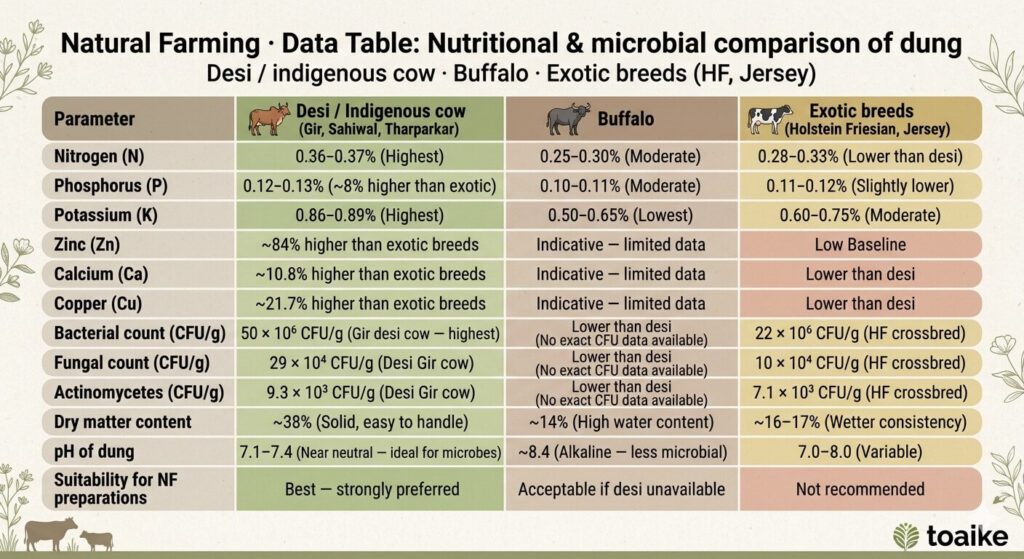
Compiled from multiple research sources. Values are indicative and may vary. Readers are encouraged to verify independently via ResearchGate, PubMed, Google Scholar, and ICAR.
One desi cow. Thirty acres. Zero factory inputs. That is the arithmetic of natural farming — and the desi cow makes it possible.
The data in the table above tells a clear story. The desi cow’s dung is not just richer in NPK — it is richer in the microorganisms, trace minerals, and biological activity that make soil come alive. Buffalo dung is more alkaline and lower in dry matter, limiting its usefulness in natural farming preparations. Exotic breed dung has roughly half the bacterial count of desi cow dung — the difference between a preparation teeming with life and one that merely goes through the motions.
This is why the National Mission on Natural Farming specifically recommends the indigenous desi cow — not out of sentiment, but out of science. When a farmer invests in a desi cow, she pays back in every preparation, every season, every harvest — for as long as the farm stands.
Nutritional & microbial comparison
References
- Sagar S. et al. (2025). Plant growth-promoting bacteria from dung of indigenous and exotic cow breeds. Biotechnology for the Environment, 2:3, CSK HP Agricultural University.https://biotechforenvironment.biomedcentral.com/articles/10.1186/s44314-025-00017-6
- Garg AK, Mudgal V. (2007). Organic and mineral composition of Gomeya (cow dung) from desi and crossbred cows. International Journal of Cow Science, 3(1&2):17–19.https://link.springer.com/article/10.1186/s40643-016-0105-9
- Microbial characteristics of cow dung: Desi Gir vs HF crossbred comparison. ResearchGate — Ganajeevamrutha and Jeevamrutha study.https://www.researchgate.net/figure/Microbial-characteistics-of-cow-dung_tbl1_370966497
- Importance of Indigenous Cow Dung and its Microbiota. ResearchGate publication.https://www.researchgate.net/publication/372590450_Importance_of_Indigenous_Cow_Dung_and_its_Microbiota
- Bioprospecting of cowdung microflora for sustainable agricultural and environmental applications. PMC / National Center for Biotechnology Information.https://pmc.ncbi.nlm.nih.gov/articles/PMC8610318/
- Cattle Dung Manure Microbiota as a Substitute for Mineral Nutrients and Growth Management Practices in Plants. ResearchGate.https://www.researchgate.net/publication/349812351
- Insights into cow dung-based bioformulations for sustainable plant health and disease management. Journal of Soil Science and Plant Nutrition, Springer, 2023.https://link.springer.com/article/10.1007/s42729-023-01558-z
Pingback: Liquid vs WP Biofertilizers: Which is Better?