
How India’s oldest farming wisdom is becoming its newest national mission
Picture a small farmer in rural India, standing at the edge of his field at dawn. Every season, he borrows money to buy fertilisers, pesticides, and herbicides. Every season, the soil demands a little more of each. And every season, what he earns barely covers what he spent. The land is tired. So is he.
Now imagine he stops buying all of it — and the farm does better.
That is not a dream. That is natural farming. And as of 25 November 2024, it is India’s official national mission.
Back to the roots — honestly
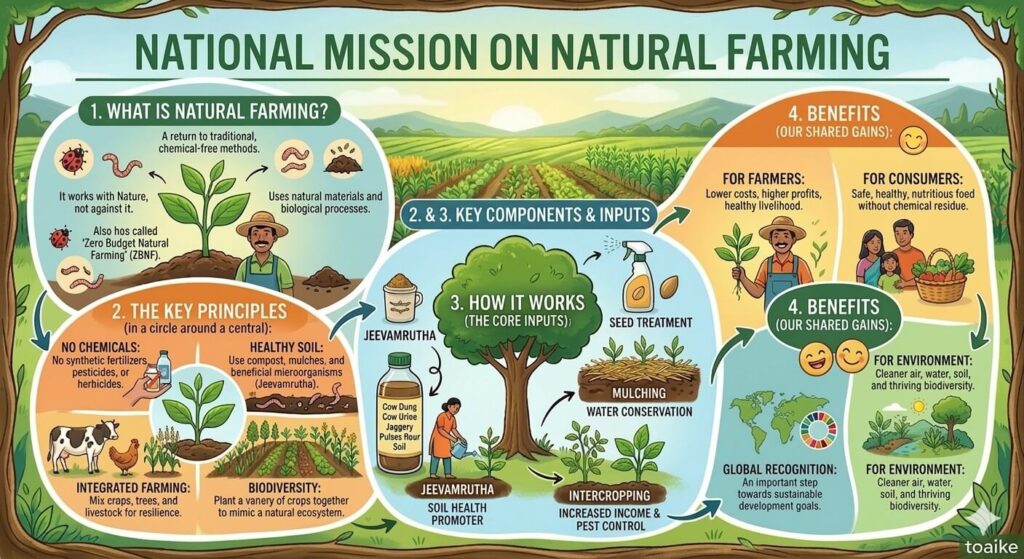
Natural farming is not a new invention. Indian farmers worked this way for centuries — nurturing the soil, rotating crops, keeping livestock close, and letting nature do most of the heavy lifting. What changed in the 20th century was the arrival of chemical agriculture, which promised bigger yields but quietly degraded the very ground beneath farmers’ feet.
The National Mission on Natural Farming (NMNF) is India’s answer to that damage — a return to chemical-free farming that draws on traditional knowledge while being backed by modern institutional support.
At the heart of this approach is something beautifully simple: the desi cow. Its dung and urine, combined with a handful of kitchen ingredients like jaggery and gram flour, form the building blocks of everything a farm needs. Beejamrut — a seed treatment made from these inputs — shields young seeds from fungal infections the way a mother shields a newborn. Jeevamrut and Ghan Jeevamrut — fermented microbial brews applied to the soil every fortnight — feed billions of invisible organisms that, in turn, feed the plant. No factory required. No invoice to pay.
When pests show up, nature has answers there too. Neemastra and Dashparni — preparations made from neem and ten medicinal leaves — send pests packing without poisoning the soil or the farmer’s hands. Mulching keeps the earth moist and cool. And beneath the surface, Whapasa — the delicate balance of air and water in the soil — quietly does its work, letting roots breathe and life flourish underground. Multi-cropping systems mean different plants look after each other. Traditional seeds — bred over generations for local conditions — ask for very little and give back a great deal.
A mission built around people, not paperwork
What makes NMNF different from most government schemes is who does the teaching. Each cluster of villages will have two Krishi Sakhis — ordinary women farmers who already practise natural farming — walking door to door, demonstrating, explaining, and encouraging. Not bureaucrats. Not consultants. Just neighbours.
10,000 community-level Bio-Input Resource Centres will stock ready-made natural inputs for farmers who are just starting out. KVKs, agricultural universities, and experienced NF farmers will host live demonstration fields — so a hesitant farmer can see thriving crops before risking his own plot. And to ease the transition, the government offers ₹4,000 per acre per year for two years — enough to cover livestock upkeep and input preparation while the farmer finds his footing.
The mission’s ambition is real: 7.5 lakh hectares, 15,000 clusters, and awareness reaching 1 crore farmers. A simple certification system and a national brand for naturally grown produce will help farmers earn more at the market for what they grow cleanly.
For India’s farmers, this is more than a scheme. It is a chance to stop buying poison, stop exhausting the earth, and start farming in a way that their grandparents would recognise — and that their grandchildren will be grateful for.
Pingback: Maize: 5 Major Threats and Their Control
Pingback: Jute : 5 Major Threats and Their Control
Pingback: Sesame: 5 Major Threats and Their Control
Pingback: Kodo Millet : 5 Major Threats and Their Control