
Fertilizers are like guests at a big village wedding—some rush in, eat quickly, and leave before the music even starts. Others settle in, chat with everyone, and stay until the last plate of sweets is served. And then there are those who practically move in and become part of the family! In soil too, fertilizers behave just like that: some disappear fast, some linger for months, and some (like biofertilizers and organic manures) stay long and keep helping quietly. Let’s walk through this in easy, lively language.
Chemical Fertilizers: The Short and Medium Visitors
These are the flashy guests—quick to act, quick to leave.
- Quick-release fertilizers (like urea):
Think of them as sprinters. They dissolve fast, give plants an instant energy boost, but vanish in 1–4 weeks. Rain or irrigation can wash them away. Farmers use them when crops need a sudden push—like a strong cup of chai before a long day! - DAP (Diammonium Phosphate):
DAP is a mix of nitrogen and phosphorus. Nitrogen is the impatient guest—gone in days to weeks. Phosphorus, though, is the slow talker. It binds to soil and can stay for months or even years, though not always in a form plants can use. That’s why farmers often add extra nitrogen later. - MoP (Muriate of Potash):
This one brings potassium. In sandy soils, it packs up and leaves quickly. But in clay soils, it stays for weeks to months. Potassium helps crops like sugarcane and cereals stay strong and upright—like a good uncle at the wedding! - SSP (Single Super Phosphate):
SSP is the balanced guest—it brings phosphorus, sulphur, and calcium. Phosphorus lasts for months, while sulphur and calcium improve soil health for a whole season. Oilseeds and pulses love SSP because they need sulphur to shine.
Organic Manures: The Gentle, Long-Staying Helpers
These are the quiet relatives who help behind the scenes—no drama, just steady support.
- Compost:
Made from kitchen waste, crop residues, and leaves. It improves soil structure and slowly releases nutrients over 6 months to 1+ year. - Cow dung manure:
A classic! It adds organic matter, improves microbial life, and feeds plants gently over months. It’s like grandma’s cooking—slow, nourishing, and full of love. - Vermicompost: The overachiever of organic manures! Made by earthworms, it is richer in nutrients than regular compost and releases them steadily over 3 to 6 months. It also boosts soil microbial activity and improves texture—like a wise, hardworking guest who quietly fixes everything before leaving!
- Bone meal:
Rich in phosphorus and calcium. It breaks down slowly and supports root growth for months to a year.
Organic manures don’t just feed plants—they feed the soil itself, making it soft, rich, and full of life.
Biofertilizers: The Long-Term Family Members
These are living microbes—tiny helpers that stay in the soil and work quietly.
- Rhizobium:
Lives in legume roots, fixing nitrogen. Active for the whole crop season, and if legumes are grown regularly, it can stay for years. - Azospirillum & Azotobacter:
Free-living nitrogen fixers. Survive for weeks to months, but need organic matter to stay strong. Farmers usually reapply them each season. - PSB (Phosphate-Solubilizing Bacteria):
Unlock phosphorus from soil. Work for 2–3 months, longer if soil is rich. - KSB (Potassium-Solubilizing Bacteria):
Release potassium from minerals. Active for months, depending on soil type. - Mycorrhiza:
Fungi that live in plant roots. Once settled, they can stay for years, helping plants absorb water and nutrients season after season.
Easy Way to Imagine It
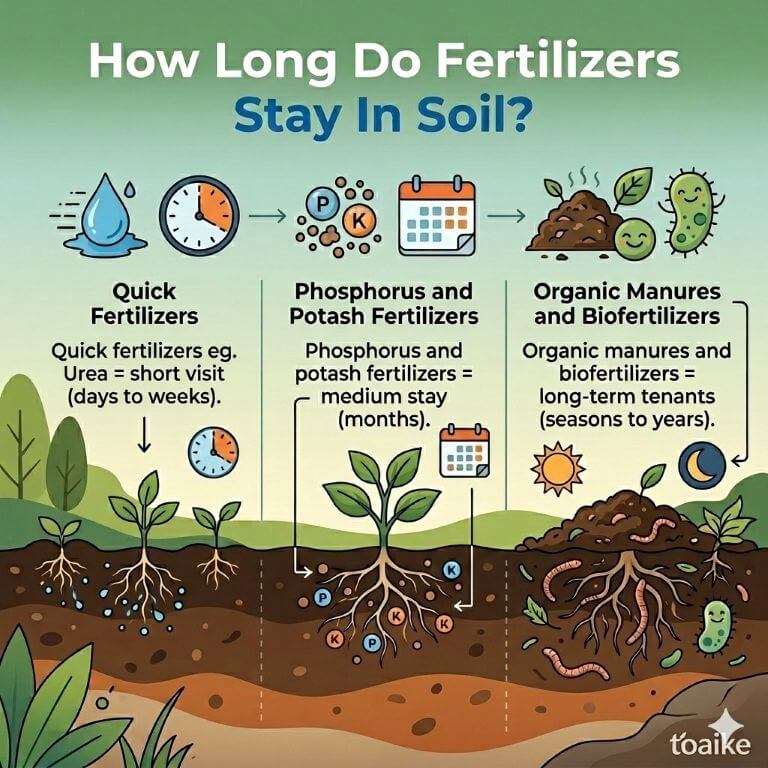
- Quick fertilizers = short visit (days to weeks).
- Phosphorus and potash fertilizers = medium stay (months).
- Organic manures and biofertilizers = long-term tenants (seasons to years).
It’s like having different kinds of guests:
- Some just pop in for tea.
- Some stay for dinner.
- Some move in and become part of the family!
Farmer-Friendly Tip
The smartest way is to mix and match:
- Use quick fertilizers for an instant boost.
- Use slow-release or phosphorus fertilizers for steady feeding.
- Use organic manures and biofertilizers to keep soil alive and healthy for the long run.
This way, crops get food at the right time, soil stays fertile, and farmers save money while protecting the environment.
So, the answer to “How long does fertilizer stay in soil?” is not one-size-fits-all. Some fertilizers are like short-term guests, some are seasonal visitors, and some are the relatives who never leave—they become part of the soil family. And just like in any good household, balance is the key: knowing which guest to invite, and when, makes the soil happy and the crops thrive.