
In the world of soil biology, most biofertilizers are bacteria — small, humble, and relatively simple in how they do their job. Then there is VAM, which looked at all of that and said “not good enough” and decided to become a fungus instead, physically merge itself into plant root cells, and build one of the most successful biological partnerships the Earth has ever seen. Scientists believe this relationship has been going on for over 400 million (40 crore) years, which means VAM was helping plants grow long before humans ever figured out that plants needed help in the first place.
What is VAM
VAM stands for Vesicular Arbuscular Mycorrhiza. Despite the intimidating name, the concept is beautifully simple — it is a beneficial fungus that connects itself to plant roots and essentially becomes an extension of the plant’s own nutrient-absorbing system. This association is found in nearly 80 percent of all land plants, making it arguably the most widespread and successful biological relationship in all of nature. What makes it especially interesting is that neither partner can truly thrive without the other. The plant depends on the fungus to reach nutrients it cannot access on its own, and the fungus depends on the plant for the sugars it needs to survive. It is a partnership built on genuine mutual need.
How VAM Connects to Plant Roots
To understand how VAM works, it helps to start from the very beginning. When VAM fungal spores present in the soil sense the presence of nearby plant roots, they begin to germinate and grow thin thread-like structures called hyphae toward the root. These hyphae do not simply wrap around the outside of the root — they actually push through the outer root layer and make their way into the inner root cells. This is where the real work begins.
Arbuscules and Vesicles: The Two Key Structures
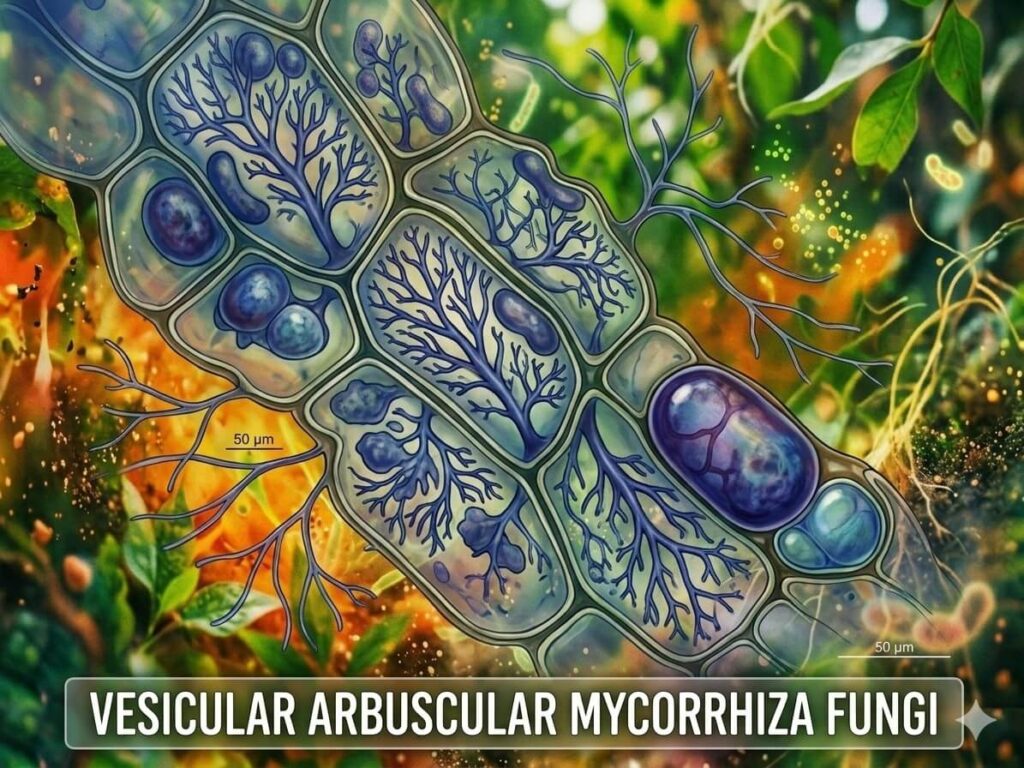
Once inside the root cells, the fungus forms two very important structures. The first are called arbuscules. These are tiny, highly branched structures that form inside individual root cells and look somewhat like miniature trees under a microscope. Arbuscules are the heart of the entire VAM system because they are the physical sites where nutrients are exchanged between the fungus and the plant. The fungus passes phosphorus, zinc, copper, and other important nutrients directly into the root cell through the arbuscule, while the plant simultaneously sends sugars and carbon back to the fungus through the same structure. This two-way exchange is continuous, efficient, and remarkably well coordinated.
The second structures formed are called vesicles. These are rounded, balloon-like storage bodies that the fungus creates within or between root cells. They act as nutrient and energy reserves for the fungus, storing fats and other compounds that help sustain the fungal network during difficult periods such as drought or low nutrient availability.
The External Hyphal Network: VAM's Greatest Strength
However, the most powerful aspect of VAM is not what happens inside the root — it is what happens outside. The fungus extends a massive web of hyphae outward into the surrounding soil, spreading far beyond where the plant’s own roots could ever reach. Because these hyphae are extraordinarily thin, much thinner than even the finest root hair, they can squeeze into the tiniest spaces between soil particles and access nutrient reserves that are completely beyond the reach of the root itself. This external hyphal network can increase the effective nutrient-absorbing surface area of the plant by up to 100 times, which is a genuinely staggering improvement.
Why VAM is Especially Powerful for Phosphorus
This becomes especially important for phosphorus, which is a nutrient that moves very slowly through soil. Plant roots tend to quickly exhaust the phosphorus immediately surrounding them, creating a depleted zone where no more phosphorus is available. The VAM hyphal network simply grows past this depleted zone and taps into fresh phosphorus further away, continuously channeling it back to the plant. This is why VAM produces the most dramatic growth improvements in soils that are low in phosphorus.
Beyond Nutrition: Drought, Disease and Soil Health
Apart from nutrient uptake, VAM also helps plants survive drought conditions by improving water absorption through its hyphal network. It strengthens the plant’s defense against harmful soil pathogens by forming a protective layer around the roots. It also improves the physical structure of the surrounding soil by releasing a sticky protein called glomalin, which glues soil particles together into stable clumps, making the soil healthier and more capable of retaining both water and nutrients over time.
Summary - Field Application and Crop Suitability
VAM is applied commercially as a spore-based inoculant mixed into the soil at planting and has delivered impressive results across a wide range of crops including wheat, maize, citrus, cassava, and vegetables. It is, in every sense, a complete biological solution — improving nutrition, water uptake, disease resistance, and soil health all at once. For a fungus that has been quietly doing this job for 400 million years, it is fair to say it has earned the right to be called the most experienced agronomist on the planet.