
16 minutes read
Let’s be honest. The first time most farmers hear “drip irrigation,” they imagine some fancy foreign system that costs a fortune, needs an engineer to install, and breaks down the moment a buffalo walks past the field. Fair concern. But here’s the interesting part — the idea of delivering water slowly to plant roots is not new. Ancient farmers in China and the Middle East used buried clay pots to do exactly this. What is new is the engineering precision behind it — modern drip irrigation as we know it today, with plastic emitters and pressurised pipe networks, was developed in Israel in the late 1950s and has since transformed irrigated agriculture worldwide
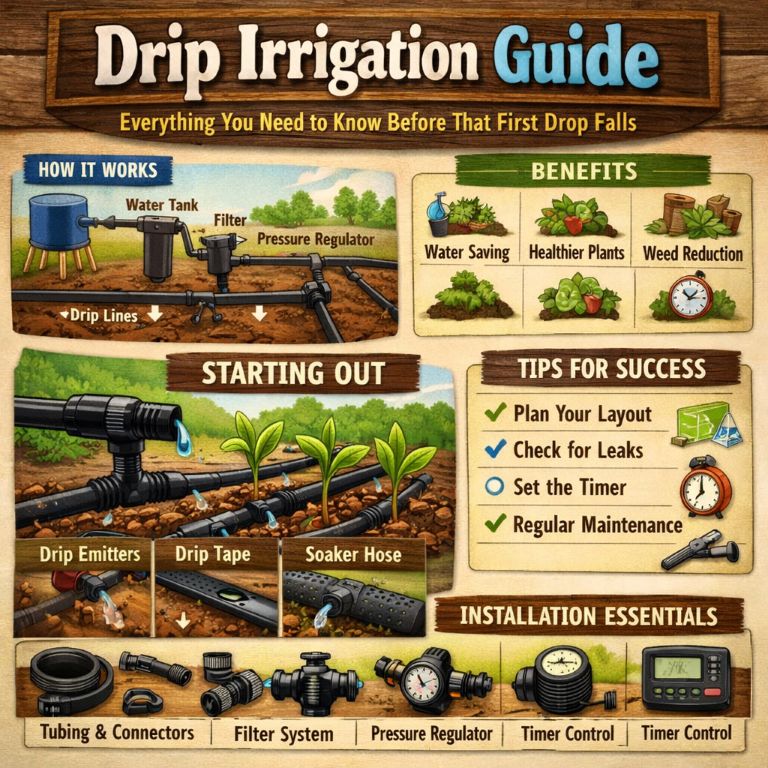
What Exactly Is Drip Irrigation?
Drip irrigation is a method of delivering water directly to the root zone of a plant — slowly, steadily, and without wasting a single drop in between. Instead of flooding an entire field or spraying water into the air where a significant portion evaporates before reaching the soil, drip irrigation uses a network of pipes, tubes, and tiny outlets called emitters to release water right where it’s needed — at the base of each plant.
Think of it this way. Flooding a field is like pouring a whole jug of water on your dining table to clean one small stain. Drip irrigation is using a damp cloth — precise, controlled, and far less wasteful.
Sometimes also called trickle irrigation, drip systems deliver water onto the soil at very low rates — typically between 2 and 20 litres per hour — from small diameter plastic pipes fitted with outlets called emitters or drippers. Water is applied close to plants so that only the part of the soil in which roots grow is wetted, unlike surface or sprinkler irrigation which wets the entire soil profile. (Source: FAO Irrigation Manual, Chapter 6 — https://www.fao.org/4/s8684e/s8684e07.htm)
How Does a Drip System Actually Work?
Now that you know what it is, let’s understand how water travels through a drip system — from source to soil.
A typical drip irrigation system works in a simple, logical flow:
Water Source → Filter → Mainline Pipe → Sub-main Pipe → Lateral Pipes → Emitters → Root Zone
Each component plays a specific role. Understanding each one helps a farmer or extension professional identify problems, plan installations, and maintain the system correctly.
Water Source
This can be a borewell, open well, canal, farm pond, or a storage tank. The source must be capable of maintaining adequate operating pressure — typically 1 to 1.5 kg/cm² at the head of the system. Insufficient pressure is one of the most common causes of uneven water distribution in poorly planned drip systems.
Filter Unit
This is the single most critical component of any drip system. Water from borewells and open sources in Indian field conditions routinely carries sand, silt, algae, organic debris, and dissolved minerals. Without adequate filtration, emitters clog within days of installation. Two filter types are commonly used:
- Sand media filters — recommended when the water source contains biological matter like algae or fine organic particles. Water passes through a bed of graded silica sand which physically traps contaminants.
- Screen filters — used when the water source is relatively clean and contains mainly fine sand or silt particles. These are simpler to clean and maintain.
For most Indian field conditions, a combination of both — sand media filter followed by a screen filter — is the recommended configuration. Filters must be cleaned at least once a week during active irrigation season, more frequently if the water source is turbid.
Mainline Pipe
The mainline is the primary supply pipe running from the pump or water source to the field. It is typically made of rigid PVC or HDPE and ranges from 63mm to 110mm in diameter depending on the flow rate and total field area. The mainline must be sized correctly to avoid excessive pressure loss over long distances.
Sub-main Pipe
Sub-mains branch off the mainline and distribute water across different sections or blocks of the field. They are typically HDPE pipes of 40mm to 63mm diameter. Large fields are often divided into irrigation blocks, with each block served by one sub-main and irrigated in rotation to match the pump’s output capacity.
Lateral Pipes
These are the thin-walled LLDPE pipes — typically 12mm or 16mm in diameter — that run alongside each crop row. Emitters are either pre-installed in the pipe at the factory (inline emitters) or punched in at the time of installation (online emitters). Lateral pipe quality is critical — thin-walled pipes deteriorate quickly under direct sunlight and mechanical stress.
Emitters (Drippers)
hese small devices control the discharge of water from the lateral pipe to the plant. All emitters have very small waterways ranging from 0.2 to 2.0 mm in diameter, which is precisely why clean, filtered water is non-negotiable. (Source: FAO Irrigation Manual, Chapter 6 — https://www.fao.org/4/s8684e/s8684e07.htm)
Emitters are available in two broad categories:
- Non pressure-compensating emitters — discharge varies with operating pressure. Suitable for flat terrain and short lateral lengths.
- Pressure-compensating (PC) emitters — maintain a constant discharge rate across a wide pressure range (typically 0.8 to 3.5 kg/cm²). Essential for undulating terrain, long lateral runs, or wherever significant elevation changes exist across the field.
Common discharge rates are 2 LPH and 4 LPH. The selection depends on soil type, crop water requirement, and emitter spacing.
The water released by the emitter moves through the soil both downward (by gravity) and laterally (by capillary action), forming a wetted bulb. The shape and size of this bulb depends on soil texture — wide and shallow in sandy soils, narrow and deep in clay soils. Understanding your soil’s wetted bulb pattern is essential for correct emitter spacing during system design.
What Crops Are Best Suited for Drip Irrigation?
Drip irrigation is technically suitable for almost all crops grown in rows or with defined plant spacing. However, its advantages are most pronounced in high-value crops where consistent, precise moisture management directly improves yield quality and quantity.
Fruits and Orchards — Grapes, pomegranate, banana, mango, guava, papaya, and citrus respond exceptionally well to drip. These perennial and semi-perennial crops benefit from the consistent soil moisture that drip provides throughout the growing season, avoiding the moisture stress cycles typical of flood irrigation.
Vegetables — Tomato, chilli, capsicum, onion, brinjal, cabbage, and cauliflower are among the most widely drip-irrigated crops in India. ICAR field studies on drip systems for vegetables demonstrated 20–30% higher yield, 40–60% saving of irrigation water, and 40% saving of labour compared to traditional practices. (Source: ICAR — Solar Powered Drip Irrigation, Sundarbans — https://icar.org.in/en/node/4625)
Cash Crops — Sugarcane and cotton are the two most significant cash crops under drip in India. For sugarcane, sub-surface drip is increasingly being adopted, where lateral pipes are buried 20–30 cm below the soil surface, protecting them from mechanical damage during field operations. ICAR’s All India Coordinated Research Project on Irrigation Water Management found that pressurised irrigation systems including drip achieved yield increases of 12.8–83.8%, water savings of 14.4–65.2%, and an improvement in water use efficiency of 16.8–93% across crop trials conducted across 14 agro-ecological regions. (Source: ICAR-IIWM Annual Report 2016-17, AICRP on Irrigation Water Management — https://www.iiwm.res.in/iiwmad/images/document/publication/AICRP_IWM_AR_2016_17.pdf )
Plantation Crops — Coconut, arecanut, and rubber are well suited to drip due to their fixed plant spacing and long productive life. The return on drip investment over a 20–30 year plantation lifespan is substantial.
Where drip has limitations — Broadcast crops like paddy (rice) and wheat, which are grown in high plant density with no defined row-to-plant spacing, are not conventionally suited to standard drip systems. Research on sub-surface drip for paddy is ongoing but not yet mainstream for field-scale adoption in India.
Advantages of Drip Irrigation
1. Precise Water Application: Drip delivers water directly to the root zone at a controlled rate. This eliminates surface runoff and significantly reduces deep percolation losses. The result is that a much higher proportion of applied water is actually used by the crop.
2. Higher Crop Yield and Quality: Consistent soil moisture without waterlogging or drought stress cycles leads to better plant growth, more uniform fruit size, and higher marketable yield. This effect is especially visible in fruit crops and vegetables where moisture stress at critical growth stages directly impacts produce quality.
3. Fertigation: Fertigation — the application of fertilisers through the drip system — is one of the most agronomically valuable features of drip irrigation. Water-soluble fertilisers are injected into the irrigation water through a fertigation unit (venturi injector or fertiliser tank) placed at the control head. The fertiliser is then carried directly to the root zone with each irrigation cycle.
The agronomic advantages of fertigation are significant:
- Nutrients are delivered precisely where active roots can absorb them
- Split application of fertilisers is easy, matching crop demand at different growth stages
- Fertiliser use efficiency improves substantially compared to broadcast application
- Leaching of soluble nutrients like nitrogen below the root zone is reduced
For extension professionals advising farmers on fertigation, it is important to note that only fully water-soluble fertilisers should be used — urea, potassium nitrate, mono-ammonium phosphate (MAP), calcium nitrate, and water-soluble micronutrient mixes. Granular fertilisers should never be dissolved and injected as they leave residues that clog emitters.
4. Reduced Weed Pressure: Since water is applied only at the root zone of the crop, the inter-row spaces remain relatively dry. This significantly reduces weed germination and growth between rows, cutting down on weeding labour and herbicide costs.
5. Labour Efficiency: After installation, operating a drip system requires minimal labour. A single operator can manage irrigation across several acres simply by operating valves or an automated controller. This is a significant advantage in conditions of rising agricultural labour costs.
6. Suitability for All Terrain: Drip irrigation is adaptable to any farmable slope. Lateral pipes are laid along crop rows following the field contour, and pressure-compensating emitters ensure uniform discharge regardless of elevation differences across the field. (Source: FAO Irrigation Manual, Chapter 6 — https://www.fao.org/4/s8684e/s8684e07.htm) This makes drip viable even for hilly terrain in states like Himachal Pradesh, Uttarakhand, and the North-East where gravity-fed drip systems can be designed without a pump.
7. Reduced Crop Disease: Keeping the soil surface and foliage dry — as drip systems do — significantly reduces the incidence of fungal diseases, soil-borne pathogens, and root rot that thrive under prolonged wet conditions associated with flood irrigation.
Disadvantages and Technical Challenges
No technical guide is honest without covering the limitations.
1. Emitter Clogging: This is the most common operational problem in drip systems. Blockage occurs when water contains algae, fertiliser precipitates, and dissolved minerals such as calcium, magnesium, and iron that crystallise inside the narrow emitter waterways. (Source: FAO Irrigation Manual, Chapter 6 — https://www.fao.org/4/s8684e/s8684e07.htm)
Prevention requires:
- Properly sized and regularly cleaned filtration
- Periodic flushing of lateral pipes
- Acid treatment (dilute hydrochloric or phosphoric acid) where calcium or iron precipitation is a recurring problem
- Chlorination of the water source where biological clogging from algae is an issue
2. Soil Salt Accumulation: In drip-irrigated fields, salts dissolved in irrigation water tend to accumulate at the periphery of the wetted bulb — the boundary between wet and dry soil. Over multiple seasons, this salt fringe can build up to phytotoxic levels if not managed. Periodic leaching irrigations — applying water in excess of crop requirement to flush salts below the root zone — must be planned as part of the irrigation schedule, particularly in areas where irrigation water has moderate to high salinity.
3. Rodent and Physical Damage: Lateral pipes lying on the soil surface are vulnerable to damage from rodents, farm machinery, and human foot traffic. Rodent damage is particularly common in sugarcane and cereal fields. Sub-surface drip installation eliminates this problem but increases installation cost and makes maintenance more difficult.
4. High Initial Investment: A well-designed drip system for a one-acre vegetable crop in India typically costs between ₹40,000 and ₹80,000 depending on crop type, emitter type, and system configuration. For orchards and cash crops requiring pressure-compensating emitters and longer lateral runs, costs can be higher. This upfront investment is the primary barrier to adoption for small and marginal farmers.
5. System Design Errors: A poorly designed drip system — incorrect pipe sizing, inadequate operating pressure, wrong emitter selection, or improper hydraulic calculations — will result in non-uniform water distribution across the field. Non-uniformity means some plants receive too much water and others too little, negating the core benefit of the technology. Proper hydraulic design is non-negotiable.
6. Soil Type Limitations: On very sandy soils, the wetted bulb formed by a standard surface emitter may be too narrow and deep to adequately cover the lateral root spread of the crop. In such cases, micro-sprinkler or wider-spaced multiple emitters per plant may be needed. On heavy clay soils, emitter discharge rate must be kept low to prevent surface ponding. (Source: FAO Irrigation Manual, Chapter 6 — https://www.fao.org/4/s8684e/s8684e07.htm)
How to Design a Drip Irrigation System — Technical Essentials
For farmers and extension professionals approaching system design for the first time, the following steps provide a practical framework.
Step 1 — Determine Crop Water Requirement (CWR)
CWR is the daily volume of water a crop needs at its peak demand stage. It is calculated using reference evapotranspiration (ET₀) — derived from local weather data — multiplied by the crop coefficient (Kc) for the specific crop and growth stage. FAO’s CROPWAT software, freely available at https://www.fao.org/land-water/databases-and-software/cropwat/en/, automates this calculation using local climate inputs. Krishi Vigyan Kendras (KVKs) and State Agriculture Universities also publish crop-wise water requirement data for different agro-climatic zones.
Step 2 — Determine System Capacity
System capacity (litres per hour) = Total field area × Peak daily CWR ÷ Planned daily irrigation hours. This determines the pump size and mainline diameter required.
Step 3 — Select Emitter Type and Discharge Rate
Emitter selection depends on:
- Soil texture (sandy soils need higher discharge rates for adequate lateral wetting)
- Crop type (widely spaced orchard trees typically need 2–4 emitters per plant; row vegetables use one lateral with inline emitters)
- Terrain (undulating fields require pressure-compensating emitters)
Step 4 — Calculate Lateral Layout
Lateral pipe length should not exceed the hydraulic limit — typically 60–80 metres for 16mm diameter LLDPE pipe — beyond which pressure variation causes unacceptable discharge non-uniformity. For longer fields, sub-mains should be positioned centrally so that laterals run in both directions, halving the effective lateral length.
Step 5 — Size Mainlines and Sub-mains
Pipe diameter is selected to keep velocity below 1.5 m/s and pressure loss within acceptable limits. Hydraulic calculations must account for elevation differences across the field. These calculations are standard in any drip system design software or can be done manually using the Darcy-Weisbach or Hazen-Williams equations.
Step 6 — Design the Control Head
The control head consists of: pump → sand media filter → screen filter → pressure gauge → fertigation unit → flow meter → mainline valve. Each component must be rated for the system’s operating pressure. A bypass valve on the filter allows cleaning without shutting down the entire system.
Step 7 — Divide Large Fields into Irrigation Blocks
Where the total field area exceeds what the pump can irrigate simultaneously, the field is divided into blocks. Each block is irrigated in rotation. Block sizes should be equal so that each block receives the same irrigation duration and volume.
System Maintenance — The Discipline That Protects the Investment
A drip system is a long-term asset that will last 7–10 years or more with proper maintenance. Neglecting maintenance — particularly filter cleaning — is the single most common cause of premature system failure.
Daily / Each Irrigation Cycle:
- Check operating pressure at the control head and at the far end of at least one lateral. Significant pressure drop indicates a blockage or leak somewhere in the system.
- Visually inspect the field for wet patches (indicating lateral or emitter damage) or dry spots near individual plants (indicating blocked emitters).
Weekly:
- Clean the sand media filter by backwashing — reversing flow through the filter to flush out trapped particles.
- Clean the screen filter by removing and washing the screen element.
- Flush the sub-main pipes by briefly opening the flush valves at their ends.
Monthly:
- Flush all lateral pipes by opening the end caps and allowing water to flow freely for 5–10 minutes. This removes sediment that accumulates at the dead ends of laterals over time.
- Check emitter discharge uniformity in a sample of laterals — collect discharge from 10–15 emitters across the field in measuring cups over 30 minutes and compare volumes. Variation greater than 10–15% indicates design or maintenance issues.
Seasonal (End of Crop):
- Flush the entire system thoroughly before storing.
- Inspect all laterals for damage — rodent holes, UV degradation, cracking.
- Store lateral pipes away from direct sunlight. UV degradation of LLDPE pipe is a significant cause of reduced pipe life in Indian field conditions.
- Apply a mild acid flush (0.5–1% phosphoric acid solution) through the entire system to dissolve mineral deposits before storage.
Annually:
- Check pump performance against original specifications.
- Inspect all fittings, connectors, and valves for wear and replace as needed.
- Verify pressure gauge accuracy.
The Bottom Line
Drip irrigation is technically sound, agronomically proven, and economically justifiable for most high-value crops grown in India. The technology rewards farmers and extension professionals who take the time to understand it — its design principles, its maintenance requirements, and the agronomic practices that complement it.
The National Water Mission explicitly identifies micro-irrigation as one of the most important tools for achieving India’s water use efficiency goals. (Source: National Water Mission, Goal 4 — https://nwm.gov.in/?q=goal-4)
For a farmer adopting drip for the first time, the recommendation is simple: start with one acre on your best crop, design it correctly, maintain it diligently, and measure your results. The system will make the case for itself.
References and Further Reading
| Source | Details | Verified Link |
|---|---|---|
|
FAO Irrigation Manual Chapter 6 — Drip Irrigation |
Covers emitter types, wetted bulb behaviour, soil-water movement, and system design principles. Flow rates: 2–20 LPH · Emitter waterways: 0.2–2.0 mm | fao.org/4/s8684e/s8684e07.htm |
|
FAO CROPWAT Tool Free irrigation planning software |
Free crop water requirement and irrigation scheduling tool. Uses ET₀ and crop coefficients (Kc) for any crop and climate zone. Recommended for system design — Step 1 (Crop Water Requirement) | fao.org/land-water/databases-and-software/cropwat/en/ |
|
ICAR Solar Drip Study Sundarbans, West Bengal |
Solar powered drip irrigation field study results for vegetable crops.
Yield: 20–30% higher ·
Water saving: 40–60% ·
Labour saving: 40% ·
Cropping intensity: up to 300% increase | icar.org.in/en/node/4625 |
|
ICAR-IIWM AICRP Annual Report 2016-17 Irrigation Water Management |
All India Coordinated Research Project on Irrigation Water Management. Pressurised irrigation systems across 14 agro-ecological regions.
Yield increase: 12.8–83.8% ·
Water saving: 14.4–65.2% ·
WUE gain: 16.8–93% | iiwm.res.in — AICRP Annual Report PDF 📄 PDF · ~4 MB |
|
NWM National Water Mission Government of India | Official NWM goals and water use efficiency mandate under India's National Action Plan on Climate Change. | nwm.gov.in |
|
NWM Goal 4 — Micro-irrigation Water use efficiency target | Micro-irrigation promotion under NWM Goal 4 — increasing water use efficiency by at least 20% through technologies including drip. | nwm.gov.in/?q=goal-4 |
|
Springer Micro-Irrigation in India Irrigation and Drainage Systems |
Prospects of micro-irrigation in India — peer-reviewed journal article.
Water saving: 40–80% ·
Yield increase: up to 100% ·
B:C ratio: 2.78–32.32 | link.springer.com/article/10.1007/BF00880798 |