
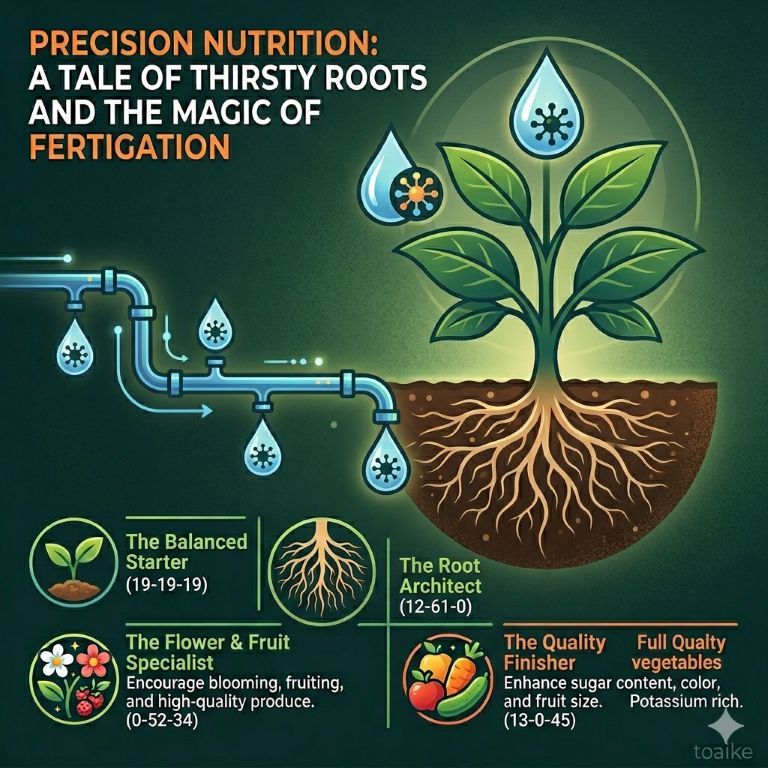
If we’ve ever tried stirring a spoonful of sand into our morning tea, we already understand why traditional granular fertilizers and modern drip irrigation systems often clash. Now imagine us as farmers, excited about installing a new and expensive drip system, only to pour a bag of conventional fertilizer into the tank. Instead of a healthy crop, we end up with clogged emitters, rising frustration, and a field that remains just as undernourished as before.
The way out of this mess lies in understanding a special class of nutrients. In modern agriculture, we call this fertigation—the simple yet powerful idea of feeding crops through irrigation. But to make this work, we can’t rely on just any fertilizer. We need products that behave like “instant coffee” for plants—completely water-soluble, clean, and immediately available.
The Chemistry of “Instant” Plant Food
In the past, we treated soil like a plate, spreading fertilizers on top and hoping water would carry them down. But plants don’t eat like we do—they drink. If nutrients don’t dissolve in water, they simply don’t reach the plant efficiently.
Fertigation-grade NPK fertilizers are designed with this exact principle in mind. They dissolve fully in water, leaving no residue behind. Chemically, these are refined crystalline or liquid salts that vanish instantly when mixed, turning irrigation water into a nutrient-rich solution that flows directly to the roots.
Instead of guessing whether nutrients will reach the plant, we ensure they do.
The All-Star Lineup: Technical NPK Grades
As we manage crops, we realize that plants don’t need the same nutrition at every stage. Just like us, their requirements change as they grow. That’s where technical NPK grades come in—they allow us to match nutrition with the plant’s exact needs.
1. The Balanced Starter (19-19-19)
When the crop is in its vegetative phase, we need steady and balanced growth. A formulation like 19-19-19 works like a multivitamin. It provides equal amounts of nitrogen, phosphorus, and potassium, helping the plant build a strong structure and healthy foliage.
When we use it through fertigation, we see uniform growth across the field—no weak patches, no uneven development.
2. The Root Architect (12-61-0)
Early in the crop’s life, our priority is root development. Without strong roots, everything else suffers.
This is where 12-61-0, or Mono Ammonium Phosphate (MAP), becomes essential. Its high phosphorus content pushes the plant to develop a deeper and stronger root system. When we apply it through fertigation, the nutrient becomes immediately available, unlike in traditional methods where phosphorus often gets locked in the soil.
3. The Flower & Fruit Specialist (0-52-34)
As the crop matures, we want it to shift from leaf growth to flowering. This transition is critical.
Using 0-52-34, or Mono Potassium Phosphate (MKP), we guide the plant toward reproduction. By removing nitrogen, we signal the plant to stop vegetative growth and focus on flowers and fruit formation. It’s a small change in composition, but a big shift in plant behavior.
4. The Quality Finisher (13-0-45)
When fruits begin to develop, our focus shifts again—this time to quality. Size, taste, color, and shelf life all matter.
Potassium Nitrate (13-0-45) helps us achieve exactly that. It improves fruit development, enhances sweetness, and strengthens the plant against stress. With the right fertigation schedule, we can produce crops that not only yield more but also look and taste better.
Why Science Supports Fertigation
When we look at research, the benefits of fertigation become even clearer. In many semi-arid regions, studies show that nitrogen use efficiency can increase from around 30% to over 60% when nutrients are delivered through drip systems.
This happens because we place nutrients exactly where the roots are. We avoid feeding weeds, reduce losses from leaching, and prevent nutrients from washing away.
There’s also a practical bonus. Some water-soluble fertilizers, especially acidic ones like urea phosphate, help clean drip systems by dissolving calcium deposits. In a way, we are feeding the crop and maintaining the irrigation system at the same time.
How We Actually Use These Fertilizers
One common misconception is that we need to buy every type of fertilizer at once. In reality, that’s not how fertigation works.
We think of these fertilizers as stage-specific tools.
At transplanting, we focus on roots and use 12-61-0. As the crop enters vegetative growth, we switch to 19-19-19. When flowering begins, we move to 0-52-34. Finally, during fruiting, we use 13-0-45 to improve quality.
We don’t stock everything. Instead, we buy what we need based on the crop stage and season. Many suppliers even offer smaller pack sizes, making it easier for us to purchase gradually. In some cases, certain crops may not require all stages—for example, leafy vegetables may rely mostly on balanced nutrition without needing flowering boosters.
The Economics Behind It
At first glance, it may seem like we are using multiple fertilizers and increasing costs. But when we look closely, the economics tell a different story.
With fertigation, we reduce wastage significantly. Nutrients are used more efficiently, which means we need less overall input. We also save on labor, avoid irrigation issues, and ultimately achieve higher yields with better quality produce.
Over time, the system pays for itself.
A Practical Way to Think About It
The simplest way to understand fertigation is to think of it as a toolkit.
We don’t carry every tool for every job. We choose the right one when the situation demands it. In the same way, we select the right fertilizer based on what the plant needs at that moment—roots, growth, flowering, or fruiting.
When we start thinking this way, farming becomes less about guesswork and more about precision.
And when we feed plants the way they actually grow—through water, at the right time, in the right form—we don’t just improve yields. We improve the entire system.