
Imagine we walk into a shop and ask for fertilizer. The shopkeeper says — “NPK 19:19:19 lo, sab kaam ho jayega.” We nod like we understood everything. We didn’t. But we bought it anyway.
Don’t worry. We are not alone. Half the farmers in India have that bag sitting in their shed right now, slightly confused about what exactly is inside it. This article is here to fix that — in plain, simple language. No chemistry lecture. Promise.
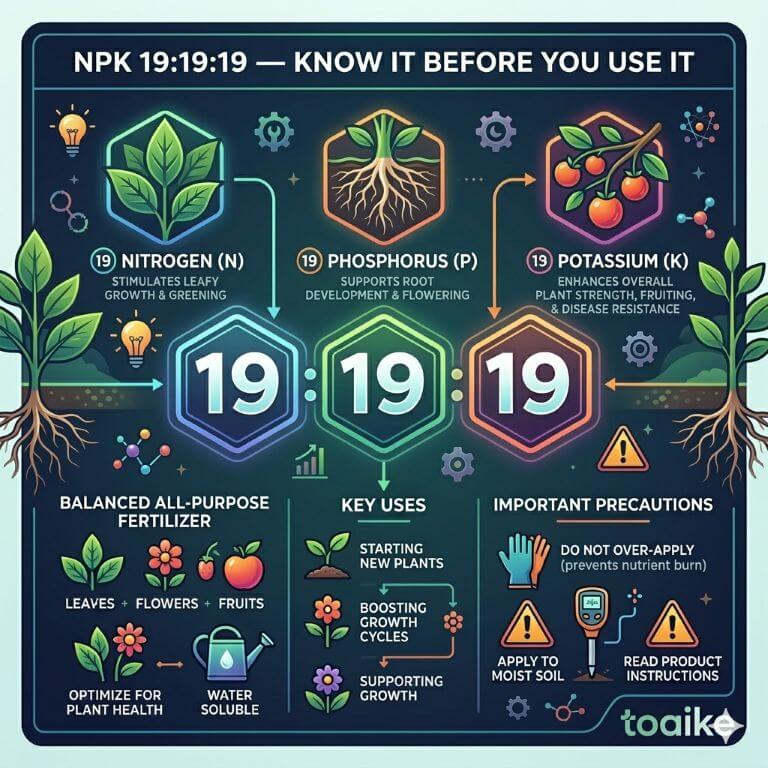
NPK 19:19:19 — The "all-in-one" fertilizer
Equal proportions of Nitrogen, Phosphorus & Potassium in a 100% water-soluble formulation
So what is it, really?
Think of NPK 19:19:19 as a thali — the kind where every item is equal. No one vegetable is more, no one is less. The number 19 means the fertilizer contains exactly 19% each of three big nutrients our crop needs: Nitrogen, Phosphorus, and Potassium. Not 20-10-5. Not 12-32-16. Exactly equal. That is what makes it special — and also why it has such a satisfying name.
And yes, it dissolves completely in water. No lumps, no residue — just a clean solution ready to feed our crop through spray or drip.
19 %
Nitrogen (N)
The “gym trainer” nutrient — makes the plant grow tall, green, and strong. Boosts leaves and shoot growth.
19 %
Phosphorus (P₂O₅)
The “foundation guy” — quietly builds roots, helps flowers form, and moves energy around the plant.
19 %
Potassium (K₂O)
The “bodyguard” — protects against disease, stress, drought, and makes fruits taste better.
Where did it come from?
NPK 19:19:19 was not invented by one person in a lab one fine morning. It grew out of the era when scientists and agri-companies started asking: “What if we gave plants all three nutrients at once, in a form they could absorb quickly?” By the turn of the millennium, as drip irrigation began spreading across our farms, big companies picked it up and brought it to us at scale. The idea was simple: less confusion, one product, balanced results.
"One bag. Three nutrients. Balanced growth."
Is 19:19:19 a brand name or a recipe?
It is a recipe. Not a brand.
Think of it like “Basmati rice” — many companies sell Basmati, but none of them own the name. Similarly, NPK ratios like 19:19:19 or 13:0:45 are open formulations. Any company that follows that nutrient ratio and gets it certified can sell it under their own label.
So when our extension worker says “use 13:0:45 at fruiting stage” — they are recommending a ratio, not a brand. We can buy whichever brand is available, affordable, and trustworthy in our area. IFFCO, Yara, Haifa, Coromandel, Multiplex, Deepak Fertilisers — they all make the same ratios, just in different packaging.
What differs between brands is purity, solubility, and price — not the fundamental nutrient ratio inside.
How do we use it?
There are three ways we can use 19:19:19 — and each one works differently:
METHOD 1
Foliar spray — directly on leaves
Mix 5 grams per litre of water. Spray during early growth stage and just before flowering. Our leaves absorb it directly and the plant feels it within days.
METHOD 2
Drip / fertigation
Mix 1.5 to 2 grams per litre. Use only during the early vegetative phase. Beyond that, we should switch to stage-specific ratios — more on this below.
METHOD 3
Basal dose — mixed into soil
Broadcast evenly or band near seed rows. Apply 2–3 weeks before sowing or at the time of sowing. Not the most efficient use but possible — read below before we try this.
Can we use it as a basal dose?
Yes, we can. But let us be honest with each other — it is a bit like using a fine silk saree to wipe a muddy plough. The saree will do the job, yes. But it deserves better work than that, and it costs too much to waste this way.
Because 19:19:19 dissolves so quickly in water, if we apply it to the soil and heavy rain arrives — a good amount of that Nitrogen will wash away before our seedling even comes up. And since it costs more than our usual DAP or MOP, we end up spending more without getting the full benefit back.
If we do use it as a basal dose — give the soil a light watering after applying. At this stage there are no roots yet, so the water is not meant to “reach the roots.” What it does is bind the fertilizer into the soil so it does not sit exposed on the surface, where Nitrogen can escape into the air or wash away in the first rain. By the time our seedling’s roots develop and start exploring downward, the nutrients will already be waiting there for them.
Is 19:19:19 the best choice for drip?
It works through drip, but it is not the smartest choice for the full season. Our crop needs different nutrients at different stages of its life. If we keep giving equal N, P, and K all the way through, we end up pushing too much Nitrogen during flowering and fruiting — which can actually work against us. Also, Phosphorus barely moves in soil, so much of that 19% P tends to stay right at the drip emitter and does not travel far into the root zone.
A smarter plan is to use 19:19:19 only as an early-season starter through drip, then shift to what our crop actually needs:
Early vegetative — use 19:19:19 here
19:19:19
This is where it belongs. Balanced start for young plants getting established.
ACTIVE vegetative
20:20:20
Similar balance, often cheaper. Good for sustained leafy growth.
FLOWERING
12:61:0
or
0:52:34
High Phosphorus triggers flower initiation. This is when our crop decides how many flowers to set.
FRUITING / GRAIN FILL
13:0:45
High Potassium improves fruit size, colour, and quality. This is where our income gets decided.
RIPENING
0:0:50
Pure Potassium for sweetness, colour, and shelf life before we harvest.
Remember — none of these are brand names. They are all open nutrient ratios made by multiple companies. We can ask our local dealer for whichever brand is available in that ratio at a fair price.
Also, the ratios listed above are not a shopping list — they are simply the range of water-soluble fertilizer options available in the market for different crop stages. Every farm is different. Before we decide which ones to use and when, we should get our soil tested and consult our nearest Krishi Vigyan Kendra (KVK) or the District Agriculture Department. They will give us a plan that fits our crop, our soil, and our budget — not a one-size-fits-all recommendation.
The good and the not-so-good
What works in its favour
- Gets absorbed fast — our plants do not have to wait
- Gives all three big nutrients in one go — no juggling bags
- Works through spray, drip, or soil — very flexible
- Great starter for young, newly planted crops
Where it falls short
- Costs more than Urea or DAP per unit of nutrient
- Leaches away quickly in heavy rain if applied to soil
- Not stage-specific — our fruiting crops need more Potassium later
- Cannot be our only fertilizer for the full season
Which crops love it most?
The short answer: almost everything we grow. It really shines during the early growth stage — when our plant is young and needs a balanced push to get going.
Which soils suit it?
- Sandy soils — replenishes nutrients that leach out
- Clay soils — unlocks nutrients in heavy, tight soils
- Loamy soils — keeps nutrition balanced and steady
The Bottom Line
PK 19:19:19 is like a good all-rounder cricketer — useful at every position, but not always the specialist we need at the end. Let us use it confidently during early and vegetative growth. As our crop moves to flowering and fruiting, we should switch to fertilizers with higher Potassium — like 0:52:34 or 13:0:45 — for better produce quality. Use it as part of a plan, not as a shortcut to skip soil testing.
