
Picture this.
It is 6 in the morning. The sun is just coming up. We have mixed what feels like a perfectly scientific cocktail into our spray tank — Nano DAP, a pinch of Zinc Sulphate, maybe some Iron too. We are feeling like a chemist. A farming genius, honestly.
We turn on the drone. It takes off beautifully.
And then — nothing. The nozzle is blocked. We look inside the tank and find a grey-white sludge sitting at the bottom like it owns the place.
Our genius moment is over. The sludge won.
Here is what actually happened inside that tank — and how one word on a label makes sure it never happens again.
So What Was That Sludge, Really?
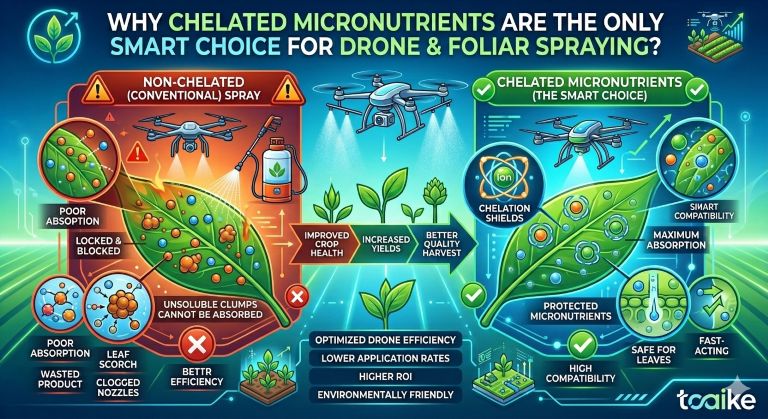
When we mix Zinc Sulphate or Iron Sulphate into a tank that already contains Nano DAP or any phosphatic fertilizer, a chemical reaction begins almost immediately — and nobody invites it.
Zinc and Iron are highly reactive minerals. The moment they enter the water, they start looking for something to bond with. And right there in the tank, sitting in plenty, is phosphate from the DAP. They find each other, bond enthusiastically, and form insoluble compounds — the kind that do not dissolve no matter how much we stir, how long we wait, or how many times we mutter under our breath.
The result? That grey-white sludge. Clogged nozzles. Uneven spraying across our field. Nutrients that never reached the plant. Money that walked out the door.
This is not a mixing mistake. It is pure chemistry — and it will happen every single time unless we change one thing.
Enter the Chelate — The Bodyguard Our Mineral Never Had
The word chelated (pronounced kee-lay-ted) comes from the Greek word chele, which means ‘claw.’
Think of a chelated nutrient as a mineral — Zinc or Iron — that has been gripped and wrapped by a larger organic molecule called a chelating agent. The most widely used chelating agent is EDTA, which stands for Ethylenediaminetetraacetic Acid. Another important one is EDDHA — Ethylenediamine-N,N’-bis(2-hydroxyphenylacetic acid) — which is particularly effective in alkaline and calcareous soils.
The chelating agent does one very important job: it wraps itself around the mineral like a protective shell. It keeps the Zinc or Iron from ‘seeing’ anything else in the tank — including the phosphate.
No contact. No reaction. No sludge. No drama.
❌ Without Chelation
Like an open magnet dropped into a box of iron filings.
The moment it enters the water, it latches onto everything it can — especially the phosphate. The result is sludge at the bottom and a blocked nozzle at the top.
✅ With Chelation
The same magnet, but inside a snug plastic case.
It cannot bond with anything in the tank. It travels safely all the way to the plant leaf — and only releases the mineral once it is inside the plant cell, where it is actually needed.
What Happens Inside the Plant — The Release
Here is where it gets genuinely interesting.
When a chelated mineral reaches the plant leaf and is absorbed, the chelating agent does not stay attached forever. Inside the plant cell, where the chemistry is different, the chelator lets go. It releases the mineral — Zinc, Iron, or whichever nutrient we applied — exactly where the plant needs it most.
Compare that with a non-chelated mineral applied as a foliar spray. It may react with compounds on the leaf surface before it even enters. Or it may get ‘locked out’ by competing ions. Much of it never reaches the cell at all.
Chelated micronutrients give the plant a complete, protected delivery. Like a sealed tiffin box that arrives hot — instead of a plate of food carried open through a dust storm.
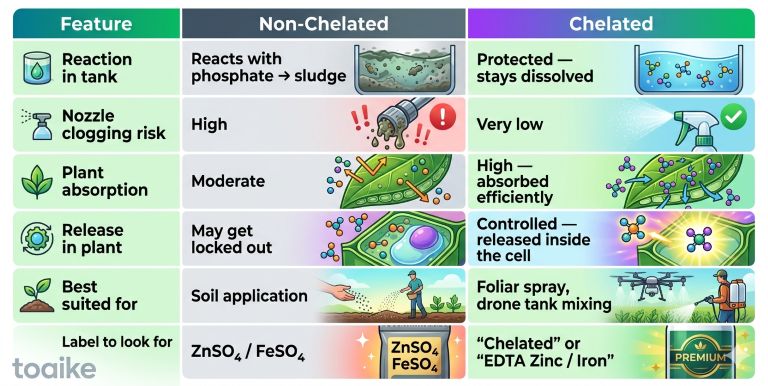
Chelated vs. Non-Chelated: The Honest Comparison
What to Look for When We Buy
The label is everything. Before we mix any micronutrient into a spray tank with a phosphatic fertilizer, look for these specific words:
- “Chelated” — printed clearly on the front of the pack.
- “EDTA Zinc” or “EDTA Iron” — for most soils and most crops.
- “EDDHA Iron” — specifically for hard, alkaline, or calcareous soils where EDTA iron loses its effectiveness. EDDHA stands for Ethylenediamine-N,N’-bis(2-hydroxyphenylacetic acid) and it holds iron stable even at high soil pH levels.
- “Water Soluble” — confirming it will stay dissolved in our tank.
Plain Zinc Sulphate (ZnSO₄) and Ferrous Sulphate (FeSO₄) are perfectly good inputs — for direct soil application. They are not the right choice for a spray tank that already has phosphatic fertilizers in it.
⚠️ FarmTruth
Chelated micronutrients cost more per kilogram. No point pretending otherwise. But here is the maths a dealer will never do for us: the cost of a clogged sprayer, wasted inputs, a delayed spray window, and uneven nutrition across our standing crop is almost always far higher than the difference in price.
Calculate the real cost. Then decide.
Common Chelated Micronutrients and Their Best Uses
Zinc
Chelated Form
EDTA Zinc 12%
Best For
Rice, Wheat, Maize, Cotton
Iron
Chelated Form
EDTA Iron 6%
Best For
Paddy, Groundnut, Vegetables
Iron (alkaline soils)
Chelated Form
EDDHA Iron 6%
Best For
Hard, calcareous soils — most of peninsular India
Manganese
Chelated Form
EDTA Manganese
Best For
Soybean, Pulses
Copper
Chelated Form
EDTA Copper
Best For
Vegetables, Fruit crops
Boron
Chelated Form
Soluble Boron 20%
Best For
Oilseeds, Fruits
Naturally water-soluble — no chelation needed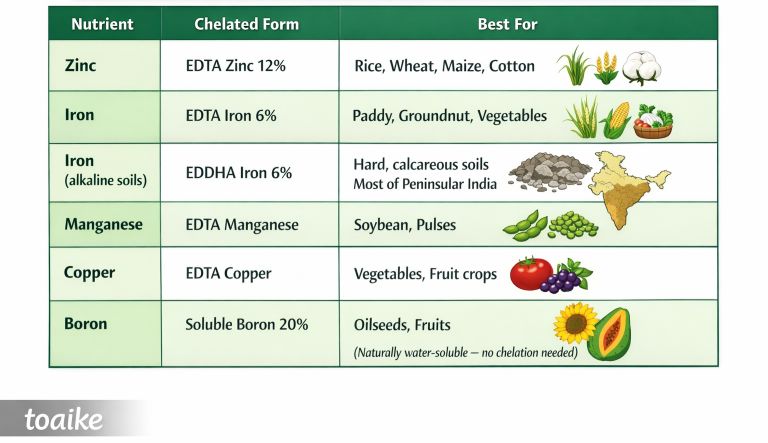
Note: This table is for quick reference. Readers are encouraged to search the web or consult local advisories for detailed recommendations.
The Bottom Line
Nobody told we any of this when we bought that bag of Zinc Sulphate. The sludge in our tank was not our fault — it was missing information.
Now we have it.
One word on the label — Chelated — separates a spray that works from a tank full of expensive grey paste. When we are working with a drone, where every drop counts and every nozzle matters, that one word does a lot of heavy lifting.
Read the label. Ask the question. And leave the sludge in the past where it belongs.
