
Fertilizer Burn
Imagine spending weeks preparing your field, carefully tending your seedlings — and then watching them wilt and brown within days of your first fertilizer application. No pest. No disease. No drought. Just a bag of something that was supposed to help, doing the exact opposite.
That scenario plays out on farms and in gardens around the world every growing season, and the culprit has a surprisingly simple name: fertilizer burn. Understanding what it is, why it happens, and which products carry the greatest risk can spare you a costly, heartbreaking season.
What is Fertilizer Burn ?
Fertilizer burn is not heat damage — no flames are involved. It is, at its core, a water crisis triggered by chemistry. Most fertilizers are composed of salt-based compounds. When these salts dissolve in soil moisture, they raise what scientists call osmotic pressure — the force that determines which direction water flows across the thin membranes surrounding plant root cells.
Under healthy conditions, the fluid inside root cells is slightly saltier than the surrounding soil, so water naturally moves inward, keeping the plant hydrated and nourished. Apply too much fertilizer, however, and the balance reverses: the soil outside the roots becomes saltier than the inside of the cells. The plant’s own biology then pulls water outward rather than inward — and the crop begins to dehydrate despite sitting in moist soil.
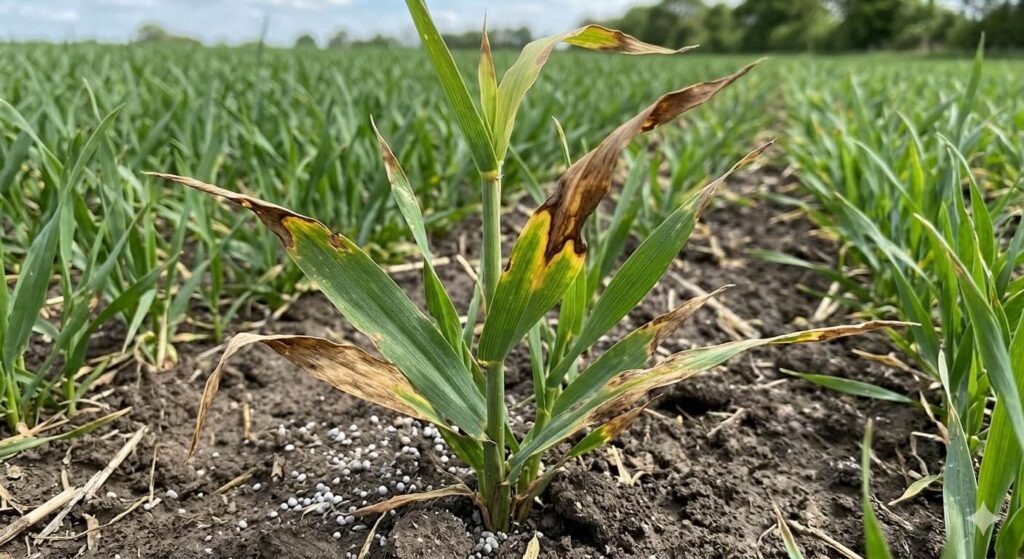
In plain terms: fertilizer burn is your plant dying of thirst in a puddle — because the chemistry of the soil won’t let it drink.
This process — water moving from low-salt to high-salt zones — is called osmosis, and it governs virtually every living cell on earth. When fertilizer disrupts it, the downstream effects are rapid and visible: wilting, browning, root decay, and, in severe cases, total plant death.
The Five Pathways to Fertilizer Burn
Fertilizer burn does not happen randomly. It follows five distinct patterns, each rooted in the same underlying chemistry:
- Too much fertilizer overall — excess salts accumulate faster than water can dilute them, overwhelming the root zone.
- Fertilizer with an inherently high salt index — some products are far saltier than others by their very chemistry, regardless of dose.
- Right product, insufficient water — even a correctly dosed fertilizer becomes dangerous when rainfall or irrigation is scarce, concentrating salts in the top soil layer.
- Excess nitrogen — nitrogen overload interferes with the plant’s ability to produce and use carbohydrates, disrupting cellular respiration from within.
- Ammonia accumulation — certain nitrogen-rich products release free ammonia gas, which penetrates root tissue directly and causes rapid internal damage.
Any one of these five pathways can trigger burn independently, but they often combine — for example, a high-nitrogen fertilizer applied in a dry spell on sandy soil, where salts concentrate quickly and water drains fast.
Which Fertilizers Carry the Highest Risk ?
Every fertilizer is assigned a salt index — a standardised score measuring how strongly it raises osmotic pressure relative to sodium nitrate, which serves as the benchmark at 100. The higher the index, the greater the burn potential. Nitrogen and potassium compounds consistently score highest; phosphorus products score lowest.
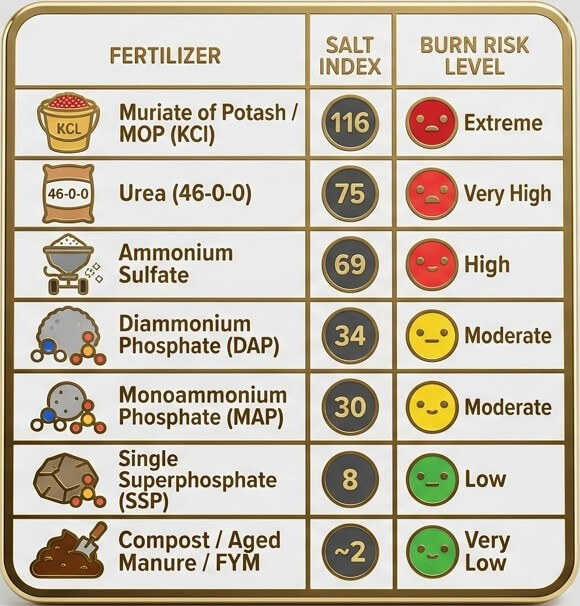
Important: A salt index above 20 is considered potentially hazardous for sensitive crops. Muriate of Potash (MOP) — India’s primary potassium fertilizer — scores 116, the highest on this list. Urea, the country’s most widely consumed fertilizer, scores 75. Both demand careful dosing and thorough watering after application.
Nitrogen & Burn Risk: Chemical Vs. Organic Inputs
Nitrogen is the nutrient most frequently linked to fertilizer burn — but not all nitrogen sources carry equal risk. Understanding the difference between chemical and organic nitrogen is one of the most practically useful things an Indian farmer can know.
Chemical Nitrogen — Fast, Potent, and Burn-Prone
Chemical nitrogen fertilizers such as urea (46-0-0), DAP, and ammonium sulfate release nitrogen almost immediately after contact with soil moisture. Urea, for instance, is hydrolysed by soil enzymes within just one to four days, flooding the root zone with a large, sudden dose of ammonium. This rapid availability is precisely what makes chemical nitrogen effective — and precisely what makes it dangerous when over-applied. The high salt indexes of these products (urea scores 75, ammonium sulfate 69) raise osmotic pressure in the soil quickly, and if the dose is even slightly excessive, burn follows fast.
Organic Nitrogen — Slow, Gentle, and Far Safer
Organic nitrogen sources used widely across Indian farms — Farmyard Manure (FYM/gobar), vermicompost, poultry manure, neem cake (neem khali), oilseed cakes from castor, groundnut or mustard, green manure crops like dhaincha and sunhemp, and biofertilizers such as Rhizobium and Azotobacter — behave in a fundamentally different way. Their nitrogen is locked inside organic matter and can only be released after soil microbes break down that material. This process is slow, gradual, and governed by soil temperature and biological activity — it cannot flood the root zone all at once.
The result is that organic inputs carry very low salt indexes and very low burn potential. A field that receives well-composted FYM, neem cake, or vermicompost at sensible rates is receiving a timed, steady supply of nitrogen — not a sudden chemical surge. This is why organic farmers rarely encounter fertilizer burn, and why agronomists consistently recommend shifting towards organic inputs as a long-term strategy for soil health and burn prevention.
The key distinction: Chemical fertilizers like urea act within days and can burn crops quickly if over-applied. Organic inputs like FYM and neem cake release nitrogen over weeks to months — making them significantly safer for soil, roots, and the broader farm ecosystem.
One practical note: even organic inputs should be applied at recommended rates, and fresh unaged manure should always be composted for at least 90 days before use. Raw manure can release free ammonia in concentrated form, which is the exception to the organic-is-safe rule. But properly composted and processed organic materials are among the best tools an Indian farmer has — both for feeding crops and for preventing burn.
Reading The Warning Signs
Fertilizer burn follows a recognisable progression. Catching it early dramatically improves recovery chances.
Above Ground — Foliage & Stems
- Yellowing or browning beginning at leaf tips and edges, spreading inward as damage intensifies
- Leaf texture becomes brittle, papery, or crunchy — in contrast to the soft wilting caused by simple drought
- Wilting that persists even after watering, because the root system can no longer absorb available moisture
- Sudden, widespread leaf drop with little prior warning in severe cases
- Stunted or completely halted new growth
Below Ground — Root System
- Roots turn dark brown or black and feel soft rather than firm — a sign of osmotic root damage
- Root rot may develop as secondary infections exploit compromised tissue
On Lawns
- Distinct yellow or brown patches tracing the exact path of the spreader or application equipment
- Grass blades feel dry and crisp to the touch rather than soft
- Streaked or checkerboard discolouration where spreader passes overlapped
- White salt crust visible on soil surface, particularly in containers or raised beds
Speed of onset matters: fast-release synthetic fertilizers can produce visible symptoms within two to three days. Slow-release or coated products may take two weeks before damage becomes apparent — by which time the problem is often more advanced.
Conditions That Amplify The Damage
The same fertilizer dose that causes no harm under ideal conditions can devastate a crop when environmental stressors are present. The following situations significantly raise burn risk:
- Dry or sandy soils — less water in the profile means salts concentrate faster and at higher intensity around the roots.
- Hot weather — elevated temperatures accelerate water loss through leaves, deepening drought-like stress even as salts accumulate.
- Application to wet foliage — fertilizer granules that land on damp leaves dissolve directly onto leaf tissue, causing contact burn.
- Already-saline soils — fields with existing salt accumulation from poor drainage or repeated heavy applications have reduced tolerance to any additional salts.
- Stressed or heat-affected plants — crops already under pressure from sun, disease, or prior drought have depleted reserves and can tolerate far less osmotic disruption.
- Cold soils — root growth slows dramatically in cold conditions, so roots remain in contact with concentrated fertilizer for longer periods.
How To Treat Fertilizer Burn: The Recovery Plan
If you spot the signs, do not wait. Speed of response directly determines whether a crop recovers fully, partially, or not at all.
- Irrigate deeply and immediately. The goal is to push accumulated salts downward and away from the root zone. Apply enough water to thoroughly saturate the soil profile, and repeat over several consecutive days.
- For potted or container plants: flush water through the pot until it flows freely from the drainage holes. If white salt crust is visible on the soil surface, remove the top centimetre of growing medium and replace it. In severe cases, repotting entirely in fresh mix is the best option.
- Collect any undissolved granules. If spilled fertilizer is still visible on the soil surface, carefully remove it before it dissolves further.
- Manage runoff responsibly. Salt-laden runoff from flushing can harm adjacent plants or enter waterways. Direct drainage away from sensitive areas.
- Suspend all fertilization. Do not apply further nutrients until the plant shows clear signs of new, healthy growth — typically several weeks after flushing.
For lawns: repeat deep watering sessions over one to two weeks. Allow the turf to rest and do not mow stressed areas until visible recovery begins.
If root tissue is completely blackened and soft throughout, recovery may not be possible. When replanting the same bed, water the site thoroughly multiple times over several days before introducing new seeds or transplants.
Prevention: Building a Burn free Approach
The overwhelming majority of fertilizer burn cases are avoidable. These eight habits, applied consistently, can essentially eliminate burn risk from a farm or garden:
- Test your soil before every season. Soil analysis tells you what nutrients are already present, preventing unnecessary additions and guiding precise dosing.
- Follow product label rates without exception. Labels are calibrated through agronomic research; treating them as conservative suggestions is a common and costly mistake.
- Prefer slow-release or organic products where feasible. These release nutrients gradually, keeping soil salt levels stable and manageable throughout the season.
- Water thoroughly after every granular application. Adequate moisture dilutes salts and moves them to a zone where roots can safely absorb nutrients without osmotic stress.
- Never fertilize onto wet foliage. Granules that cling to moist leaves dissolve directly onto the surface, causing contact burn regardless of soil conditions.
- Avoid fertilizing during heat waves or dry spells. Applying fertilizer when plants are already water-stressed stacks two stressors simultaneously, dramatically increasing vulnerability.
- Use split applications. Dividing the total seasonal dose into smaller applications spread across the growing period keeps soil salt levels consistently low.
- Track all nitrogen inputs together. Count nitrogen from every source — manure, compost, amendment, and synthetic product — as part of a single cumulative budget.
The Bottom Line
Fertilizer is one of the most useful tools in farming, but it must be used carefully. Think of it like serving food to a guest at a wedding. If you give the right amount, the guest is happy. Too little, and they feel unsatisfied. Too much, and they feel uncomfortable. Crops behave in a similar way. They need nutrients, but only in the right quantity. Plants cannot tell you when you have given them too much fertilizer. Instead, they show problems later, often at the worst time during the growing season.
So it is important to treat fertilizer like a strong spice in cooking—use it with care and measure it properly. Farmers who test their soil and follow fertilizer recommendations usually get better harvests than those who simply add more fertilizer and hope for good results. When you understand the science, watch your crops closely, and apply fertilizer in the right way, your crops will grow well. But if fertilizer is used without care, the field may end up looking less like a productive farm and more like an expensive experiment that did not work.