
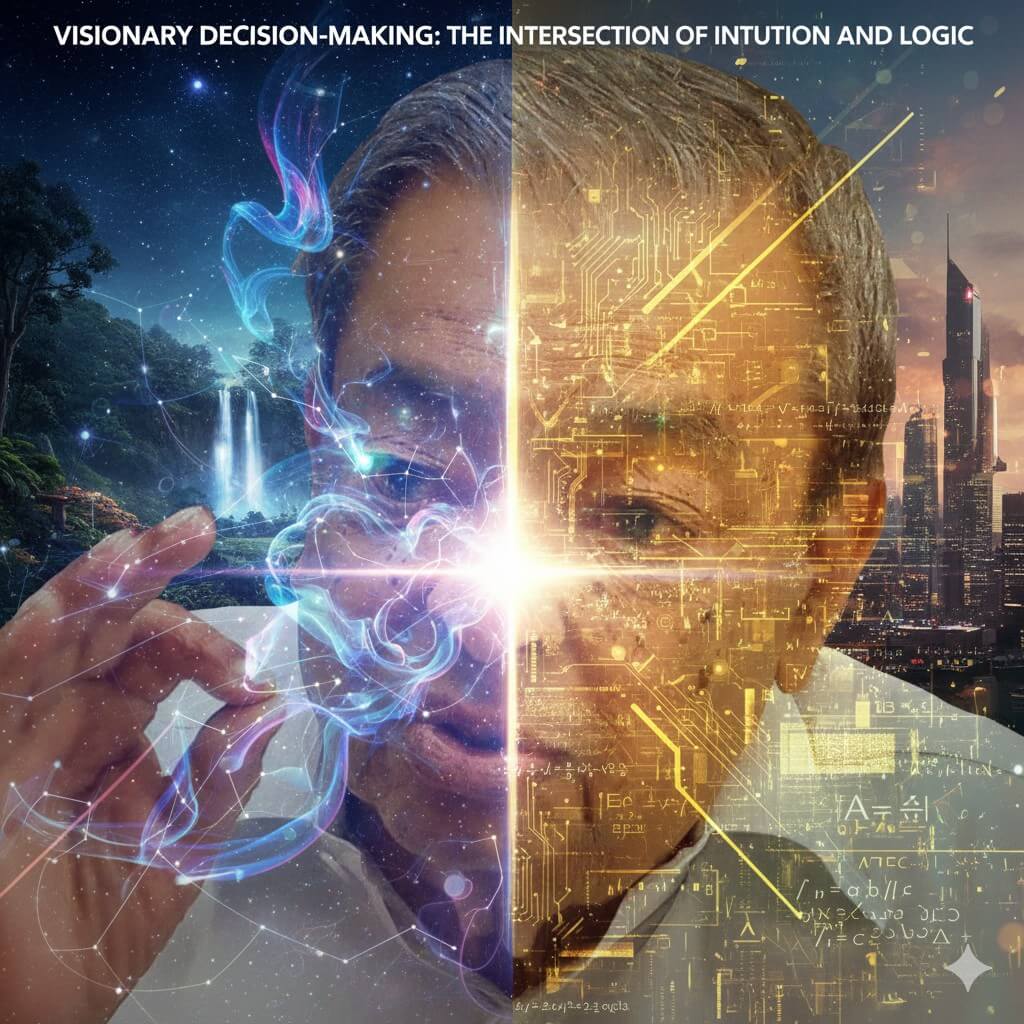
Visionary decision-making represents the art of making transformative choices that reshape futures and redefine possibilities. It emerges not from pure analytical reasoning alone, nor from unbridled intuition, but from the dynamic synthesis of both. Throughout history, the most impactful decisions have been made when gut instinct meets rigorous analysis, when inspiration encounters validation. The most transformative decisions in history didn’t come from people who simply followed data or ignored reality. Instead, these breakthrough moments happened when someone trusted their gut feeling and backed it up with solid reasoning.
History shows this clearly. When Galileo Galilei argued that the Earth was a sphere and not the center of the universe, he faced enormous resistance. His ideas were dismissed because they challenged long-held beliefs. Yet his willingness to question popular assumptions led to a deeper understanding of our world. Einstein’s journey followed a similar pattern. He started with doubts about the physics of his time and kept challenging familiar concepts. His doubts opened doors to insights that shaped modern science. In both cases, disagreement and curiosity, not comfort, pushed thinking forward.
Intuition and logic both play powerful roles in how we understand and act. Intuition is that quick inner signal that whispers, “Something is off,” even when we can’t yet explain why. Logic is the deliberate process of examining facts and connecting them step by step. Neither works well without the other. Intuition can guide us toward a direction, but logic helps verify whether that direction is right. Logic can analyze information, but intuition often sparks the first insight. In daily life, we rely on both more than we realize—choosing a career, judging people’s intentions, making financial decisions, or sensing that a situation needs attention even before we have all the data.
At the personal level, these two abilities grow through regular practice. We sharpen intuition by exposing ourselves to new ideas, reflecting on past experiences, paying attention to emotional cues, watching how people behave, and staying curious. Over time, the mind starts recognizing subtle patterns. Logic develops through reading, asking questions, organizing our thoughts, breaking problems into smaller steps, and being honest about evidence rather than guesswork. When we form a habit of combining a gut feeling with a quick mental check—“Why do I feel this way?” “What supports this thought?”—our decisions become clearer and stronger.
Great leaders use this balance beautifully. Verghese Kurien, the force behind India’s White Revolution, had strong instincts about the potential of farmer-run cooperatives. He sensed that rural communities could transform their own future if they controlled the supply chain. But he didn’t rely on instinct alone. He studied existing models abroad, analyzed what worked, adapted ideas to Indian conditions, and built systems grounded in data and transparency. His intuition helped him recognize possibilities early; his logic turned those possibilities into reality.
Nandan Nilekani’s contribution to AADHAAR shows the same blend. His intuition told him that identity was not just a bureaucratic formality but a powerful tool for inclusion. Yet he approached the project with careful analysis, building a digital infrastructure that could withstand scale, security needs, and future expansion. It was a mix of instinctive vision and disciplined planning that made the system reliable and transformative.
The environments we live and work in deeply influence how well we can think. If intuition is brushed aside as emotional or if logic is treated as slow and unnecessary, genuine insight gets blocked. The best workplaces encourage both: a place where people can express early worries or ideas without fear, and then examine them through reasoning and evidence. Even simple practices help, such as encouraging someone to question a plan, imagining what could go wrong before acting, or trying small experiments before committing to big decisions. These habits protect creativity while reducing avoidable mistakes.
Timing, too, shapes thinking. Acting too early can be risky, and waiting too long can be equally harmful. Intuition often signals when something requires immediate action, even without full information. Kurien acted quickly when farmers were struggling because delay would have only deepened their crisis. On the other hand, some decisions demand slow, patient thinking. Nilekani’s team spent months refining the technical backbone of Aadhaar before enrolling a single person because the system had to be strong from the start. Knowing when to move fast and when to slow down is a skill that comes from observing situations carefully and trusting both instinct and reason.
In our own lives, the same rhythm matters. Some choices—like stepping away from a harmful friendship or seizing a sudden opportunity—need a quick response. Others, like switching careers, making investments, or choosing long-term commitments, benefit from calm analysis. The more we practice listening to our inner signals and then checking them with facts, the more confident and accurate our decisions become.
What truly strengthens thinking is the willingness to let our ideas be tested. When someone challenges our view, it may feel uncomfortable, but that discomfort sharpens understanding. It forces us to explain our reasoning, notice weak spots, or sometimes even change our minds. Thinking is not about always being right; it is about refining our ability to see clearly. Galileo and Einstein did not fear doubts—they welcomed them. That openness allowed their ideas to grow stronger than opposition.
In the end, thinking is not a solo act. It is shaped by intuition, logic, timing, conversation, and the courage to question. When we engage with different viewpoints, when we let instinct and analysis work together, when we learn from the experiences around us, our understanding deepens. Anyone can cultivate this ability. It starts with curiosity, honesty, and the willingness to think beyond the first answer.
