
The Workplace Balancing Act: Why Too Much Work Burns People Out and Too Much Fun Burns Money
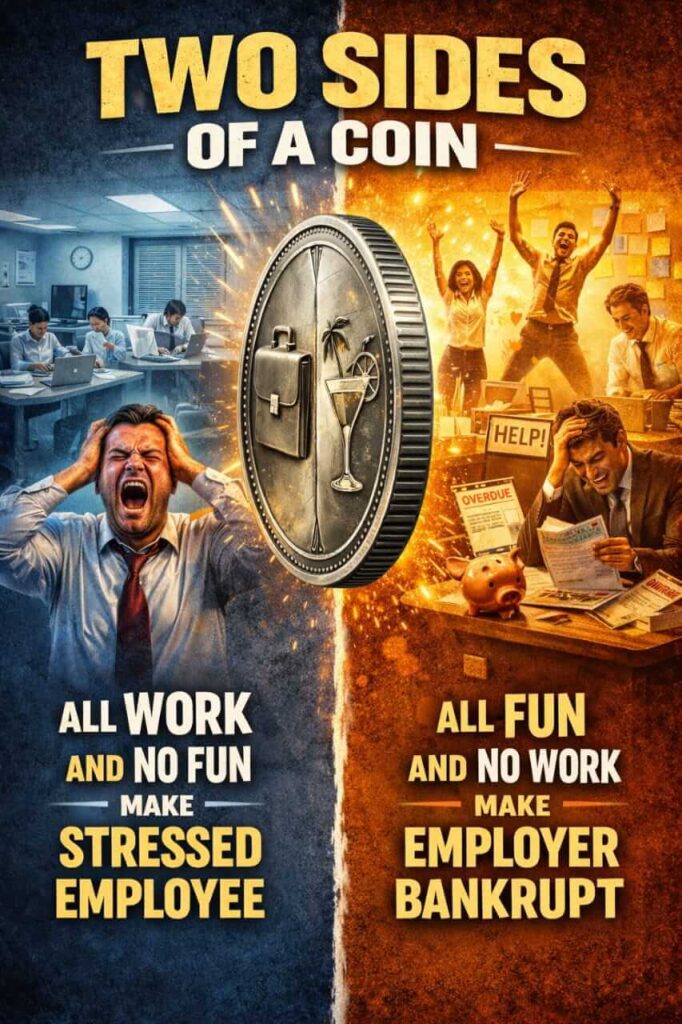
We’ve all heard the saying “all work and no play makes Jack a dull boy.” But here’s the flip side nobody talks about enough: all play and no work makes Jack’s boss go bankrupt.
It sounds like a joke, but this tension sits at the heart of every workplace debate about culture, productivity, and success. Push employees too hard, and you’ll watch them crumble. Let things get too relaxed, and you’ll watch your business crumble instead.
So where’s the middle ground? Let’s dig into both extremes, look at real companies that learned these lessons the hard way, and figure out what actually works.
The "All Work" Trap: When Grinding Becomes Destroying
Picture this: It’s 11 PM on a Friday. Sarah, a marketing analyst, is still at her desk finishing a report that’s due Monday. She skipped lunch, again. Her phone keeps buzzing with Slack messages from her manager. She hasn’t seen her friends in weeks, and her gym membership is basically a monthly donation at this point.
This isn’t a horror story.
For millions of people, this is just another workday.
What Happens When Work Consumes Everything
When companies adopt an “always on, always hustling” mentality, they think they’re maximizing productivity. In reality, they’re lighting money on fire, just slowly enough that they don’t notice the smoke at first.
Here’s what actually happens:
Burnout becomes the norm. Employees stop caring. They’re physically present but mentally checked out. That enthusiasm they had on day one? Gone. Now they’re just surviving until the weekend, counting down the hours.
Quality tanks. Exhausted people make mistakes. A tired developer writes buggy code. A sleep-deprived doctor misses a diagnosis. An overworked designer rushes through a project and delivers mediocre work. You can’t squeeze creativity and excellence out of someone running on fumes.
People quit, and they don’t come back. The cost of replacing an employee is typically 50-200% of their annual salary. When your best people burn out and leave, they take years of knowledge and relationships with them. Plus, they’ll probably warn their talented friends to avoid your company like the plague.
Health problems spike. Stress causes real physical damage. Heart disease, anxiety, depression, weakened immune systems. Some companies have literally worked people into early graves, and that’s not hyperbole.
These aren’t just theoretical concerns or worst-case scenarios. They’re documented patterns that have played out across industries and continents. Major corporations, prestigious financial institutions, and tech giants have all faced the consequences of pushing employees beyond sustainable limits. The following examples show what happens when the “always hustle” mentality goes too far.
Examples of the ‘All Work’ culture
Amazon (headquartered in Seattle, Washington), the e-commerce and cloud computing giant that delivers millions of packages daily, saw its warehouse workers become poster children for workplace stress. Reports emerged of employees facing extreme time pressures with minimal breaks, leading to concerning workplace practices. Injury rates soared. Turnover hit 150% annually at some facilities, according to a New York Times investigation, meaning the company had to replace its entire warehouse workforce every eight months. The situation drew sustained public attention and debate.
Goldman Sachs (headquartered in New York City), one of the world’s leading investment banking and financial services firms, saw its junior analysts make headlines in 2021 when a leaked survey showed them working 100-hour weeks with declining mental and physical health. These weren’t lazy complainers; these were top graduates from elite schools being ground into dust. The outcry forced the entire Wall Street industry to promise reforms.
Foxconn (headquartered in New Taipei City, Taiwan), the world’s largest electronics contract manufacturer that produces devices for Apple and other tech giants, installed suicide nets on their buildings in 2010 after multiple worker deaths. Think about that for a second. A company had to install nets to catch people trying to jump off buildings because the work pressure was so crushing. That’s not productivity. That’s tragedy.
Tesla (headquartered in Austin, Texas) and SpaceX (headquartered in Hawthorne, California), Elon Musk’s electric vehicle and space exploration companies, are widely known for operating at an exceptionally high intensity, with workweeks during peak periods often extending to 80–100 hours. This demanding pace, driven by ambitious goals and tight timelines, is experienced differently across individuals—some employees find it motivating and aligned with their personal drive, while others find it difficult to sustain over the long term, particularly alongside family or personal commitments.
Another recent example of the costs of over-optimization comes from the airline industry. In December 2025, India’s largest airline, IndiGo, experienced widespread flight cancellations and delays affecting thousands of passengers after it faced a shortfall of just over 120 pilots amid evolving rostering rules and a busy travel season. Despite operating around 2,200 flights daily, the imbalance between crew availability and scheduled flying highlighted how lean staffing strategies and intense operational pressure can leave systems vulnerable to stress, especially when regulatory changes or unexpected demand shifts occur. The resulting disruptions triggered prolonged delays across major airports, significant inconvenience for travellers, and public scrutiny of the airline’s planning processes, illustrating how pushing operational efficiency too far without adequate buffers can create cascading problems.
The broader takeaway is that when elevated workloads become a consistent norm rather than a temporary phase, pressure tends to accumulate over time, often affecting people, processes, and overall effectiveness.
These are just a few prominent examples of the “all work” extreme. There are numerous other cases from companies around the world that illustrate both sides of this coin, and they can be easily researched online for anyone wanting to dive deeper into specific industries or situations.
The "All Fun" Trap: When Startups Forget They're Actually Businesses
Now let’s swing to the other extreme.
Picture a different office: There’s a fully stocked bar in the kitchen. Ping-pong tables in the break room. Unlimited vacation policy. Catered lunches every day. A “relaxed” approach to deadlines. Friday afternoon happy hours that turn into Monday morning hangovers.
Sounds pretty great, right? Here’s the problem: companies aren’t summer camps. At some point, someone has to do actual work that generates actual revenue.
When the Party Becomes the Priority
Companies that go overboard on “culture” and “fun” often make a fatal mistake: they confuse perks with performance. They think that if employees are happy and comfortable, success will naturally follow.
Sometimes it does. But more often, here’s what happens instead:
Nobody’s really accountable. When the culture is all about keeping things chill and fun, it becomes awkward to hold people to standards. Deadlines slip. Quality slides. But hey, at least everyone’s vibes are good, right? Until the company runs out of money.
Spending spirals out of control. Free food, expensive office space, lavish parties, unlimited perks. It all costs money. If the company isn’t generating enough revenue to cover these costs, it’s just burning through investor cash with a smile.
The wrong people thrive. A culture with no accountability attracts people who are great at looking busy and having fun, but not necessarily great at doing difficult, important work. Your star performers might even leave because they’re frustrated carrying people who coast on culture.
Reality hits like a truck. When the money runs out or market conditions change, these companies have no muscle memory for operating lean. They’ve never had to make tough decisions or prioritize ruthlessly. The transition is brutal.
The “all fun” problem is less visible than burnout because these companies often look successful from the outside—right up until they collapse. They have buzzworthy launches, exciting office spaces, and enthusiastic teams. But underneath the surface, the fundamentals are crumbling. Let’s look at some high-profile examples of companies that learned this lesson the expensive way.
Examples of Companies That Struggled After Prioritizing Perks Over Fundamentals
WeWork (headquartered in New York City), the co-working space provider that rents flexible office spaces to freelancers and companies, is a widely cited cautionary example. The company offered beer on tap, beautiful spaces, community events, and a mission-driven culture that made people feel like they were changing the world. Meanwhile, the actual business model was fundamentally unprofitable: they were signing long-term leases and offering short-term sublease arrangements, losing money on nearly every transaction.
When investors finally looked at the numbers in 2019, WeWork’s $47 billion valuation collapsed almost overnight. The planned IPO was ultimately withdrawn. Thousands lost their jobs. The company barely survived.
Pets.com (headquartered in San Francisco, California), an online pet supply retailer from the dot-com era, i.e. late 1990s, spent money like it was going out of style during the dot-com boom. Their Super Bowl commercials cost more than their quarterly revenue. They had parties, perks, and plenty of media buzz. What they didn’t have was a viable business model. The company went from IPO to liquidation in 268 days, becoming a symbol of late-90s excess.
Groupon (headquartered in Chicago, Illinois), the daily deals platform connecting local businesses with consumers through discounted offers, grew insanely fast in the early 2010s with aggressive hiring, party culture, and a fun workplace. But underneath the surface, there wasn’t enough operational discipline. When growth slowed, the lack of sustainable business practices became obvious. The stock price fell sharply, and the company’s influence and scale diminished compared to its earlier peak.
Quirky (headquartered in New York City), a product development platform that crowdsourced inventions from community members, raised $185 million to build a “community-driven” invention platform. The culture was creative and engaging, and the mission was inspiring. But the invention process was more about community feel-good moments than profitability. Each product lost money, but the company continued investing heavily in culture and community initiatives until the money ran out. They filed for bankruptcy in 2015.
Zynga (headquartered in San Francisco, California), the social gaming company behind hits like FarmVille and Words With Friends, created a fun workplace with all the startup perks. Behind the scenes, though, leadership was weak, game quality suffered, and the company relied on metrics that later drew investor scrutiny. After a disappointing IPO, the stock collapsed by 75%.
Here’s the truth: these companies didn’t fail because they were too fun. They failed because they prioritized appearing successful over actually being sustainable. The perks were a distraction from fundamental problems.
So we’ve seen both sides now: companies that worked their people into the ground and companies that partied their way to bankruptcy. At first glance, these seem like opposite problems requiring opposite solutions. But look closer, and you’ll notice something interesting—both approaches are making the same fundamental mistake.
Why Both Extremes Are Dead Ends
Here’s what’s fascinating: both approaches fail for surprisingly similar reasons.
The “all work” companies think they’re being serious and professional, but they’re actually being short-sighted and wasteful. Burning through talented people is expensive and stupid.
The “all fun” companies think they’re being enlightened and modern, but they’re actually being naive and irresponsible. Running a business on vibes instead of fundamentals is a recipe for disaster.
Both extremes share a common flaw: they ignore basic human reality.
Understanding Why Neither Extreme Works
Let’s dig deeper into why both approaches are fundamentally flawed.
Humans aren’t machines. We can’t produce more output simply by running longer hours or pushing harder indefinitely. Our brains and bodies need rest, recovery, and variety. Push us too hard for too long, and we break down—physically, mentally, and emotionally. Quality suffers, creativity disappears, and eventually people either burn out or quit. The “all work” approach treats people like machines that can run 24/7, ignoring the biological and psychological reality of human beings.
But humans also aren’t passive consumers of entertainment. We need challenge, accomplishment, growth, and purpose. Work isn’t just about earning a paycheck—it’s where many people find meaning, build skills, form relationships, and create impact. Let us coast indefinitely without accountability or standards, and we get bored, directionless, unfulfilled, and disengaged. The “all fun” approach treats people like children who just need to be kept happy and comfortable, ignoring our deep need for meaningful achievement.
Both extremes make the same mistake: they’re dehumanizing. The “all work” culture dehumanizes by reducing people to their productive output, ignoring their needs for rest, connection, health, and life outside work. The “all fun” culture dehumanizes by reducing people to their happiness levels, ignoring their needs for challenge, growth, accountability, and meaningful contribution.
Both create cultures of dishonesty. In “all work” environments, people can’t be honest about their limits, struggles, or need for help because it’s seen as weakness. Everyone pretends they’re fine while secretly drowning. In “all fun” environments, people can’t be honest about problems, failures, or difficult realities because it would harsh the vibe. Everyone pretends everything is awesome while the ship slowly sinks.
Both lead to poor decision-making. The “all work” company makes decisions based on short-term extraction—how much can we squeeze out right now, regardless of long-term consequences? The “all fun” company makes decisions based on short-term feel-good metrics—how can we keep people happy right now, regardless of business sustainability? Neither approach considers the full picture or plans for the long term.
Both are ultimately unsustainable. You can’t maintain a business where talented people constantly leave due to burnout. The cost of recruitment, training, lost productivity, and damaged reputation eventually catches up. Similarly, you can’t maintain a business that burns money on perks and culture while ignoring profitability. The funding eventually runs out, and reality arrives with brutal force.
The irony is that both extremes claim to be “realistic” or “practical,” but they’re actually deeply impractical. Running people into the ground isn’t hard-nosed business sense—it’s wasteful and short-sighted. Building a fun culture without business discipline isn’t visionary—it’s irresponsible and naive.
The Numbers Tell a Different Story
Want proof that balance actually works? Let’s look at two companies that rejected both extremes and built something sustainable:
Reliance Industries Limited – RIL (headquartered in Mumbai, India), the multinational conglomerate operating across energy, petrochemicals, retail, telecommunications, and digital services, demonstrates how investing in employee welfare drives business success. The company spends ₹14,817 crore annually on employee benefits and maintains comprehensive programs including R-Swasthya for holistic wellness, Reliance Employee & Family Emergency Response Service (REFERS) for 24/7 emergency support, generous parental leave, flexible working arrangements, and mental health counseling through their Employee Assistance Programme. The results speak for themselves: Reliance’s market capitalization grew from around ₹3 trillion in fiscal year 2014 to over ₹20 trillion in fiscal year 2024—nearly a sevenfold increase. Annual revenue reached ₹10 trillion in FY 2024, up significantly from previous years, while the company generated over 65,000 jobs and maintained employee satisfaction ratings of 3.9 out of 5 on platforms like Glassdoor, with 76% of employees recommending it as a workplace.
Microsoft (headquartered in Redmond, Washington), the technology giant behind Windows, Office, and Azure cloud services, provides an even more dramatic example. When Satya Nadella became CEO in 2014, Microsoft’s market value was around $300 billion. By 2023, it had soared past $2.5 trillion—nearly a tenfold increase. The company’s stock price increased by 27% annually during this period, ending a 14-year stretch of near-zero growth. Revenue reached $281.7 billion in fiscal 2024, up 15% year-over-year, with Azure cloud services generating over $75 billion annually and growing at 34%. This remarkable turnaround happened precisely because Nadella eliminated the toxic “stack ranking” system, fostered a growth mindset culture, and improved work-life balance while maintaining high performance standards.
These aren’t outliers or flukes. They’re examples of what happens when companies recognize a simple truth: sustainable success requires both discipline and humanity.
Humans aren’t machines that produce more output the longer you run them. We need rest, connection, meaning, and recovery. Push us too hard and we break.
But humans also aren’t children at recess. We need challenge, accomplishment, structure, and purpose. Let us coast indefinitely and we get bored, directionless, and unfulfilled.
The answer isn’t choosing between these extremes. The answer is rejecting the false choice altogether.
Finding the Balance: What Actually Works
So what does healthy workplace culture look like? It’s not some perfect middle point on a slider between “sweatshop” and “summer camp.” It’s something more nuanced.
Clear Expectations Plus Genuine Flexibility
The best companies set high standards and give people the freedom to meet them their own way. They care about results, not hours logged. They trust employees to manage their time and energy.
Patagonia (headquartered in Ventura, California), the outdoor clothing and gear company known for environmental activism and sustainable business practices, lets employees surf when the waves are good, offers on-site childcare, and gives generous time off. They also expect high-quality work and take their environmental mission seriously. The result? Extremely loyal employees who stick around for years and genuinely care about doing great work.
Real Rest, Not Performative Perks
There’s a difference between a ping-pong table you never have time to use and an actual vacation you’re encouraged to take. The best companies ensure people genuinely disconnect and recharge.
They don’t offer “unlimited vacation” that creates anxiety about taking time off. They mandate minimum vacation days. They don’t send emails at midnight expecting responses. They model healthy boundaries from the top down.
Sustainability Over Heroics
Great companies recognize that marathon sprints are impossible. Sure, there might be occasional crunch times for important launches or deadlines. But if “crunch time” is permanent, that’s not ambition, that’s mismanagement.
Microsoft transformed from a cutthroat culture with brutal “stack ranking” (where managers had to rate employees on a curve and fire the bottom performers) to a “growth mindset” culture focused on learning and collaboration. They improved work-life balance and psychological safety. The company didn’t become less successful. It became more innovative and profitable. Employees reported feeling more empowered to take risks and experiment without fear of failure. Cross-team collaboration increased dramatically as internal competition gave way to shared goals. The shift proved that creating a supportive environment doesn’t soften performance—it actually unleashes creativity and drives better business outcomes.
Google (headquartered in Mountain View, California), now part of Alphabet Inc., offers another long-running example of balance translating into sustained success. Known for its structured yet flexible work culture, Google has consistently invested in employee well-being through thoughtful workplace design, generous benefits, psychological safety initiatives, and policies that encourage focused work rather than constant burnout. Importantly, these cultural investments were paired with strong operational discipline and data-driven decision-making. Over time, this balance helped Google scale profitably across search, advertising, cloud services, and artificial intelligence, while maintaining high levels of employee engagement and retention. Alphabet’s steady growth and resilience over multiple technology cycles suggest that supportive work environments, when aligned with clear business fundamentals, can reinforce rather than undermine long-term performance.
Accountability Without Cruelty
You can have high standards without dehumanizing people. You can give honest feedback without crushing spirits. You can fire someone who isn’t working out without humiliating them.
The best managers push people to grow while also recognizing them as whole human beings with lives, families, and limits.
Purpose Plus Pragmatism
People want to do meaningful work that matters. But they also need to pay rent. The best companies connect daily work to bigger purpose while also being realistic about business constraints.
They don’t promise to change the world and then treat employees like disposable resources. They don’t offer beer on tap while the company hemorrhages money toward inevitable layoffs.
The Bottom Line
Here’s what we learn from watching companies succeed and fail: sustainable success requires both heart and spine.
We need the heart to recognize that people aren’t just “human resources” or “assets.” They’re complex individuals with needs, dreams, families, and limits. Treating them well isn’t just because it’s nice, but because it’s smart business.
We need the spine to maintain standards, make tough decisions, and stay focused on actually building something sustainable. Being kind to employees doesn’t mean accepting mediocre work or ignoring financial reality.
The companies that thrive long-term are the ones that figure out this balance. They work hard and rest properly. They have high standards and show compassion. They build strong cultures and viable businesses.
It’s not easy. There’s no formula or template. Every company has to figure out what works for their specific situation, industry, and people.
But one thing is certain: the extremes don’t work. All work and no play doesn’t make employees productive. It makes them stressed, sick, and gone. All fun and no work doesn’t make companies innovative. It makes them broke.
The future belongs to companies brave enough to reject both extremes and build something better. A place where people can do great work without sacrificing their humanity. A place where business success and human flourishing aren’t opposing forces, but two sides of the same coin.
That’s the workplace worth building. That’s the balance worth fighting for.
Note: The examples provided above have been simplified for the sake of readability and to illustrate broader patterns in workplace culture. Each case is complex with multiple factors at play. Readers are encouraged to explore these cases in greater depth to form their own conclusions and understanding of the nuances involved.

Pingback: Finding Balance: Why Companies Need Both Hard Work and Human Care - Toaike