
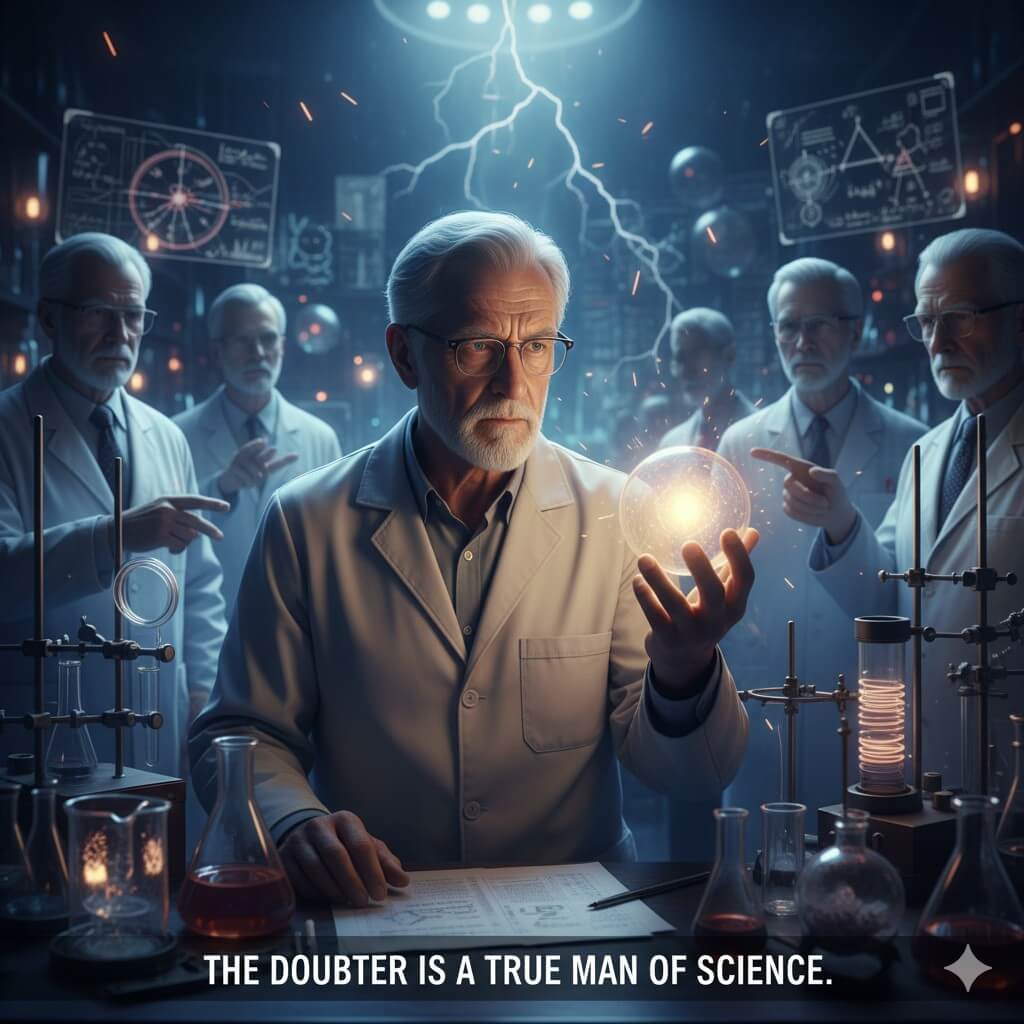
Science moves forward not because people accept everything they hear, but because someone, somewhere, dares to say, “I’m not sure this is true.” The idea that “the doubter is a true man of science” perfectly expresses this truth. A scientist is not someone who simply repeats what others believe; a scientist is someone who questions, investigates, and looks for proof. Doubt is not a weakness—it is the beginning of real understanding. Only when a person doubts can they begin the search for deeper truth.
History shows us that every major discovery started with doubt. One of the earliest and strongest examples is Galileo Galilei. In his time, people believed that Earth was flat or that it sat unmoving at the centre of the universe. These ideas had been accepted for centuries without question. But Galileo was not satisfied with simply accepting what everyone else believed. He doubted these old ideas. He observed the sky through his telescope, studied the movement of planets, and paid attention to the curved shadow that Earth cast on the Moon during a lunar eclipse. His doubt helped him realise that Earth was not flat at all—it was spherical, and it was not the centre of everything. Galileo’s courage to question long-held beliefs changed the world forever. He showed that truth depends on evidence, not tradition.
Many years later, Albert Einstein followed the same spirit of doubt. When he was young, he wondered whether light and time behaved in the way scientists of his time described. This single doubt pushed him to explore deeper questions about how the universe works. He imagined thought experiments, questioned accepted theories, and challenged the basic understanding of space and time. His doubts eventually led to the theory of relativity, one of the greatest scientific breakthroughs in history. Einstein’s work reminds us that progress comes not from accepting easy answers but from daring to ask difficult questions.
India too has a long tradition of scientists who used doubt as their guide. Ancient Indian mathematicians and astronomers questioned traditional beliefs about Earth, time, and celestial bodies. Aryabhata doubted the old idea that Earth was motionless. He boldly suggested that Earth rotates on its axis—an idea far ahead of his time. This willingness to challenge accepted beliefs came from a desire to understand the truth, not simply to follow common opinion.
In modern India, this same spirit can be seen in the life of C.V. Raman. When Raman observed the bright blue colour of the sea, he doubted the explanation given by Western scientists. Something about their theory did not seem right to him. Instead of ignoring his doubt, he investigated the behaviour of light himself. His experiments led to the discovery of the Raman Effect, for which he became India’s first Nobel Prize winner in science. Raman’s achievement shows that doubt can be the first step toward groundbreaking discoveries.
Dr. A.P.J. Abdul Kalam also began with doubt. When India’s space programme was young, many believed that India could never build advanced rockets or become self-reliant in space technology. Kalam doubted this belief. He questioned the assumption that India must always depend on other nations. His doubt and determination helped him lead the development of the SLV-III and later the Agni missile programme. Kalam’s life is a reminder that doubt, when combined with effort, can turn dreams into reality.
Homi J. Bhabha, the father of India’s nuclear programme, also refused to accept limiting beliefs. Many experts at the time felt that nuclear research was too advanced and too expensive for India. But Bhabha doubted this assumption. He believed that India had the talent and potential to excel in nuclear science. His belief in questioning what others thought impossible helped establish India as a strong nuclear nation with world-class research institutions.
Meghnad Saha, one of India’s greatest astrophysicists, also used doubt as his guiding light. When earlier scientists tried to explain how stars produced light, Saha felt something was missing. He doubted their explanations and worked to create a better one. His doubts led to the Saha Ionization Equation, which became a foundation for understanding stars. His work shows how doubt can inspire deep scientific progress.
These examples, from India and around the world, prove that doubt is not the enemy of science. It is the spark that lights the path to discovery.
A true scientist shows two essential qualities: the courage to doubt the world around him and the humility to doubt himself. This humility is important because scientific knowledge is never final. Even the best theories may one day be replaced by better ones. Einstein himself said he did not know whether his theories would remain permanent. This willingness to stay open to new evidence kept him learning throughout his life. Someone who believes they already know everything can never grow—but someone who doubts stays curious and open-minded.
Doubt also protects science from becoming rigid or stuck. If people had never questioned old ideas, we might still believe that Earth is flat, diseases are caused by evil spirits, or that the Sun moves around Earth. It is because someone doubted these beliefs that we now enjoy medicine, electricity, space exploration, and advanced technology. Every step of human progress began with a question.
Even in daily life, doubt plays a positive role. It teaches us to think before accepting information. When we read something online or hear a rumour, doubt helps us check whether it is trustworthy. It prevents the spread of false ideas and encourages responsible thinking.
But scientific doubt is never wild or careless. Scientists do not doubt everything blindly. Their doubt is disciplined and responsible. They ask clear questions, gather evidence, run experiments, observe results, and accept whatever the evidence shows—even if it challenges their own beliefs. This balance between healthy skepticism and respect for evidence is what makes science strong.
When scientists use doubt wisely, they discover things that change the world. Galileo doubted the flat-Earth belief. Einstein doubted old ideas about time and space. Marie Curie doubted the belief that atoms could not change. Indian scientists doubted that a low-cost Mars mission was impossible—and the result was the famous Mars Orbiter Mission. Every one of these breakthroughs began with a simple question: “Is this really true?”
Doubt also fuels creativity. It pushes people to imagine new possibilities and explore new ideas. The inventions we take for granted today—the telephone, electric light, medicines, airplanes, and computers—exist because someone doubted the limits of their time.
In today’s world, where information spreads quickly, both true and false, the habit of doubt is more important than ever. A society that encourages questioning will always be wiser and stronger. Scientific thinking helps us make good decisions about health, environment, technology, and public issues.
In the end, the doubter is truly the real man of science because he carries the qualities that keep science alive—curiosity, honesty, courage, and humility. Without doubt, there would be no progress, no innovation, and no discovery. When we honour the doubters, we honour the spirit of learning itself.
As long as people continue to question, explore, and seek answers, humanity will keep moving toward a brighter future. Doubt, when guided by reason, is not a barrier—it is a bridge that leads us from what we know to what we have yet to discover.
Additional Reads
https://toaike.com/international-day-of-older-persons-2025/
https://toaike.com/from-farm-to-table-tackling-food-waste/
