
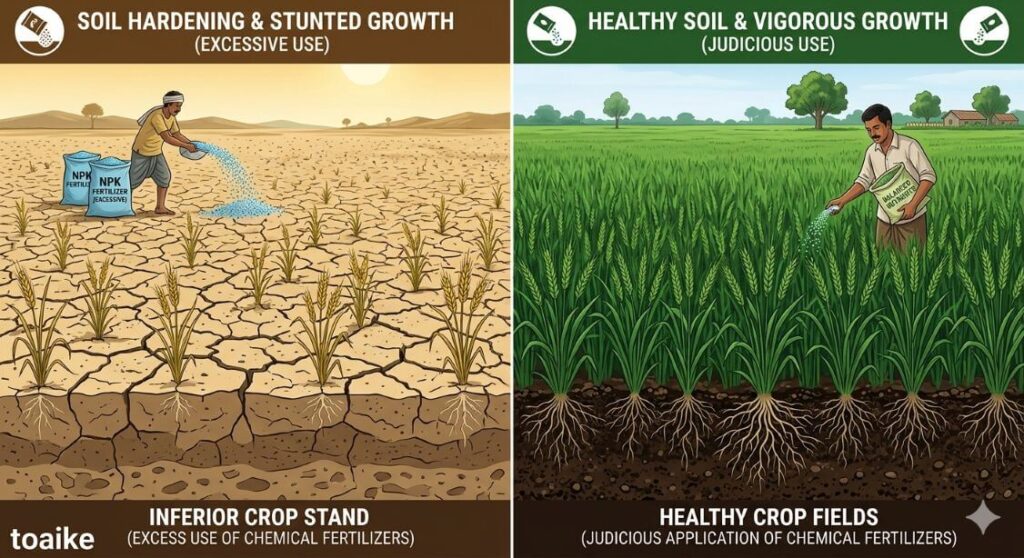
Indian farming has changed dramatically over the past few decades. Fertilizers that were once used sparingly and always alongside manure and compost have become the primary — and in many fields the only — source of crop nutrition. The land has absorbed these inputs season after season, year after year, and in many parts of the country it is now showing the strain. Fields that once drained well sit waterlogged after rain. Soils that once crumbled softly in the hand now feel dense and resistant. Roots that once went deep now spread shallow. More fertilizer is applied than ever before, yet yields do not respond the way they used to.
The connection between these observations — more chemical input and harder, less responsive soil — is what this article is about.
What is soil hardening ?
Soil is not simply dirt. It is a living, structured community — billions of organisms, mineral particles, channels of air and water, and organic matter all working together. When this community is healthy, water moves easily through the soil, roots push deep, and nutrients are continuously cycled and made available to crops. When it breaks down, none of these things happen properly.
Soil hardening is the breakdown of this living structure. It shows itself in two ways. The first is surface crusting — the top layer of the field seals itself shut after rain or irrigation, so that the next rain runs off instead of soaking in, and young seedlings struggle to push through. The second and more damaging form develops beneath the surface — a dense, hard layer forming a few inches below the ground, invisible when walking the field but devastating in what it does to crops. Roots hit this layer and spread sideways instead of going down. Water collects above it instead of draining through. The soil above stays wet while the soil below stays dry.
Both forms of hardening are caused, at least in part, by the way chemical fertilizers are used.
How chemical fertilizers Harden Soil ?
The damage does not happen overnight. A single season of heavy fertilizer use will not visibly harden a field. But when the same fertilizers are applied in the same quantities, season after season, without returning organic matter to the soil, the damage builds slowly and quietly until the field behaves very differently from how it once did.
Here is how it happens, step by step.
When nitrogen fertilizers — urea, ammonium sulphate, DAP — break down in the soil, they release acid. Healthy soil contains calcium and magnesium, and these minerals act like a glue that binds small soil particles together into crumbs or aggregates. It is these aggregates that give healthy soil its loose, open structure, full of the small tunnels and pores through which water drains, air moves, and roots grow. When acid from fertilizers attacks and dissolves this calcium-magnesium glue, the aggregates fall apart. The tiny individual particles left behind pack together densely, squeezing out pores and channels. The soil becomes denser and harder with every passing season.
Ammonium sulphate is particularly damaging in this regard because it directly exhausts the calcium in the soil. Once the calcium is gone, the acid has nothing to neutralise it, and it does even greater structural damage. The harder the soil becomes, the more vulnerable it is to the next season’s fertilizer application, and the cycle worsens.
Some fertilizers cause a different kind of hardening. Sodium-bearing fertilizers — Chilean sodium nitrate and sodium nitrate — do something specific and very destructive to clay. They cause the tiny clay particles to separate from each other and float individually through the soil water, instead of clumping together the way healthy clay should. When the soil dries, these separated particles settle into the pores and channels and block them. The result is a hard, near-impermeable layer that water cannot pass through. This is the most severe form of soil hardening and the hardest to fix.
Phosphate fertilizers like SSP and DAP, when applied beyond what the crop actually needs, cause phosphorus to combine with iron and aluminium in the soil, forming hard cemented compounds. These compounds block pores and contribute to the crusting and stiffening of the soil profile over time.
Every synthetic fertilizer, when applied in excess, also leaves behind salts. Season after season, these salts build up in the soil. They draw moisture out of the soil aggregates, causing them to shrink. When the soil dries, the shrunken, salt-coated particles stick together into a hard mass. This salt accumulation is particularly severe where drainage is poor and rainfall is insufficient to flush salts downward and away.
Running through all of these chemical processes is something even more fundamental — the slow decline of the soil’s biological life. Healthy soil is full of bacteria, fungi, earthworms, and other organisms that continuously loosen and aerate the soil, bind particles into aggregates, and cycle nutrients. Mycorrhizal fungi in particular weave fine threads through the soil that physically hold aggregates together and create the channels through which water moves. When chemical fertilizers are applied exclusively, without returning organic matter, this biological community gradually collapses. The biological tillage it was performing ceases. The glue it was producing disappears. Without that living activity, no amount of fertilizer can restore what the soil has lost.
The Fertilizers most responsible
Urea is the fertilizer most widely associated with soil hardening — not because it is uniquely dangerous in a single application, but because it is used in such large quantities, often far more than crops can actually use. Every application that exceeds what the crop takes up leaves acid and salt behind. Over years and decades, this cumulative load gradually destroys the soil’s structural integrity.
DAP compounds the problem by delivering both ammonium and excess phosphate simultaneously. The ammonium contributes to acidification while the excess phosphate leads to the cementation effects described above. When urea and DAP are applied together, season after season in wheat and rice fields, the combined acid load has proved particularly damaging to soil structure over time.
Ammonium sulphate is the most acidifying of the common nitrogen fertilizers. It depletes calcium reserves aggressively and is especially harmful in soils that are already on the acidic side, such as those in northeastern India.
Chilean sodium nitrate is the most structurally destructive fertilizer available. The sodium it contains causes the clay dispersion described earlier, and this damage is very difficult to undo. On soils that are prone to waterlogging or have poor drainage, it should be avoided entirely.
Muriate of potash, or MOP, suppresses the soil microorganisms that maintain structure and, when over-applied, displaces calcium from the soil’s exchange sites, weakening the bonds that hold aggregates together.
Is The Hardening Temporary or Permanent ?
This depends on what caused the hardening and how long it has been developing.
Surface crusting from moderate salt accumulation is the most reversible form. With the right treatment, a single season is often enough to break the crust and restore reasonable water infiltration. The soil beneath has not been fundamentally changed — only its surface has been sealed.
Moderate compaction in the upper layers, caused by years of nitrogen overuse and declining organic matter, is also reversible — but it takes longer. Two to four growing seasons of consistent corrective management are typically needed before the soil’s feel and behaviour meaningfully improves. There are no shortcuts here.
Deeper compaction, where the hard layer has developed further down in the profile, may take five years or more of sustained effort. The chemical bonds that have formed deep in the soil do not break easily, and the biological community that would naturally help restore structure takes time to rebuild once conditions improve.
Sodium-induced hardpan — the white, powdery usar land familiar in parts of Uttar Pradesh, Bihar, and Rajasthan — is a fundamentally different problem. This damage is semi-permanent. Recovery is measured in years and sometimes in a decade or more. The sodium has restructured the clay itself, and undoing that requires sustained chemical correction, water management, and biological rebuilding all working together over a long period. Some severely degraded usar land may never return fully to its original productivity. This is why preventing sodium damage matters so much more than trying to cure it.
Consequences of Soil Hardening
1. Shallow Roots
Once soil hardens, roots cannot push through the compacted layers. They spread sideways instead of going deep. Shallow-rooted crops cannot reach moisture stored in the lower soil, so they suffer in dry spells even when recently irrigated, and cannot access nutrients stored at depth.
2. Topsoil Loss
Rain falling on a hard surface runs off instead of soaking in. This runoff carries away topsoil — the most fertile part of the field — along with whatever fertilizer was recently applied. Both the soil and the investment in inputs are lost in a single heavy rain. Repeated over years, this erosion strips the productive layer entirely.
3. Waterlogging
Water that enters the soil but cannot drain past the hardpan below has nowhere to go. It accumulates in the root zone. Waterlogged roots cannot breathe, begin to rot, and become susceptible to fungal diseases. Crops turn yellow and stunted, and the cause is not always immediately obvious from the surface.
4. Nutrient Lockout
Acidified, compacted soil locks phosphorus, calcium, magnesium, zinc, and iron into chemical forms that plant roots cannot absorb. Nutrients are present in the soil but unavailable to the crop. Applying more fertilizer does not solve this — it only adds to the salt and acid load that is causing the problem.
5. Biological Shutdown
As the soil’s biological community collapses under exclusive chemical fertilization, the natural nutrient cycling that healthy soil performs continuously comes to a halt. Nitrogen, phosphorus, and other nutrients that are applied can no longer be properly processed and released to plant roots. The soil has lost the biological machinery to make fertilizer available — which is why many farmers find themselves applying more and more each season with diminishing results.
6. The Downward Spiral
Each of these consequences feeds the others. Hard soil produces shallow roots, which reduce crop residue returned to the soil, which reduces organic matter, which accelerates hardening further. The overall trajectory, if left uncorrected, is a farm requiring ever-increasing inputs to produce ever-decreasing outputs — until the land can no longer support a productive crop at all.
Remediation - How to Heal the Soil ?
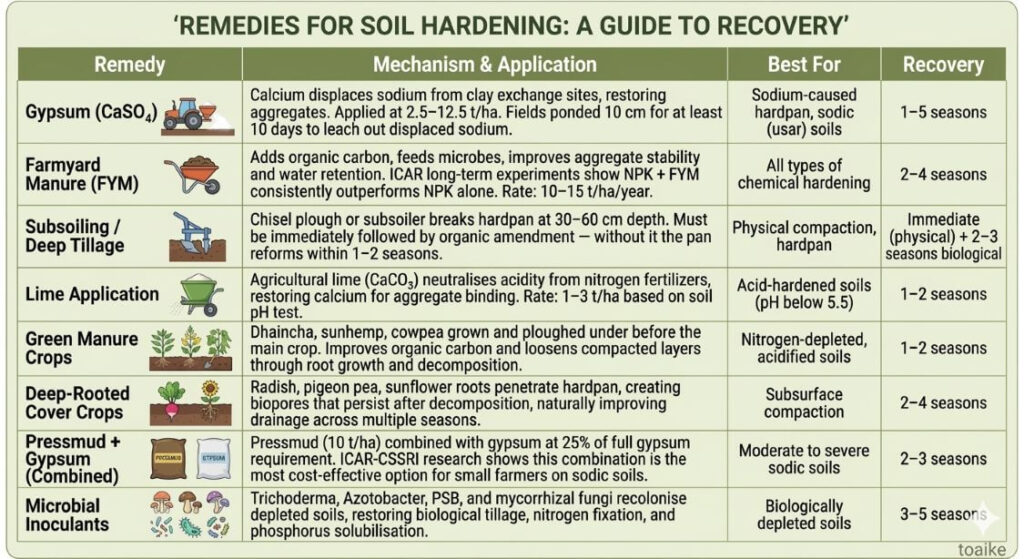
Soil hardening, in most cases, can be reversed. The remedies require effort, consistency, and a willingness to change habits that may have been in place for years. But they work.
1. Gypsum
The calcium in gypsum displaces sodium that has been destroying clay structure. The displaced sodium is then flushed out by ponding water on the treated field for several days. As sodium leaves and calcium takes its place, clay particles reaggregate, pores reopen, and water begins moving through the soil again. On severely sodic soils, the process must be repeated across multiple seasons.
2. Gypsum + Pressmud
Pressmud — available from sugar mills — is rich in organic matter and beneficial microorganisms. Applied alongside gypsum, it rebuilds aggregate structure while gypsum handles the sodium chemistry. Research confirms this combination outperforms either treatment used alone, and requires less gypsum per hectare, making it the more affordable option for smaller farms.
3. Lime
Agricultural lime neutralises soil acidity from nitrogen fertilizers, restores calcium, and allows aggregates to reform. The quantity needed depends on how acidic the soil has become — a soil test before application is essential. On genuinely acidified soil, even a single season of lime produces a visible improvement in water infiltration and root development.
4. Farmyard Manure and Vermicompost
Farmyard manure is the most universally effective treatment for chemically hardened soil. It feeds the biological community, provides aggregate-binding organic compounds, and improves water retention. Meaningful quantities are needed — small amounts make little difference. Vermicompost complements manure by adding humic acids that strengthen aggregate bonds and reintroducing earthworms whose burrowing provides natural, continuous compaction relief.
5. Subsoiling and Green Manure
A chisel plough or subsoiler physically breaks established hardpan at depths beyond ordinary tillage. It must be immediately followed by organic amendment — without it, the pan reforms within a season or two. Green manure crops — dhaincha, sunhemp, cowpea — grown for four to six weeks and ploughed back before maturity, rapidly build organic matter and leave root channels that guide subsequent water movement and root growth.
6. Deep-Rooted Cover Crops
Deep-rooted species — fodder radish, pigeon pea, sunflower — are strong enough to physically crack hardpan layers with their roots. When these roots die and decompose, they leave behind biopores — permanent drainage and root channels that continue working long after the crop is gone.
7. Microbial Inoculants
Products containing Trichoderma, Azotobacter, phosphate-solubilising bacteria, and mycorrhizal fungi recolonise soils depleted by chemical fertilizer overuse and gradually restore the biological processes that maintain soil structure. They only work effectively when organic matter is present in the soil to provide the food and habitat they need to survive and multiply.
8. Legume Rotation
Legumes — arhar, moong, lentil, groundnut — fix nitrogen from the atmosphere without acidifying the soil, breaking the acid cycle that cereals and synthetic nitrogen create season after season. Their root architecture differs from cereals, disrupting compaction patterns, and their residues return varied organic matter that builds a more diverse and resilient microbial community.
How long Will Recovery Take ?
Honest expectations matter here. Unrealistic timelines lead to disappointment and abandonment of practices that were actually working.
Where soil has surface crusting and moderate salt accumulation, meaningful improvement is visible within a single season of gypsum application, organic mulching, and careful irrigation. Water will infiltrate better, seedlings will emerge more evenly, and the surface will not seal as quickly after rain.
Where soil has moderate compaction from years of nitrogen overuse and organic matter decline, a plan of two to three full seasons should be expected — lime where needed, farmyard manure every season, cover cropping, and reduced synthetic fertilizer doses. Improvement happens incrementally each season, but the full benefit takes time.
Where soil has a deep, well-established hardpan, three to five years of sustained effort are realistic — combining mechanical subsoiling with ongoing organic matter building and biological restoration. The field did not become this way quickly, and it will not recover quickly. But each season of correct management produces measurable improvement.
For sodic usar land, a multi-year reclamation programme is necessary — combining gypsum, pressmud, sodicity-tolerant varieties, and careful water management. Recovery on severely affected land takes five to fifteen years. But even severely degraded land can be brought back to some level of productive farming within a few years of beginning the programme. Every step of the process produces improvement that is itself a return on the effort invested.
Precautionary Measures
Prevention is always less costly than cure. The practices that prevent soil hardening are largely the practices of good farming that were sidelined when synthetic fertilizers made shortcuts seem acceptable.
1. Soil Testing
A soil test reveals what the field contains, what it lacks, and its pH and salt status. Fertilizing based on this knowledge rather than habit means applying only what the crop needs — less waste, lower cost, and better soil protection. Soil Health Cards are available through the government scheme and should be used every season.
2. Return Organic Matter
Every crop removes organic carbon from the soil. If it is not replaced through manure, compost, crop residue, or green manuring, soil structure weakens and compaction follows predictably. Returning organic matter is not optional — it is the most fundamental requirement of sustainable farming.
3. Manage Irrigation
Water applied faster than the soil can absorb runs off the surface, carrying topsoil and fertilizer with it. Wet the surface gradually before applying full flow. Drip and furrow irrigation, where feasible, significantly reduce the surface impact that causes crusting and salt accumulation.
4. Vary Tillage Depth
Ploughing to exactly the same depth every year creates a hard compaction layer at precisely that depth. Varying tillage depth seasonally breaks this pattern and prevents tillage pans from forming. Heavy equipment should never be operated on wet soil — a single pass on wet ground can create compaction that takes years to undo.
5. Legume in Rotation
Even one season of arhar or moong in three gives the soil a rest from the acid-producing cereal-fertilizer cycle. Legumes add biological nitrogen, improve soil physical structure, and reduce dependence on synthetic inputs in the following season — at no additional cost.
6. Neem-Coated Urea
The neem coating slows nitrogen release, meaning less acid is produced per application and less urea is lost to the atmosphere. It is a simple, low-cost change that protects both the soil structure and the value of the fertilizer investment.
7. Biofertilizers
Rhizobium, PSB, and mycorrhizal fungal inoculants are affordable supplements — not replacements — for chemical inputs. Applied at planting, they gradually restore the biological machinery of the soil that chemical fertilizers alone cannot sustain.
Conclusion
Soil hardening by chemical fertilizers is not a sudden disaster. It is a slow process, accumulating across seasons and decades, invisible until the damage is substantial and costly to reverse. The mechanisms are well understood — acid from nitrogen fertilizers, sodium from sodium-bearing fertilizers, salt accumulation from excess synthetic inputs, and biological collapse when the soil’s living community is not sustained. The remedies are equally well established — gypsum, lime, organic matter, deep tillage, cover crops, microbial inoculants, and the basic discipline of soil testing before application.
What is required is the recognition that soil is not an inert medium that can absorb unlimited chemical inputs without consequence. It is a living system with its own needs and limits. Farming’s long-term future depends entirely on whether those needs are met — and meeting them is not complicated. It requires only the willingness to farm with the soil rather than against it.
References
- Effect of Chemical Fertilizers on Soil Compaction and Degradation — Massah & Azadegan (2016), Agricultural Mechanization in Asia, Africa and Latin America. https://www.researchgate.net/publication/303568416_Effect_of_Chemical_Fertilizers_on_Soil_Compaction_and_Degradation
- Understanding and Managing Soil Compaction in Agricultural Fields — NMSU Cooperative Extension, Circular CR-672. https://pubs.nmsu.edu/_circulars/CR672/
- Soil Fertility Status in India: Challenges and Solutions — Agriculture.Institute, May 2025. https://agriculture.institute/agriculture-fundamentals/soil-fertility-challenges-solutions-india/
- Enhancing Soil Health Through Balanced Fertilization — Frontiers in Microbiology, April 2025. https://www.frontiersin.org/journals/microbiology/articles/10.3389/fmicb.2025.1536524/full
- India’s Soil Health Crisis and the Sustainable Food Systems Report — CSE, December 2025. https://www.usthadian.com/indias-soil-health-crisis-and-the-sustainable-food-systems-report/
- Empowering India’s Farmers Through Strategic Fertilizer Management — Press Information Bureau, Government of India. https://www.pib.gov.in/PressNoteDetails.aspx?NoteId=154966&ModuleId=3
- Farmers’ Participatory Sodic Soil Reclamation through Gypsum and Pressmud — ICAR-CSSRI, Karnal. https://icar.org.in/en/node/4602
- Synergizing Microbial Enriched Compost and Mineral Gypsum for Rice-Wheat Productivity in Sodic Soils — ICAR-CSSRI / MDPI Sustainability, 2022. https://ideas.repec.org/a/gam/jsusta/v14y2022i13p7809-d848731.html
- Impact of Fertilizer Consumption on Soil Health and Environmental Quality in India — Kumar et al. (2022), ICAR-IISS. https://www.researchgate.net/publication/364779635_Impact_of_Fertilizer_Consumption_on_Soil_Health_and_Environmental_Quality_in_India