
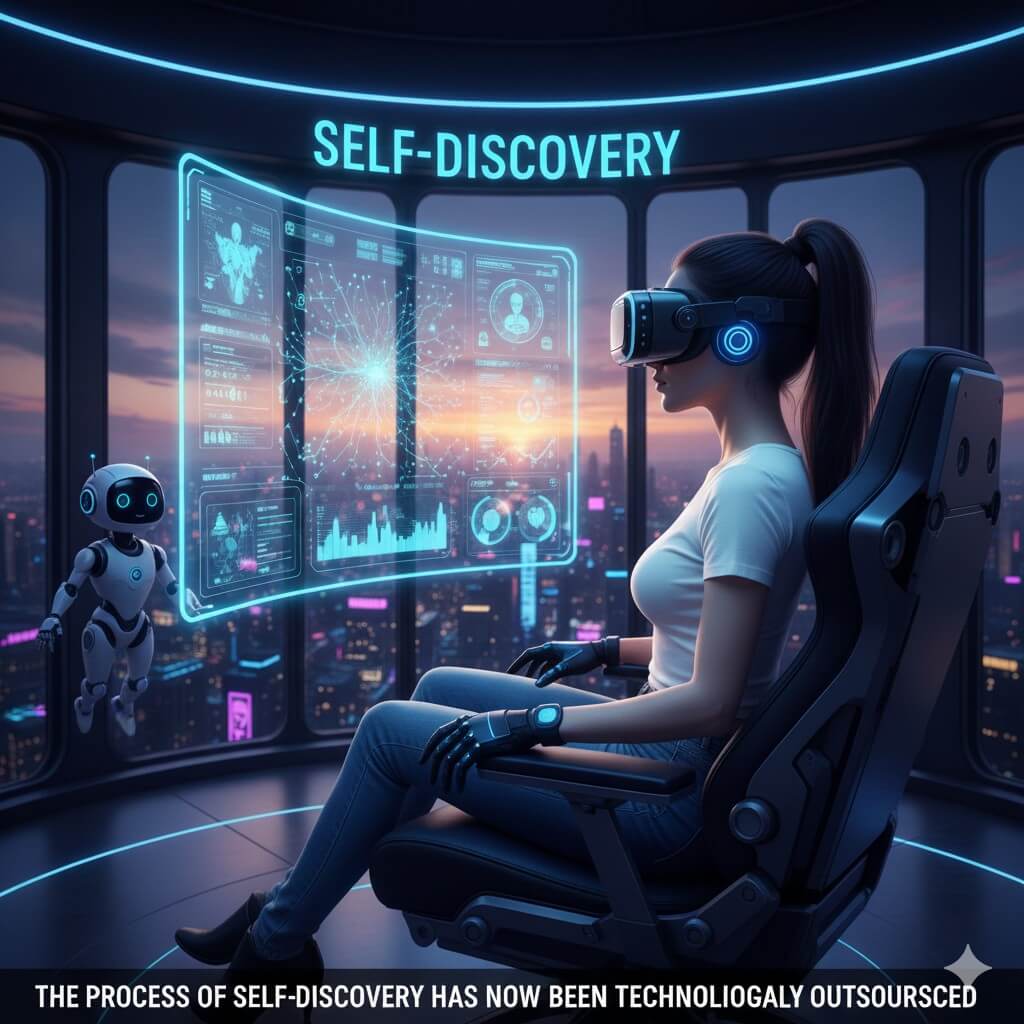
Once upon a time, if we wanted to discover who we were, we sat quietly, thought deeply, maybe stared at the ceiling for a while, and questioned our life choices. Today, we simply open an app. Spotify tells us our personality in the form of playlists, Instagram decides how interesting we are based on likes, and a five-minute online quiz confidently announces that we are a “Thoughtful Introvert With Leadership Potential.” Congratulations—self-discovery complete. Or so it seems.
For centuries, self-discovery was a deeply personal and human journey. People explored who they were through reflection, life experiences, conversations, art, philosophy, faith, and even boredom. It was slow, confusing, and sometimes uncomfortable—but it was real. Today, much of that process has been quietly handed over to technology. Instead of asking ourselves hard questions, we allow algorithms to answer them for us. While this feels convenient, the outsourcing of self-discovery comes with serious risks. The loss of authenticity, algorithmic manipulation, identity commodification, and psychological dependence on technology outweigh its benefits. What was once a meaningful inner journey is now often reduced to data points and digital feedback.
Traditionally, self-discovery meant looking inward and learning through life itself. Ancient philosophers encouraged people to reflect on virtue, purpose, and character. Religious traditions emphasized prayer, meditation, and moral discipline. Writers and artists explored identity through creativity. Travel, work, friendships, and failure shaped people over time. This process was slow and uncertain, but it allowed individuals to grow naturally. We learned who we were by living—not by being told.
In contrast, modern technology promises instant clarity. Personality tests give labels in minutes. Recommendation algorithms decide our tastes before we fully form them. Career platforms suggest paths that supposedly suit us best. These tools create the illusion of fast and easy self-discovery. But real identity does not come from shortcuts. When self-discovery is rushed or automated, it becomes shallow. The key question shifts from “Who am I?” to “Who does the algorithm think I am?”
Today, technology has become the primary mirror through which we see ourselves. Streaming platforms shape our tastes in music and movies. Social media feeds reinforce specific interests and opinions. Fitness trackers convert health into scores. Productivity apps [for example Todoist (task management), Notion (all-in-one workspace for notes and projects), Asana and monday.com (team collaboration and project tracking), Trello (Kanban-style task organization), Google Calendar (scheduling and calendar management), Calendly (meeting scheduling), Toggl (time tracking), and Reclaim (AI-based calendar management), etc.] reduce human effort to charts. Even AI tools offer advice on careers, relationships, and emotions. On the surface, these tools appear helpful. But beneath that convenience lies a deeper influence.
Technology does not simply reflect identity—it actively shapes it. Algorithms are designed to predict and influence behavior. They push us toward content that keeps us engaged, not necessarily content that helps us grow. Over time, this creates a loop. We click on something, the algorithm feeds us more of it, and soon that becomes “who we are.” In this way, self-discovery turns into a guided tour rather than an exploration. The mirror is no longer neutral—it is curated.
To be fair, technology does offer some benefits for self-discovery. Digital tools make information and insights widely accessible. We can explore interests, connect with communities, and express ourselves online. For those without access to mentors or traditional resources, technology can offer guidance and support. Marginalized voices can find platforms. Mental health apps can raise basic awareness. These benefits matter.
However, they are limited. Technology offers convenience, not depth. Speed, not wisdom. Accessibility, not authenticity. True self-discovery requires time, reflection, and lived experience—things that cannot be compressed into notifications or dashboards. When everything is instant and automated, we lose the struggle that actually shapes understanding.
The risks of outsourcing self-discovery are far greater than the benefits. The most serious danger is the loss of authenticity. When algorithms shape our preferences, we may mistake curated choices for genuine self-knowledge. Instead of discovering who we truly are, we adopt identities suggested by platforms. This weakens individuality.
Echo chambers make the problem worse. Algorithms show us more of what we already like, limiting exposure to new ideas. Growth requires discomfort, difference, and challenge. But algorithmic environments prioritize comfort and familiarity. Over time, curiosity shrinks and identity becomes narrow.
Another major risk is data commodification. Self-discovery becomes a business model. Our habits, emotions, interests, and struggles are collected, analyzed, and sold. Identity turns into a product. What was once private and personal becomes transactional. This changes how we relate to ourselves—self-reflection becomes something to share, post, and monetize.
Psychological dependency is another concern. Many of us now rely on external validation to feel secure. Likes, views, and algorithmic feedback replace inner confidence. This creates fragile identities that depend on digital approval. Anxiety increases. Self-worth becomes unstable. Without constant feedback, we feel lost.
Manipulation is built into the system. Algorithms are optimized for engagement and profit, not truth or well-being. They subtly push users toward behaviors and identities that serve commercial goals. A young person’s sense of self may be shaped more by what keeps them scrolling than by genuine exploration. This makes outsourced self-discovery not just flawed, but dangerous.
The cultural consequences are equally serious. The meaning of “knowing ourselves” has shifted from inner understanding to external metrics. Identity is measured in numbers—followers, scores, playlists—rather than experience. Philosophically, this raises a critical question: if identity is shaped by algorithms, is it still authentic?
Culturally, global platforms promote sameness. Trends repeat, individuality flattens, and diversity is filtered. When everyone follows the same algorithmic patterns, personal uniqueness fades. Society risks becoming a collection of standardized digital identities rather than richly human ones.
These issues are not theoretical. Influencers often shape their identities around engagement metrics. Dating apps reduce attraction to swipes and formulas. Mental health apps simplify emotional complexity into scores. In every case, technology offers efficiency at the cost of depth. Self-discovery becomes something managed, optimized, and packaged.
Yet the solution is not to reject technology entirely. The answer lies in balance. Technology can assist self-discovery, but it should never replace reflection and lived experience. Digital tools should act as guides, not authorities. A recommendation can suggest a direction, but the journey must remain personal.
We can reclaim self-discovery by slowing down. Journaling, meaningful conversations, creative work, time offline, and real-world experiences matter more than ever. Communities, mentors, and shared stories help counter algorithmic isolation. Mindful use of technology allows us to benefit without surrendering control.
Most importantly, we must remember that self-discovery is not a product—it is a process. It is messy, ongoing, and deeply human. No app can replace reflection. No algorithm can define purpose. Technology may offer suggestions, but only we can decide who we become.
In the end, the most meaningful step we can take is simple: pause before outsourcing our self-discovery. Use technology as a tool, not a mirror. Ask our own questions. Seek experiences, not just feedback. Measure growth by understanding, not metrics. When we take ownership of our inner journey, we protect authenticity in a digital world. Algorithms may point the way, but self-discovery belongs to us—and it always will
