
Rhizobium
If plants could talk, they would probably complain about nitrogen the most. “It’s everywhere in the air,” they might say, “but we still can’t eat it!” Even though about 78% of the atmosphere is nitrogen, plants cannot use it in its gaseous form. For plants, nitrogen is like food locked inside a sealed container. To be useful, it must first be changed into forms like ammonia or nitrate. This conversion process is called nitrogen fixation — and this is where Rhizobium bacteria become true heroes of the soil.
Rhizobium is a group of beneficial soil bacteria with a special talent: they can capture nitrogen gas from the air and turn it into a form plants can absorb. What makes them even more interesting is the close friendship they form with leguminous plants. This is not a one-way relationship. It is teamwork. Both the plant and the bacteria support each other.
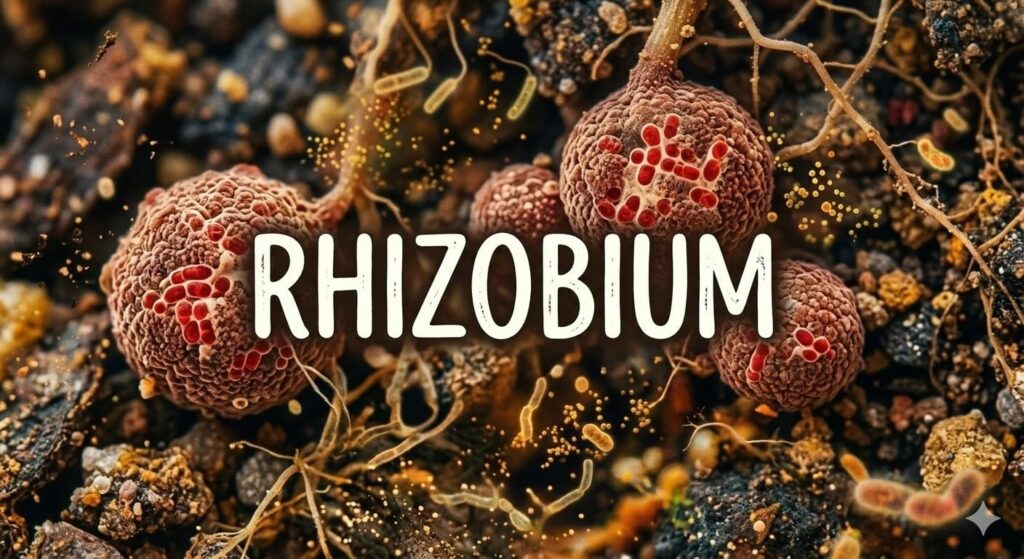
When Rhizobium bacteria in the soil sense the roots of a legume plant, they are attracted by natural chemical signals released by the roots. They enter through tiny root hairs and begin multiplying. In response, the plant forms small rounded structures on its roots called nodules. These nodules become a safe home for the bacteria. Inside them, the plant provides sugars and carbon compounds as food. In return, the bacteria fix atmospheric nitrogen and supply it directly to the plant.
Within these nodules, nitrogen fixation happens in a carefully controlled environment. The main worker in this process is an enzyme called nitrogenase, produced by the Rhizobium bacteria. Nitrogen gas (N₂) is very stable because its two nitrogen atoms are connected by a strong triple bond — one of the strongest bonds in nature. This makes nitrogen gas almost inactive and difficult for plants to use. Breaking this bond requires a large amount of energy. Nitrogenase manages this challenging task inside the nodule. The plant supplies sugars to the bacteria, which they convert into energy in the form of ATP (adenosine triphosphate). Around 16 ATP molecules are needed to fix a single molecule of nitrogen gas, showing how energy-intensive the process is. Using this energy, nitrogenase transfers electrons to the nitrogen molecule, gradually weakening and breaking its triple bond. Once separated, the nitrogen atoms combine with hydrogen (H⁺) inside the cell to form ammonia (NH₃).
However, nitrogenase has one weakness — it cannot tolerate oxygen. Too much oxygen can damage the enzyme and stop nitrogen fixation. To protect it, the nodules contain a special pink protein called leghemoglobin. This protein carefully controls oxygen levels inside the nodule. It provides just enough oxygen for the bacteria to produce energy while keeping the concentration low enough to protect nitrogenase.
After ammonia is formed, it quickly changes into ammonium (NH₄⁺). The plant then converts it into useful nitrogen compounds such as amino acids like glutamine and glutamate. These amino acids act as building blocks for proteins, enzymes, nucleic acids (DNA and RNA), and chlorophyll. All of these are essential for plant growth, cell development, and photosynthesis.
The benefits of Rhizobium do not end with one crop. When the growing season finishes and the nodules break down, the nitrogen stored inside them is released back into the soil. This naturally improves soil fertility and supports even non-legume crops planted afterward. In addition, Rhizobium can produce growth-promoting substances that encourage better root development and improve nutrient absorption.
In simple terms, Rhizobium is like a quiet partner working underground — capturing nitrogen from the sky, feeding the plant, and leaving the soil richer for the future.