
The Role of Local Economies in India's Sustainable Development
India, with its vast population of more then 1.4 billion people and rich cultural diversity, represents one of the world’s most complex and unique economic ecosystems. Local markets and economies have an absolutely pivotal role in shaping sustainable development across the country. Approximately 69% of India’s population resides in rural areas, relying heavily on agriculture, local crafts, and small businesses for livelihood, while the urban middle class is expanding rapidly, driving demand for goods and services in cities and towns.
Promoting inclusive and localized economic growth within towns, villages, and urban neighborhoods is essential to foster balanced regional progress and ensure that prosperity reaches all parts of society. This requires strengthening local markets, empowering entrepreneurs, boosting micro-, small and medium enterprises (MSMEs), and ensuring that money generated within a community circulates there rather than leaking to distant metropolitan or online platforms.
The upliftment of local economies in India presents a powerful pathway to job creation, poverty reduction, equitable income distribution, and cultural preservation. As India’s economy modernizes and digital platforms expand, the challenge is to integrate new technologies into this framework without sidelining the traditional and vital local markets that form the backbone of livelihoods for millions.
Contents
Understanding the Upliftment of Local Economy and Market in India
India’s economy has always been deeply rooted in its local markets—whether it is the bustling bazaars of Jaipur, the periodic rural haats where villagers trade fresh produce, the neighborhood kirana stores that supply daily essentials, or artisan clusters like those producing Banarasi sarees and sandalwood carvings. These markets are much more than mere commerce centers; they are linchpins of social interaction, culture, and community cohesion.
Strengthening this framework today means tailoring policies and programs that empower small and medium enterprises (SMEs), farmer producer organizations (FPOs), rural cooperatives, and informal sector enterprises by increasing their access to affordable credit, better marketplaces, and modern technology. Initiatives like the Pradhan Mantri Mudra Yojana and support for FPOs have already begun to address these needs but require continued expansion to meet future challenges.
The concept of the local multiplier effect is vividly observable in India’s microeconomies. For instance, when consumers purchase from a village kirana shop or a local artisan, the income generated circulates through multiple layers—shopkeepers pay wages to local laborers, buy stock from local wholesalers, and reinvest in their businesses—helping sustain a network of livelihoods. By contrast, online purchases from national or international e-commerce platforms often reroute income outside the community, sharply reducing local reinvestment and weakening these interdependent economic ties.
The Impact of E-commerce vs. Local Market Support in India
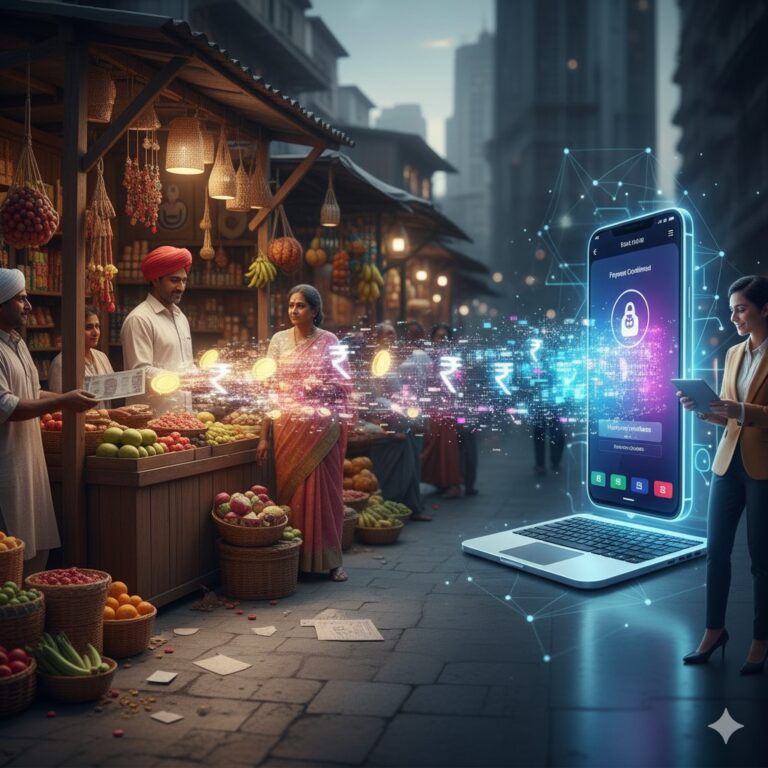
India’s digital revolution has turbocharged e-commerce expansion, with platforms like Flipkart, Amazon, and Reliance Retail extending their reach to semi-urban and rural consumers. The Indian e-commerce market is estimated to reach a valuation of around $200 billion by the end of 2025, growing at a compound annual growth rate (CAGR) of approximately 27% since 2020. Internet users in India are projected to reach 900 million by 2025, with over 70% of e-commerce transactions happening via mobile devices, fueling this rapid growth. Tier-2 and Tier-3 cities, along with rural areas, have become significant contributors, with nearly 60% of new online customers since 2020 coming from these smaller cities and towns [source: Bloom Agency; Bain & Company].
While these platforms offer unmatched convenience and product variety at competitive prices, their expansion threatens to hollow out India’s traditional retail sector, especially the small kirana stores and neighborhood markets that employ millions. Micro and small enterprises contribute nearly 30% to India’s GDP and employ a significant portion of the workforce, but face intense competition from e-commerce giants wielding superior pricing power and supply chain efficiencies. With increasing money flows out of local supply chains to national and international digital conglomerates, small shopkeepers struggle to reinvest or create new jobs, heightening economic and social vulnerabilities in their communities.
To counter this, the Government of India’s “Digital India” campaign advances digital literacy and infrastructure, while the “Vocal for Local” movement encourages citizens to buy local products, thereby supporting MSMEs, indigenous crafts, and traditional manufacturing businesses. Enterprises involved in handloom weaving, pottery, and organic farming are experiencing renewed attention and stronger marketing support, helping bridge the gap between tradition and modern marketplace access.
Wealth Accumulation and Property Value Appreciation Locally
Locally generated economic gains in India significantly drive not only individual prosperity but also community wealth through improved social infrastructure. When entrepreneurs, farmers, shopkeepers, or artisans earn income locally and reinvest in their communities by acquiring property, expanding businesses, or improving homes, it leads to rising property values—a key indicator of economic vitality.
Higher property values increase revenue for local urban and rural authorities through property and land taxes, enabling them to invest in critical community assets such as roads, water supply, sanitation, schools, and healthcare centers. Such improvements further attract investment and skilled labor, creating a positive growth cycle.
An illustrative example can be seen in tier-2 cities like Pune and Coimbatore, and rapidly industrializing regions in Tamil Nadu and Maharashtra, where rising commercial and residential real estate values are linked to broader economic diversification and enhanced amenities, reducing migration pressures on megacities like Mumbai, Bangalore, and Delhi.
Promoting Local Economy: A Pillar of India's Sustainable Development
India’s pursuit of sustainable development demands an approach that balances robust economic growth with inclusion and environmental stewardship. Local economic development (LED) initiatives occupy a central role as effective strategies to realize this balance.
Promoting local markets and community enterprises in India can:
Generate broad-based employment, especially in rural regions, thereby easing urban migration.
Integrate marginalized groups including women, Scheduled Tribes, and Scheduled Castes into formal economic growth.
Encourage responsible utilization of local natural resources, promote sustainable agriculture, handicrafts, and traditional knowledge systems.
Enhance economic resilience by diversifying local economies and reducing reliance on global shocks.
A prime example is the Amul cooperative model in Gujarat, which has morphed from a village milk producers’ initiative into a national brand, exemplifying how collective local enterprise can achieve large-scale success without losing local grounding.
Seasonal Agriculture, Outmigration, and Rural Market Challenges
Seasonal agriculture remains the primary livelihood for millions of Indians, but it also creates significant seasonal employment gaps. To supplement income, many rural workers migrate temporarily to urban centers or other states. While this migration generates remittances, much of the earned income is often spent outside home villages, limiting reinvestment in rural markets and development initiatives.
This economic leakage slows rural GDP growth, leads to underdeveloped markets, and erodes agrarian livelihoods. Strengthening rural infrastructure such as roads, storage, agro-processing facilities, and digital access can enhance value addition locally while creating diversified rural entrepreneurship opportunities beyond agriculture.
Government schemes like Mahatma Gandhi National Rural Employment Guarantee Act (MGNREGA) provide guaranteed work during lean seasons, promoting local consumption and stimulating rural markets.
Urgent Need for a Sustainable Local Market Economy
For India to sustain its impressive growth trajectory and inclusive development goals, it is vital to prevent the excessive concentration of wealth, businesses, and industrial activity in a few megacities or export corridors.
A sustainable local market economy ensures wealth circulates equitably inside regional ecosystems, supporting livelihood creation, social welfare, and regional economic diversification. The “Vocal for Local” initiative encourages consumers to prioritize Indian-made and locally produced goods, thereby reinforcing regional MSMEs, textile artisans, handicraftspeople, and organic food producers.
Sustaining such markets also contributes to India’s goals under the UN Sustainable Development Goals (SDGs), including poverty eradication, decent work, and sustainable consumption.
Strategies to Promote Local Market and Economy in India
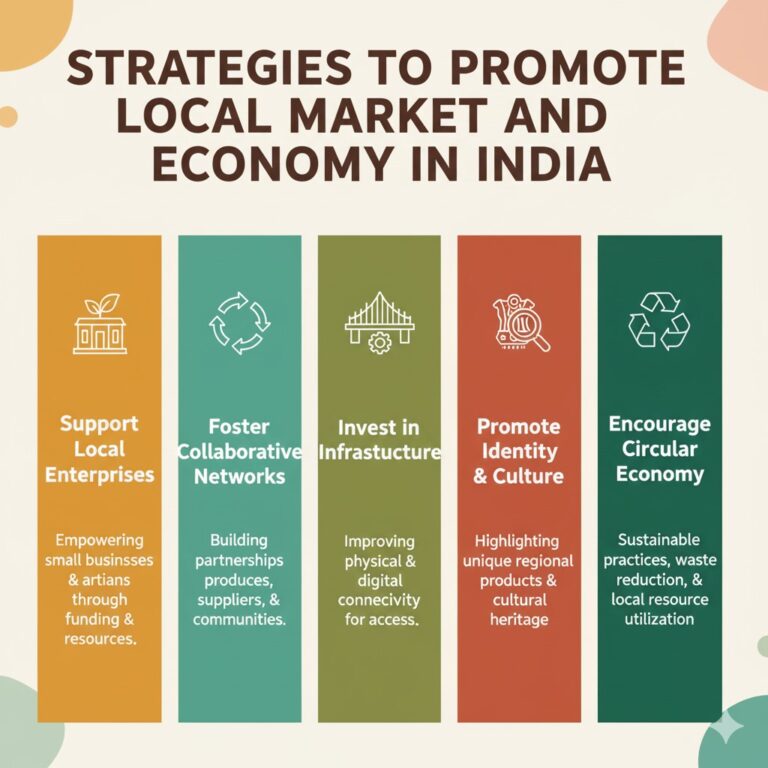
Support Local Enterprises
Supporting local enterprises is fundamental to India’s economic fabric, particularly for MSMEs, which contribute around 30% to the country’s GDP and employ over 100 million people. Micro-financing schemes like the Pradhan Mantri Mudra Yojana have democratized access to credit, enabling entrepreneurs, especially women and rural artisans, to scale their businesses. For example, Mudra loans helped countless women-led small ventures in textiles and handicrafts access working capital, transforming cottage industries into sustainable income sources.
In urban areas, business incubators such as those in Bengaluru and Ahmedabad offer startups critical support through mentoring, co-working spaces, and funding access, nurturing innovation tailored to local markets. Rural cooperatives enable collective bargaining and resource pooling, as exemplified by the Amul dairy cooperative, which revolutionized milk production and provided millions with steady incomes.
Madhya Pradesh stands out as a vibrant hub for local enterprise development. The state’s MSME Development Policy 2025 supports entrepreneurs through capital subsidies, interest subsidies, and infrastructure development, particularly in textile clusters like Indore and Bhopal, and manufacturing units across Ujjain, Dewas, and Jabalpur. Madhya Pradesh’s experience is illustrative of a broader national trend, where multiple states are actively crafting and implementing policies that nurture local entrepreneurship, ensuring the widespread multiplication of economic benefits and fostering resilient local economies.
The availability of skilled labor, rich traditional crafts, and government support create an ecosystem conducive for these micro-enterprises to flourish, ensuring resilience, job creation, and inclusive growth. Empowering such local enterprises at scale builds a strong foundation for vibrant, self-sustaining communities that drive India’s broader economic progress.
Foster Collaborative Networks
Collaborative networks among local producers, suppliers, and consumers are vital for amplifying the impact of India’s diverse markets. Business clusters like the handloom weaving groups in Varanasi and spice producer cooperatives in Kerala demonstrate how collective action enhances market reach, reduces costs, and improves product quality. These clusters enable small producers to pool resources, negotiate bulk procurement deals, and participate in shared marketing efforts, increasing competitiveness against larger national or global players.
Furthermore, collaborative associations facilitate capacity building through skill development workshops and technology access, fostering innovation within traditional sectors. Digital platforms also play a transformative role in linking producers directly with consumers, as seen in localized e-commerce initiatives promoting organic foods and handicrafts. The synergy generated by such networks not only strengthens livelihoods but also embeds a culture of mutual support and solidarity, which is essential for sustainable economic development. By fostering effective collaboration, India’s local markets can achieve greater operational efficiency, resilience, and growth potential while preserving cultural heritage and community identity.
Invest in Infrastructure
Investing in both physical and digital infrastructure is critical for connecting India’s local markets to wider economic opportunities. Physical infrastructure, including improved highways, rural roads, transportation services, and modern marketplaces, reduces logistical bottlenecks, shortens supply chains, and lowers costs for small producers and traders. For instance, government initiatives like the National Highways Development Project and rural road schemes have bolstered market access for agricultural producers, increasing income and reducing wastage.
On the digital front, programs such as BharatNet aim to provide high-speed internet connectivity to over 250,000 gram panchayats, enabling rural entrepreneurs to engage with e-commerce, digital payments, and online marketing. This digital inclusion facilitates access to information, finance, and customers beyond geographic limitations. Quality infrastructure not only improves business efficiency but also nurtures consumer confidence and market vibrancy. As India’s economy further embraces digital transformation, integrating infrastructure investment with capacity building ensures that local enterprises remain competitive, inclusive, and sustainably linked to national and global value chains, propelling local economies forward.
Promote Local Identity and Culture
Leveraging local identity and cultural heritage is a powerful strategy for economic empowerment in India, a country with unparalleled diversity of traditions and crafts. Promoting heritage-linked tourism, festivals like the Pushkar Camel Fair and Mysore Dasara, and crafts such as Banarasi silk and Madhubani painting attracts visitors and consumers, creating livelihoods beyond agriculture. The government’s “Make in India” and “Vocal for Local” campaigns stress the significance of regional artisanship and traditional industries in nation-building.
By marketing products with authentic cultural narratives, local businesses can differentiate themselves and command premium pricing, tapping into both domestic and international audiences who value heritage. Educational programs and community events foster pride and ensure generational transmission of skills, safeguarding intangible cultural assets. Promoting local culture fosters sustainable economic activity that enriches communities socially and financially, reinforcing identity while adapting to contemporary marketplaces.
Encourage Circular Economy
India is increasingly embracing circular economy principles as an integral part of its sustainable development strategy. Circular economy focuses on resource efficiency by reducing waste, encouraging recycling, and promoting the reuse of materials to build sustainable livelihoods and conserve the environment.
One prominent government initiative supporting circular economy practices is the Swachh Bharat Mission, which goes beyond cleanliness to promote decentralized waste management and waste-to-energy projects at local, municipal levels. These projects turn organic waste into biogas and compost, creating jobs while reducing pollution. Similarly, the Paramparagat Krishi Vikas Yojana (PKVY) promotes organic farming, decreasing chemical inputs, improving soil health, and giving farmers access to organic markets that often demand environmentally sustainable produce.
In the handicraft sector, the National Institute of Design supports projects where artisans recycle and upcycle waste materials—such as fabric offcuts, metal scraps, and discarded fibers—into creative handicrafts. This fusion of creativity and sustainability empowers local artisans economically while protecting natural resources.
For local shopkeepers and street vendors, the PM Street Vendor’s AtmaNirbhar Nidhi (PM SVANidhi) scheme is significant. It provides collateral-free working capital loans of up to ₹10,000, with incentives including a 7% interest subsidy and cashback rewards on digital transactions. This financial support enables vendors to invest in sustainable business practices, including waste reduction, sustainable packaging, and efficient resource use—key components of a circular economy. By facilitating access to affordable credit and encouraging digital adoption, PM SVANidhi helps integrate local vendors into environmentally responsible commerce while boosting their economic resilience.
Together, these integrated schemes—addressing waste management, organic agriculture, sustainable handicrafts, and vendor financing—demonstrate India’s comprehensive approach to embedding circular economy principles within local markets. They ensure that economic growth harmonizes with environmental stewardship and social inclusion, reinforcing India’s pathway toward sustainable, grassroots prosperity.
Conclusion: The Path to Inclusive and Lasting Prosperity Through Promoting India's Local Markets
Promoting local markets and economies in India is essential to achieving sustainable, inclusive development that benefits all segments of society—from rural farmers and artisans to urban entrepreneurs.
When wealth is generated and reinvested locally, Indian communities become more resilient, diversified, and vibrant. Such circular economic activity preserves precious cultural heritage and improves livelihoods by reducing poverty, enhancing education and healthcare opportunities, and widening access to credit and technology.
India’s government initiatives like “Vocal for Local,” MSME development programs, rural digitalization policies, and urban-rural infrastructural connectivity projects illustrate a strong national commitment to this vital goal. Consumers, too, play a critical role by consciously choosing local goods, supporting small businesses, and fostering regional pride.
Through sustainable and inclusive promotion of India’s local markets, economic growth becomes equitable, environmental stewardship becomes a shared responsibility, and cultural legacies thrive proudly. This creates a future where prosperity uplifts every Indian community, making India’s development story truly holistic and enduring.
References
- Ministry of Statistics and Programme Implementation, India. PRESS NOTE ON QUARTERLY ESTIMATES OF GDP, Q1 FY 2025-26.
- Deloitte Insights. India Economic Outlook 2025.
- Press Information Bureau, Government of India. India’s GDP Surge: Driving the Growth Story. August 2025.
- Wikipedia. Economy of India.
- Government of India. Pradhan Mantri Mudra Yojana.
- Ministry of Rural Development, MGNREGA.
- PM Street Vendor’s AtmaNirbhar Nidhi (PM SVANidhi) Scheme, Ministry of Housing & Urban Affairs, Government of India
- Swachh Bharat Mission, Ministry of Housing & Urban Affairs
This post is shared to inspire curiosity and deepen understanding.