
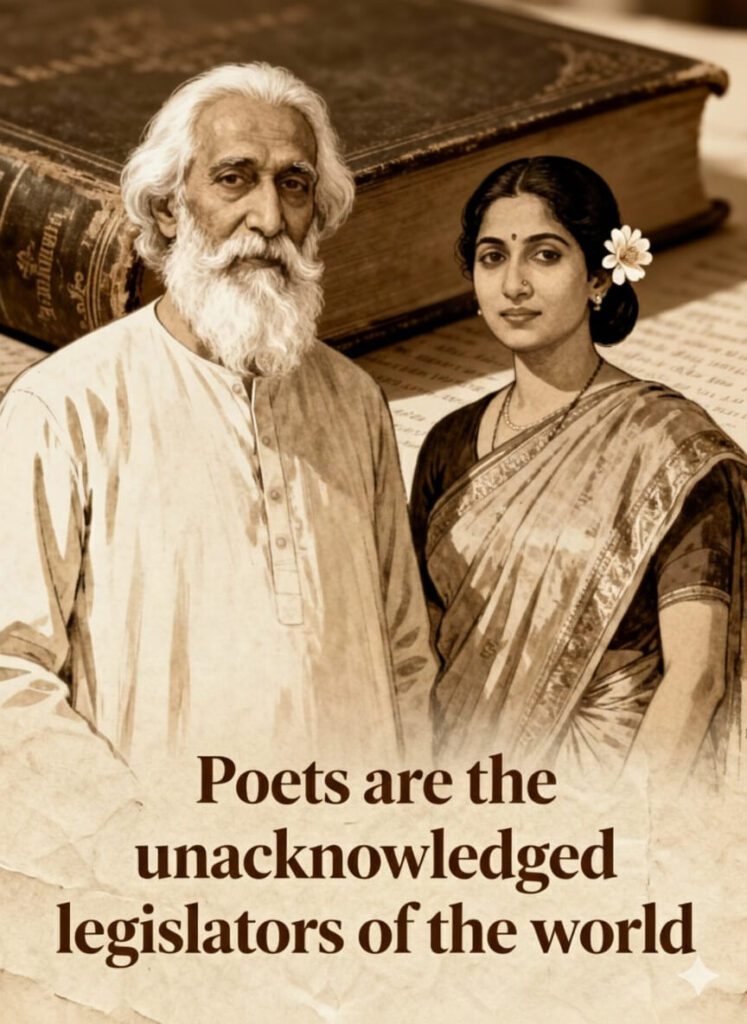
“Poets are the unacknowledged legislators of the world”—this bold line may sound confusing at first. How can poets be lawmakers when they neither write bills nor run governments? But if we look closely at how societies change and grow, this statement starts to make sense. Poets shape the way we think, feel, and imagine life. They build the emotional and moral space in which real laws are later created. And they do all this silently, without attention—exactly why they remain “unacknowledged.”
The quiet strength of poetry becomes clear when we understand what “legislation” really means. Yes, lawmakers write rules we must follow. But before those rules appear, people’s thoughts about right and wrong must shift. Someone has to show us new ways of seeing justice, fairness, beauty, or cruelty. That “someone” is often the poet. Poets speak to our hearts first, helping us view life differently.
Think about India’s freedom struggle. Long before Gandhi inspired millions through non-violence, poets had already planted feelings of pride and unity among people. When Bankim Chandra Chattopadhyay wrote “Vande Mataram” in 1875, he wasn’t just creating a song—he was helping Indians picture their nation as a mother worth loving and protecting. This bond became so strong that the British banned the song because they sensed its power to awaken resistance.
In the same way, when Rabindranath Tagore wrote “Jana Gana Mana,” he gave Indians a dream of togetherness that cut across regions and religions. These weren’t legal texts, yet they achieved something laws could not—they made people feel connected. Independence came many years later, but poets had already created the emotional ground needed for that change.
Poets have also served as the conscience of society—the voice for people who had no voice. In India, saint-poets like Kabir and Rahim spoke about inequality centuries before any law tried to fix it. Kabir, who lived in the 15th century, used simple words that everyone could understand. He questioned caste, religious arrogance, and social divisions through his dohas. His poetry did not change rules right away, but it changed attitudes—and changed attitudes eventually reshape society.
Rahim Das shared lessons about life that still guide us. His famous couplet about concentrating on one task at a time—likening it to how a tree stays green when water reaches only its roots—teaches the value of focus and commitment.
The influence of poetry becomes most visible during times of great change. During the freedom struggle, poets like Maulana Hasrat Mohani created slogans that carried enormous power. “Inquilab Zindabad” was not just a chant—it was a spark that encouraged countless people to fight for freedom. Bhagat Singh made it widely known, and it soon became the motto of the Hindustan Socialist Republican Association.
Sarojini Naidu used poetry to inspire both men and women to join the movement. Her poems about India’s beauty and suffering made the idea of freedom feel real and urgent. Tagore’s 1905 song “Ekla Cholo Re” told people to keep walking even if no one stood with them. This single poem has lifted spirits in many social and political movements since then, showing how a few lines can spread courage across generations.
Poetry is not limited to books. It flows into cinema, songs, and every form of art. The song “Kar Chale Hum Fida” from the film Haqeeqat captured the spirit of sacrifice during the 1962 India-China war. It did not set military strategy, but it shaped how people understood patriotism and duty.
Our ancient epics—the Ramayana, Mahabharata, and Bhagavad Gita—are huge poetic works that have guided Indian values for thousands of years. The teachings of the Bhagavad Gita on duty, action, and the meaning of life influence millions even today, from personal choices to national ideas. No government turned these teachings into laws, but they still guide how people live and think.
If poets have such deep influence, why are they still “unacknowledged”? It’s because their power works quietly. When a law is passed, everyone knows the date and the leader behind it. But when a poem shifts someone’s thinking, the change happens silently, sometimes without the person even noticing it.
Poets also rarely seek public praise or political power. Kabir was a simple weaver, not a ruler. Tagore rejected the knighthood after the Jallianwala Bagh tragedy, showing that he valued truth over titles. These poets worked behind the scenes, improving society without expecting applause.
Society often undervalues cultural influence while overvaluing political authority. We easily remember prime ministers and presidents but forget the poets who shaped the morals these leaders talk about. The impact of poetry is real but hidden—like roots feeding a tree. We see the fruit but forget what nourished it.
This idea still matters today. Poetry has changed forms—appearing in rap songs, spoken-word performances, and viral lines on social media. Indian hip-hop artists now speak about caste discrimination, gender issues, and corruption through their lyrics, reaching people traditional politics cannot reach. Even modern social movements depend on poetic phrases and creative expression to touch hearts before they change laws.
In the end, poets truly are the unacknowledged legislators of the world because they shape something more important than laws—they shape imagination, empathy, and values. They help us notice injustice where we once saw nothing wrong, notice beauty where we saw dullness, and notice possibility where we saw barriers. They give strength to the fearful, comfort to the unheard, and vision to those who cannot imagine a better world.
From Kabir’s challenge to social barriers to Tagore’s dream of universal humanity, from freedom-movement slogans to today’s socially aware music, poets have always prepared society for change. Lawmakers may write the laws, but poets build the emotional and moral language that makes those laws meaningful.
They remain unacknowledged not because they lack impact, but because their influence is so deep that it becomes invisible. We forget that someone had to imagine equality before it could become law, dream of freedom before it could be won, and define justice before it could be demanded. That “someone” is often the poet—working quietly but powerfully, shaping the world one word, one heart, and one imagination at a time.
