
Plant Nutrients
If plants could talk, they would probably sound a lot like a fussy dinner guest — “I need nitrogen, but not too much. I want phosphorus, but only in the right form. And do not even get me started on zinc — I need it, but just a tiny pinch, thank you very much.” The truth is, plants are extraordinarily demanding when it comes to nutrition, and they need not one or two but seventeen different nutrients to grow properly. Each one has a specific job, and missing even one of them is enough to throw the entire show into chaos.
Plant nutrients are divided into two broad categories based on how much of them a plant actually needs — Macronutrients, which are needed in large amounts, and Micronutrients, which are needed in very small amounts but are no less important for it.
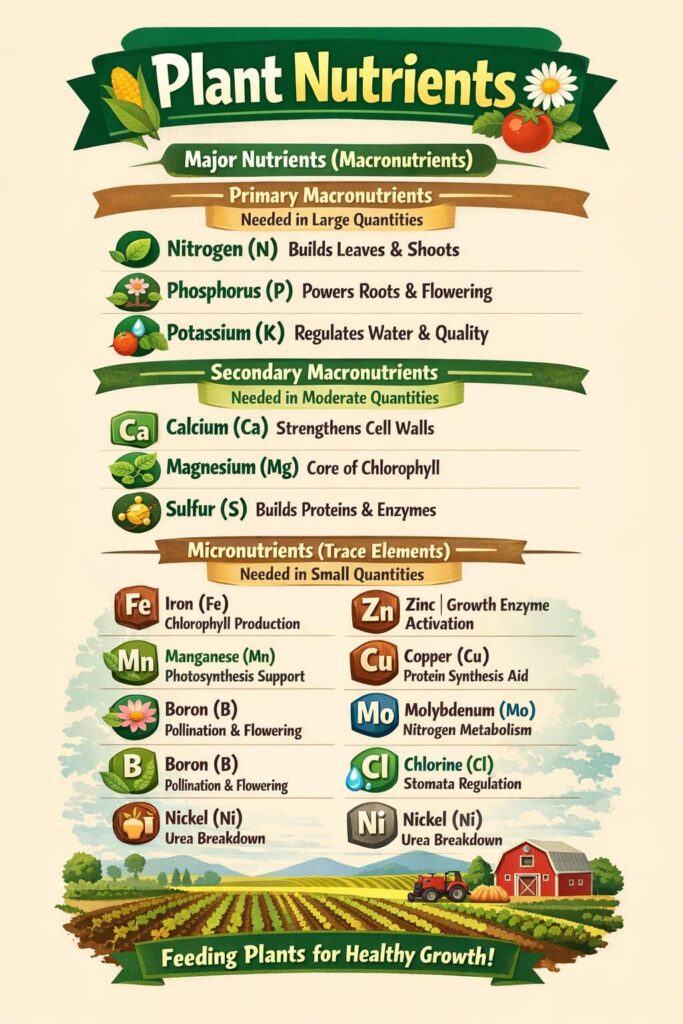
Major Nutrients (Macronutrients)
These are further divided into Primary and Secondary Macronutrients.
Primary Macronutrients — needed in the largest quantities of all:
Nitrogen (N) — The growth engine of the plant. Nitrogen is responsible for building proteins, forming chlorophyll, and driving the rapid growth of leaves and shoots. A plant well supplied with nitrogen looks lush, green, and vigorous. A plant starved of nitrogen looks pale, yellowing, and tired — much like a person who has not eaten in two days.
Phosphorus (P) — The energy currency of the plant. Phosphorus powers energy transfer between cells, supports strong root development, drives flowering, and is directly involved in seed and fruit formation. It is also a building block of DNA and cell membranes, making it essential right from the moment a seed germinates.
Potassium (K) — The regulator and quality controller of the plant. Potassium manages the movement of water in and out of cells, activates dozens of enzymes, strengthens cell walls, improves resistance to disease and drought, and directly influences the size, taste, and quality of fruits and grains. It does not build the plant’s body the way nitrogen and phosphorus do, but without it the plant simply cannot function properly.
Secondary Macronutrients — needed in moderate quantities:
Calcium (Ca) — The structural cement of the plant. Calcium is a core component of cell walls and gives them their rigidity and strength. It is also essential for healthy root tip development and helps regulate the movement of other nutrients into cells.
Magnesium (Mg) — The heart of chlorophyll. Every single chlorophyll molecule has a magnesium atom sitting right at its center, making magnesium absolutely indispensable for photosynthesis. Magnesium also helps in the transport of phosphorus within the plant and activates several important enzymes.
Sulfur (S) — The protein builder’s assistant. Sulfur is required for the synthesis of certain amino acids that form proteins, as well as for the production of vitamins and enzymes within the plant. It also contributes to the characteristic smell and flavor of crops like onion, garlic, and mustard.
Micronutrients (Trace Elements)
These are nutrients needed in very small quantities — sometimes just a few parts per million — but their absence causes serious and visible problems in plant growth and productivity.
Iron (Fe) — Required for the production of chlorophyll and the functioning of several key enzymes involved in energy transfer and respiration within plant cells. Iron deficiency shows up as yellowing of young leaves while the veins remain green, a condition called chlorosis.
Zinc (Zn) — Drives the activity of a large number of enzymes involved in carbohydrate metabolism, protein synthesis, and gene regulation. Zinc is also directly involved in the plant’s own production of auxin, the growth hormone that regulates development. Zinc deficiency leads to stunted growth, small distorted leaves, and poor grain filling.
Manganese (Mn) — Supports the light reactions of photosynthesis and activates several enzymes involved in nitrogen metabolism and the plant’s defense against oxidative stress. Manganese deficiency causes pale yellowing between leaf veins, particularly in younger leaves.
Copper (Cu) — Involved in protein synthesis, the functioning of enzymes related to photosynthesis and respiration, and the development of pollen and reproductive tissues. Copper deficiency often shows up as wilting of young shoot tips even when the soil has adequate moisture.
Boron (B) — Essential for the formation and strengthening of cell walls, the transport of sugars from leaves to other parts of the plant, and the successful completion of pollination and fertilization. Boron deficiency causes hollow stems, distorted growing tips, and poor fruit and seed set.
Molybdenum (Mo) — Plays a critical role in nitrogen metabolism, particularly in the functioning of the nitrogenase enzyme that drives biological nitrogen fixation, and in the conversion of nitrate into ammonia within plant cells. It is needed in the tiniest quantities of all the micronutrients but is still absolutely essential.
Chlorine (Cl) — Involved in regulating the opening and closing of stomata, which controls water loss and gas exchange in the plant. Chlorine also participates in the water-splitting reactions of photosynthesis that release oxygen.
Nickel (Ni) — Required in extremely small trace amounts for the activity of an enzyme called urease, which breaks down urea into usable nitrogen within the plant. Without nickel, urea accumulates to toxic levels at leaf tips, causing a condition called urea toxicity.
So there you have it — seventeen nutrients, each with its own very specific job, each absolutely convinced that it is the most important one in the room. The nitrogen thinks it runs the show. The phosphorus believes nothing would work without its energy. The potassium quietly regulates everything and takes no credit. And somewhere in the back, nickel is doing one very small but essential job and hoping nobody forgets to invite it to the party. The truth is, a plant needs all of them, and removing even the smallest one from the equation is enough to bring the whole magnificent system crashing down. In plant nutrition, there are no small roles — only nutrients that have not yet had their moment in the spotlight.