
Phosphate Solubilizing Fungi
(Penicillium sp. and Aspergillus awamori)
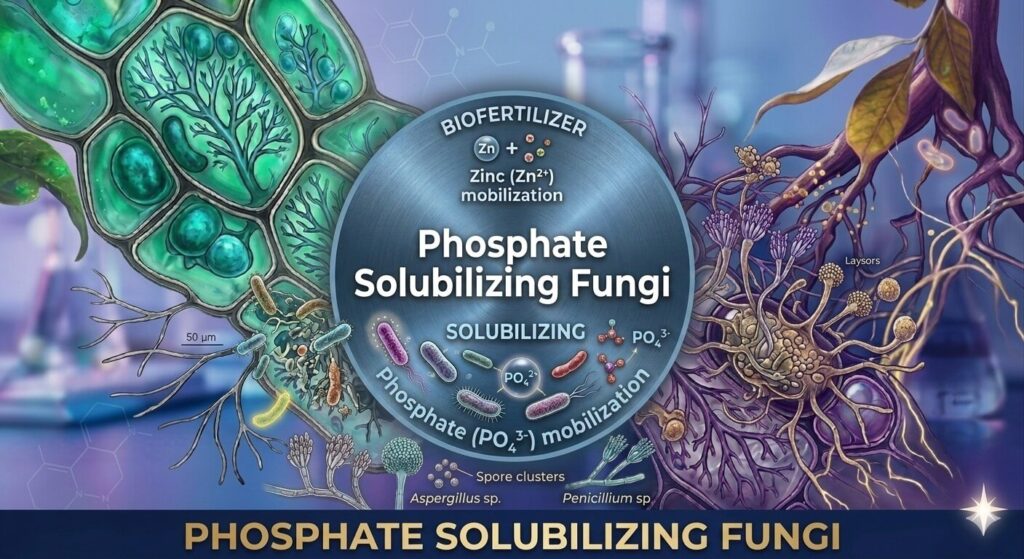
If bacteria thought they had the biofertilizer world all to themselves, fungi would like a word. While Rhizobium, Azotobacter, and their bacterial friends have been enjoying most of the spotlight in soil microbiology, two fungal species have been quietly building a reputation for being exceptionally good at one very important job — making phosphorus available to plants. Meet Penicillium sp. and Aspergillus awamori, the fungal duo that nobody talks about enough but every phosphorus-hungry soil desperately needs.
Phosphorus is one of the three most important nutrients a plant requires to grow well. It is involved in almost every major process inside the plant — from transferring energy between cells, to building roots, to forming flowers and seeds. Simply put, without enough phosphorus, a plant cannot perform at its best. It grows slowly, its roots remain weak, and its overall yield suffers considerably.
The frustrating reality is that most agricultural soils actually contain large amounts of phosphorus. The problem is not that phosphorus is absent — the problem is that it is locked. Most of this phosphorus sits trapped inside hard mineral compounds like calcium phosphate, iron phosphate, and aluminum phosphate, which plant roots have no ability to dissolve or break open on their own. Farmers try to fix this by applying chemical phosphatic fertilizers like DAP, but even a significant portion of that applied phosphorus quickly gets locked into insoluble forms again shortly after reaching the soil. It is an expensive cycle that keeps repeating itself without fully solving the problem.
This is exactly where Penicillium sp. and Aspergillus awamori step in. These two fungi belong to a group called Phosphate Solubilizing Fungi, and their defining ability is to chemically unlock this trapped phosphorus and release it into the soil water in a form that plant roots can directly absorb. What makes them stand out from phosphate solubilizing bacteria is the sheer quantity of organic acids they produce. These fungi are remarkably prolific acid producers, releasing gluconic acid, citric acid, oxalic acid, and tartaric acid into the surrounding soil in large and sustained amounts.
These organic acids work through two actions simultaneously. First, they lower the pH of the soil immediately around the fungal hyphae (tiny thread-like structures, similar to very fine roots, through which the fungus grows and spreads through the soil in all directions), making the local environment more acidic and chemically weakening the hard mineral compounds holding phosphorus captive. Second, they carry out chelation (where acid molecules behave like a pair of tiny hands that wrap themselves around the mineral ions locking phosphorus in place and pull them away — setting the phosphorus free), releasing free phosphate ions directly into the soil water where plant roots can absorb them. Gluconic acid is particularly powerful at this job and is produced in especially high amounts by both Penicillium and Aspergillus awamori, which is a big reason why these two fungi are so consistently effective.
Beyond organic acids, these fungi also produce enzymes called phytases. Not all soil phosphorus is locked in minerals — a significant portion is also trapped inside organic matter and decomposing plant residues in the form of compounds called phytates. Phytase enzymes specifically target these phytate molecules, break them apart, and release the phosphorus held within them. This means these fungi are simultaneously unlocking phosphorus from two completely different sources — minerals and organic matter — giving them a broader reach and greater overall impact than most other phosphate solubilizers.
There is one more advantage that makes these fungi genuinely special, and it comes down to their physical structure. Unlike bacteria, which are individual cells sitting in one spot in the soil, fungi grow as a continuous interconnected web of hyphae that spreads outward through the soil over considerable distances. This expanding web dramatically increases the area of soil the fungus can reach and act upon. More soil contact means more mineral surface exposed to acid and enzyme activity, which means more phosphorus released. In this sense, the hyphal network of Penicillium and Aspergillus awamori functions very much like the external hyphae of VAM fungi, massively extending the biological reach of the plant beyond what its own roots could ever achieve alone.
Penicillium sp. and Aspergillus awamori are commercially available as biofertilizer inoculants and have delivered consistently strong results in crops like wheat, maize, chickpea, and vegetables, especially in alkaline and heavily farmed soils where phosphorus fixation is most severe. As chemical fertilizer costs rise and their environmental consequences become harder to ignore, these two quietly hardworking fungi offer farmers something genuinely valuable — a natural, affordable, and biologically intelligent way to feed their crops better. They may not have the fame of their bacterial counterparts, but in the phosphorus department, they have always been the ones quietly running the show.