
The One Thing We Never Put on Our Shopping List
Every season, we plan carefully. We budget for seeds, fertilizers, and irrigation. We track input costs and calculate expected returns. But there is one thing most of us never plan for — never budget for — and rarely even think about until it is too late.
Soil organic matter.
It does not come in a bag. It does not have a price tag at the agri-input shop. And yet without it, everything else we spend on our farm begins to work against us rather than for us.
Across intensively cultivated land in India and globally, organic matter levels are shrinking season by season. The Government of India’s Soil Health Card programme classifies Soil Organic Carbon — the measurable indicator of organic matter in our soil — into three levels:
Soil Organic Carbon (OC) — Where Does Our Soil Stand?
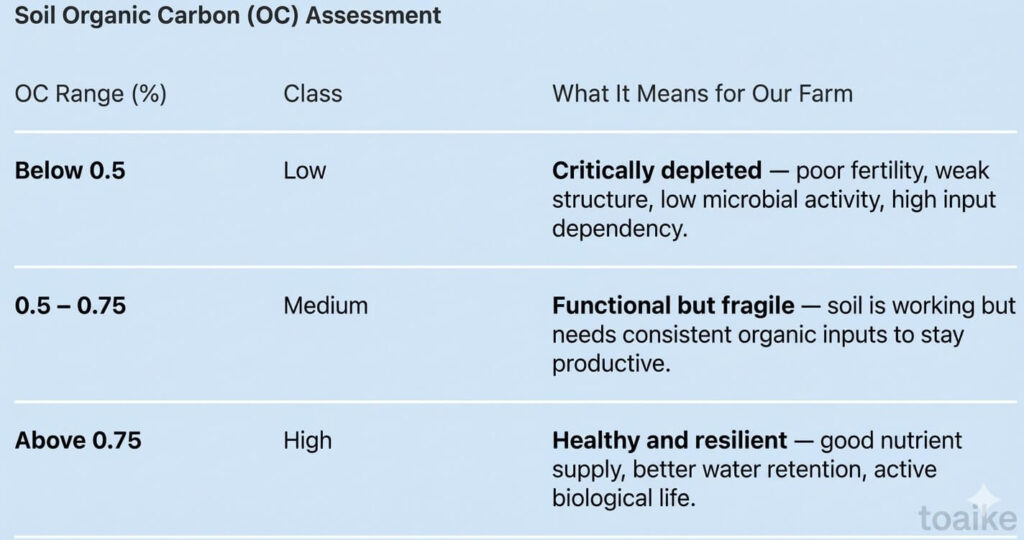
Source: Draft Teacher’s Manual on Soil Health, Department of Agriculture & Cooperation, Government of India. Available at: soilhealth.dac.gov.in
The reality is that a large proportion of our intensively farmed soils in India today fall in the Low category — below 0.5% OC. This is a number we cannot afford to ignore, because everything our soil does for us — holding water, supplying nutrients, supporting life — weakens as this number falls.
So What Exactly Is Soil Organic Matter?
Organic matter is the living and once-living fraction of our soil. It includes decomposing plant roots, surface litter, crop stubble, animal dung, and the countless generations of microorganisms that have lived, worked, and died in the ground beneath our feet.
According to the FAO, soil organic matter is made up of two key fractions that work together: an active organic fraction — including living microorganisms — that makes up 10 to 40 percent, and a resistant or stable fraction known as humus, which accounts for 40 to 60 percent of total organic matter. The active fraction drives nutrient cycling and biological activity. The stable fraction — humus — holds nutrients, buffers pH, and gives soil its long-term structure and resilience. Both are essential, and both decline when we mismanage our land.
What makes organic matter so valuable is not any single thing it does — it is everything it does, all at once:
- It sustains the vast underground community of bacteria, fungi, and soil organisms that drive nutrient cycling and keep the soil food web intact
- It absorbs and retains moisture far beyond its own weight — acting as a buffer against dry spells and reducing how much irrigation our crops need
- It holds soil particles together in stable, crumbly clusters — the kind of structure that lets roots grow freely and water move evenly
- It functions as a slow-release nutrient store — steadily supplying nitrogen, phosphorus, sulphur, and trace elements as crops need them
- It stabilises soil pH — preventing the extreme acidification or alkalisation that makes nutrients unavailable to plants
- It sequesters carbon — keeping it locked underground rather than releasing it into the atmosphere
Remove organic matter from this picture and every one of these functions begins to fail — not one by one, but together.
The Cascade of Consequences
What makes organic matter decline so damaging is that it does not produce a single, isolated problem. It sets off a chain reaction across the entire soil system.
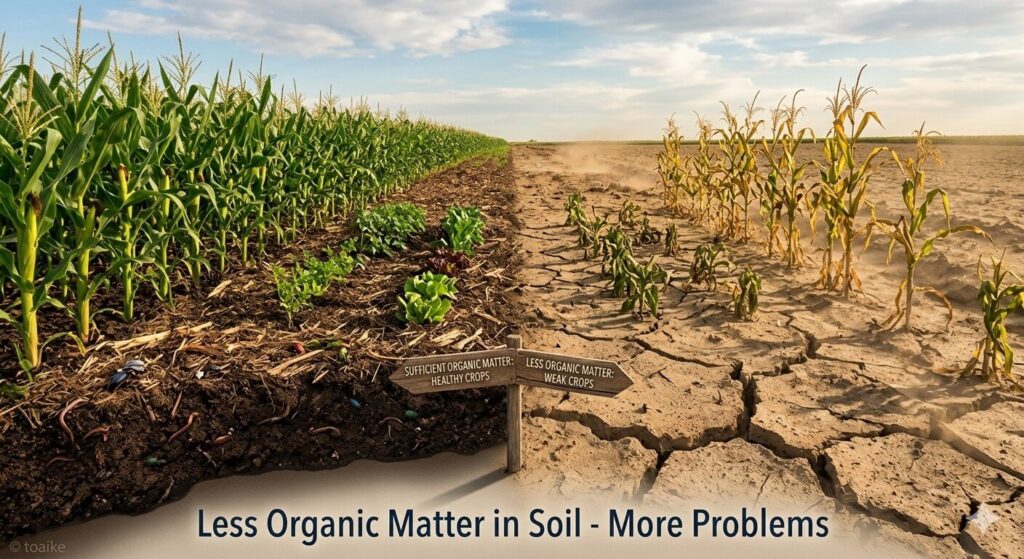
Water retention collapses. Organic matter holds moisture like a sponge. As levels drop, our soil dries out between rains and irrigation cycles much faster. Crop stress increases. Water bills rise. And drought, which was once manageable, becomes a recurring crisis.
Physical structure deteriorates. The organic glue that holds soil aggregates together weakens. Soil compacts under machinery and rainfall, crusts over at the surface, and begins shedding water rather than absorbing it. Roots hit resistance earlier and cannot develop the depth they need.
Fertilizer efficiency falls. In organically depleted soil, chemical fertilizers have no stable matrix to work within. Nutrients leach away before roots can reach them, or get locked up in chemical forms plants cannot use. We apply more and get less — a cycle that drains our budget while degrading our soil further.
The soil community shrinks. Every microorganism in our soil depends on organic matter as its energy source. When that source diminishes, populations crash. Nutrient cycling slows. Natural disease suppression disappears. The invisible workforce that once ran our soil for free goes silent.
pH control is lost. Without organic matter buffering our soil chemistry, pH becomes reactive and unpredictable — swinging acidic under nitrogen fertilizers and alkaline under hard irrigation water, making nutrient availability increasingly unreliable.
Carbon escapes into the air. Every percentage point of organic matter lost from our soil means carbon that was safely stored underground is now in the atmosphere — accelerating the very climate shifts that make farming harder each decade.
How Did We Get Here?
The answer lies in a combination of practices that have become routine on most farms. We burn our crop residues after harvest — removing the single largest source of organic matter replenishment available to us. We till heavily and repeatedly — exposing organic matter to air and accelerating its breakdown. We rely on chemical inputs alone, year after year, without returning any biological material to the ground. And we grow the same crop continuously, giving the soil no opportunity to rest or recover.
Each of these decisions, taken individually, seems manageable. Taken together, season after season, they quietly hollow out our soil’s most vital resource.
It is like withdrawing from a savings account every season — and never once making a deposit.
Rebuilding What We Have Lost
Organic matter cannot be restored in a single season. But it can be rebuilt — consistently and meaningfully — through a set of practices that any farmer can begin today.
Stop burning. Start incorporating. Crop residues chopped and turned into the soil after harvest are the most immediate and affordable source of organic matter replenishment available to us. What we currently burn is exactly what our soil is asking for.
Compost regularly. Well-matured compost delivers stable organic matter directly into the soil, feeds microbial communities, and improves structure with every application. It is one of the most reliable long-term investments we can make in our land.
Return Farm Yard Manure to the field. Applied before sowing, FYM gives the soil time to fully absorb its biological and nutritional benefits. Its value compounds with each passing season.
Grow and turn green manure crops. Species like Dhaincha, Sunhemp, and Cowpea grow quickly during fallow periods and can be ploughed back while still green — delivering a rapid boost of both organic matter and nitrogen to our soil.
Reduce tillage wherever possible. Every unnecessary pass of the plough breaks down organic aggregates and exposes stored carbon to oxidation. Minimum and no-till approaches preserve what the soil has already built up.
Rotate with legumes. Legume crops contribute nitrogen through their root nodules and add biomass to the soil after harvest — supporting both organic matter accumulation and long-term nutrient balance.
Conclusion : What We Need to Remember
Organic matter is not a supplement to good farming — it is the foundation of it. Every other input we apply — fertilizer, water, lime, gypsum — works better when organic matter levels are healthy. And every problem we face in our soil — compaction, poor drainage, nutrient deficiency, pH instability — is made worse when they are not.
The Soil Organic Carbon classification from the Government of India’s Soil Health programme gives us a clear, simple benchmark — above 0.75% is where we want to be. If our Soil Health Card shows us in the Low or Medium range, rebuilding organic matter is the single most important investment we can make in our farm’s future.
We do not need to transform our entire operation at once. We simply need to begin returning to the soil what we have been taking from it — steadily, season by season.
The soil has a long memory. Every good decision we make today will show up in the ground — and in our harvests — for years to come.
References
- Bot, A. and Benites, J. (2005). The Importance of Soil Organic Matter: Key to Drought-Resistant Soil and Sustained Food Production. FAO Soils Bulletin 80. Food and Agriculture Organization of the United Nations, Rome. Available at: https://www.fao.org/4/a0100e/a0100e.pdf
- Department of Agriculture & Cooperation, Government of India. Draft Teacher’s Manual on Soil Health. National Soil Health Card Programme. Available at: https://soilhealth.dac.gov.in/files/Manual/140723DraftTeacherManual_PDF.pdf