
When our Soil Health Card arrives, we scan through twelve parameters — pH, Nitrogen, Phosphorus, Potassium, Zinc, and the rest. Each one carries meaning. Each one points to something specific our soil needs.
But one parameter stands apart from all the others.
Organic Carbon –The One Number That Connects Everything Beneath Our Feet
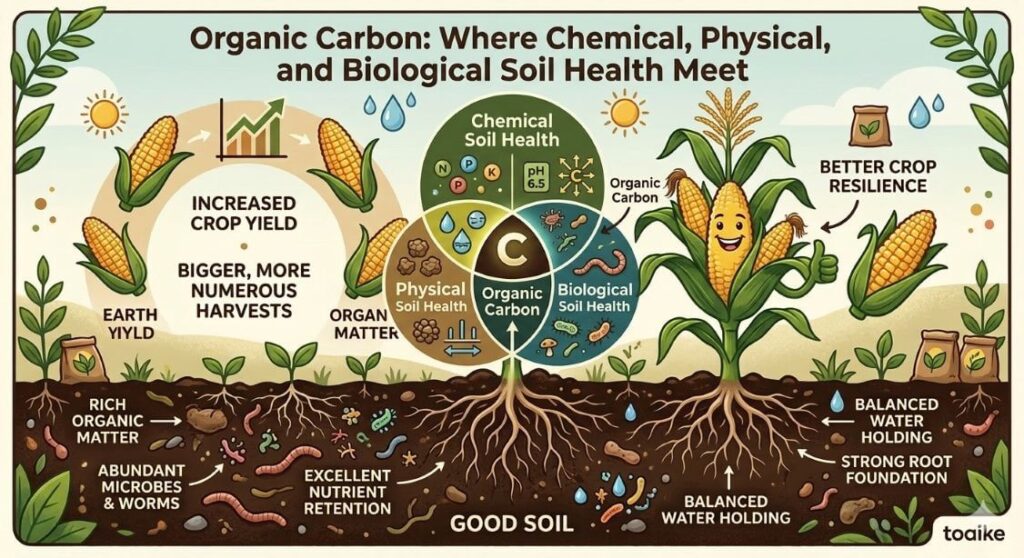
Every other reading on that card tells us something about one aspect of our soil. Organic Carbon tells us about all three — its chemical condition, its biological vitality, and its physical structure — at the same time. No other single measurement does this.
That is not a minor distinction. It is the reason why organic carbon is considered, by soil scientists and agricultural institutions worldwide, to be the most integrative indicator of overall soil health that we have. Understanding why changes not just how we read a soil report — it changes how we manage our land.
What Organic Carbon Actually Is?
Organic carbon is the carbon fraction remaining in our soil after plant residues, animal matter, root systems, and microbial remains have been broken down by soil organisms over time. It is what persists after decomposition — a stable, dark, biologically active material that accumulates slowly and depletes faster than most of us realise.
It is measured in the laboratory as a percentage of total soil weight and appears on our Soil Health Card under chemical parameters. India’s National Soil Health Card Programme places it in one of three classes:
| OC Range (%) | Class |
| Below 0.5 | Low |
| 0.5 – 0.75 | Medium |
| Above 0.75 | High |
Source: Draft Teacher’s Manual on Soil Health, National Soil Health Card Programme
A significant portion of intensively cultivated land in India today sits in the Low bracket. That single fact — a number below 0.5 on a piece of paper — carries consequences that reach into every corner of how our soil functions.
The Chemical Dimension — Feeding the Crop From Within
The most familiar role organic carbon plays is a chemical one — and it is substantial.
As organic matter breaks down, it continuously releases nitrogen, phosphorus, sulphur, and an array of micronutrients directly into the soil solution in forms that plant roots can absorb without any processing. This is not a one-time release — it is a steady, season-long supply that operates independently of whatever we apply from outside. When organic carbon is abundant, this internal feeding system quietly supplements everything else we do. When it is depleted, that supplement disappears — and the full burden falls on purchased inputs that cannot replicate its consistency or balance.
Organic carbon also functions as a chemical stabiliser for pH. It resists the acidifying effect of repeated nitrogen fertilizer applications and buffers against the alkalising influence of hard irrigation water. Soils that have lost their organic carbon have lost this buffering capacity — their pH becomes reactive and unpredictable, swinging in response to inputs rather than holding steady.
Perhaps most practically significant is organic carbon’s effect on Cation Exchange Capacity — our soil’s ability to hold positively charged nutrient ions like calcium, magnesium, potassium, and ammonium in the root zone rather than losing them to leaching. Organic carbon is one of the primary contributors to this capacity. As it declines, our soil’s grip on nutrients weakens — and fertilizers we apply wash below the root zone before our crops can reach them. We spend more. We get less. And the cycle continues.
The Biological Dimension — Born From Life, Sustained By Life
And yet, reducing organic carbon to a chemical measurement misses something fundamental about its nature.
Organic carbon does not arrive in a bag. It cannot be synthesised in a factory or purchased from an agri-input dealer. It is created exclusively through biological activity — the patient, continuous work of soil organisms breaking down plant and animal material over time. Without life in our soil, organic carbon cannot form. Without organic carbon in our soil, life cannot be sustained. The relationship runs in both directions, simultaneously.
Every organism living in our soil — every bacterium, fungus, protozoan, and earthworm — draws on organic carbon as its primary energy source. When organic carbon is present in adequate amounts, this community is diverse, active, and productive. Nutrient cycling runs efficiently. Atmospheric nitrogen gets fixed by bacteria and made available to our crops. Mycorrhizal fungi extend root reach far beyond what the plant could achieve on its own. Disease-causing organisms are kept in check by a diverse community of natural competitors and predators.
When organic carbon falls below the threshold our soil organisms need, this community contracts. Populations shrink. Diversity collapses. Processes that once ran without any input cost begin to slow or fail altogether. We find ourselves compensating with fungicides for the disease control that a healthy microbial community once provided freely, and with synthetic nitrogen for what soil bacteria once fixed from the atmosphere.
The humus fraction of organic carbon — its most stable component — is itself a biological product. It forms through successive rounds of transformation by soil organisms across many generations. No chemical process creates it. No purchased product replicates it. It accumulates only where biological life is active and organic matter is consistently returned to the soil.
When we measure organic carbon, we are in a very real sense measuring the history of biological management on that piece of land — the cumulative result of how much organic matter we have returned, how much we have removed, and how well we have protected the living community that transforms one into the other.
The Physical Dimension — Holding the Soil Together
The influence of organic carbon on our soil’s physical condition is equally significant — and perhaps the least appreciated of the three.
Healthy soil has a characteristic structure — crumbly, open, and stable — that allows water to enter and move freely, roots to extend without resistance, and air to circulate through the profile. This structure does not happen automatically. It is built and maintained by organic carbon, working together with the sticky substances produced by soil fungi and bacteria, to bind individual mineral particles into larger, stable clusters called aggregates.
These aggregates are the architecture of a functional soil. They create the pore network that determines how water, air, and roots move through the profile. When organic carbon is adequate, aggregates are stable — they hold their shape under the impact of rainfall, the pressure of machinery, and the force of irrigation water. When organic carbon is depleted, aggregates disintegrate. The pore network collapses. The soil seals over at the surface, shedding water rather than absorbing it. Roots hit resistance at shallow depths. Compaction sets in faster and goes deeper.
The water retention consequences are equally direct. Organic carbon holds several times its own weight in moisture — acting as a reservoir that releases water gradually to plant roots during the dry intervals between rainfall and irrigation events. Every percentage point of organic carbon we lose from our soil translates into measurably faster drying, greater irrigation demand, and deeper vulnerability to drought stress during critical growth stages.
Erosion risk rises in parallel. Organic matter on and within the soil surface cushions the energy of falling raindrops — preventing the particle displacement that triggers surface sealing and runoff. It also holds topsoil particles in place against wind and water movement. Fields low in organic carbon are among the most erosion-prone — and the topsoil they lose carries away the organic carbon it contained, accelerating the very decline that made them vulnerable in the first place.
Organic carbon - The Single Indicator That Reflects All Three
What distinguishes organic carbon from every other parameter on our Soil Health Card is this: its decline does not signal a problem in one dimension. It signals stress across all three at once.
When our organic carbon is in the High range:
- Nutrients are cycling efficiently, pH is stable, and fertilizers are working as they should
- Soil life is active, diverse, and providing services we would otherwise have to purchase
- Soil structure is stable, water is being retained, roots are growing freely, and compaction is being resisted
When our organic carbon falls into the Low range, none of these conditions hold. Chemistry, biology, and physical structure all weaken together — not sequentially, but simultaneously.
A single low organic carbon reading deserves more attention than any other number on that card. It is not telling us about one problem. It is telling us that our soil’s entire functioning system is under strain.
One Practice. Three Returns.
Recognising organic carbon as a cross-dimensional indicator reframes how we think about the practices that build it.
Every time we incorporate crop residues rather than burning them, apply compost or Farm Yard Manure, establish a green manure crop, reduce unnecessary tillage, or rotate with legumes — we are not just addressing a chemical deficiency. We are simultaneously feeding our soil’s biological community, stabilising its physical structure, and replenishing its nutrient reservoir.
There is no other single category of farm practice that delivers returns across all three dimensions of soil health at the same time. That is the case for placing organic carbon management at the centre of everything we do on our land — not as one priority among many, but as the foundation on which all other soil health investments rest.
What the Number on Our Card Is Really Telling Us
If our Soil Health Card shows organic carbon in the Low category — below 0.5 percent — that reading is carrying a message that goes well beyond chemistry.
It is telling us that our soil’s nutrient supply system is weakening. That its biological community is under stress. That its physical structure is becoming fragile. That our inputs are working less efficiently than they should, our water is being retained less reliably than it could be, and our roots are meeting more resistance than they need to.
Bringing that number up — through patient, consistent organic matter management across seasons — does not just improve a laboratory reading. It rebuilds the capacity of our soil to do what it was always meant to do: sustain life, support crops, and reward the effort we put into our land.
That is what organic carbon represents. And that is why, of all the numbers on our Soil Health Card, it is the one that tells us the most.
References
FAO Soils Bulletin 80 — The Importance of Soil Organic Matter. Food and Agriculture Organization of the United Nations, Rome. Available at: https://www.fao.org/4/a0100e/a0100e.pdf
Draft Teacher’s Manual on Soil Health. National Soil Health Card Programme, Department of Agriculture & Cooperation, India. Available at: https://soilhealth.dac.gov.in/files/Manual/140723DraftTeacherManual_PDF.pdf