
NPK Liquid Consortia Biofertilizer
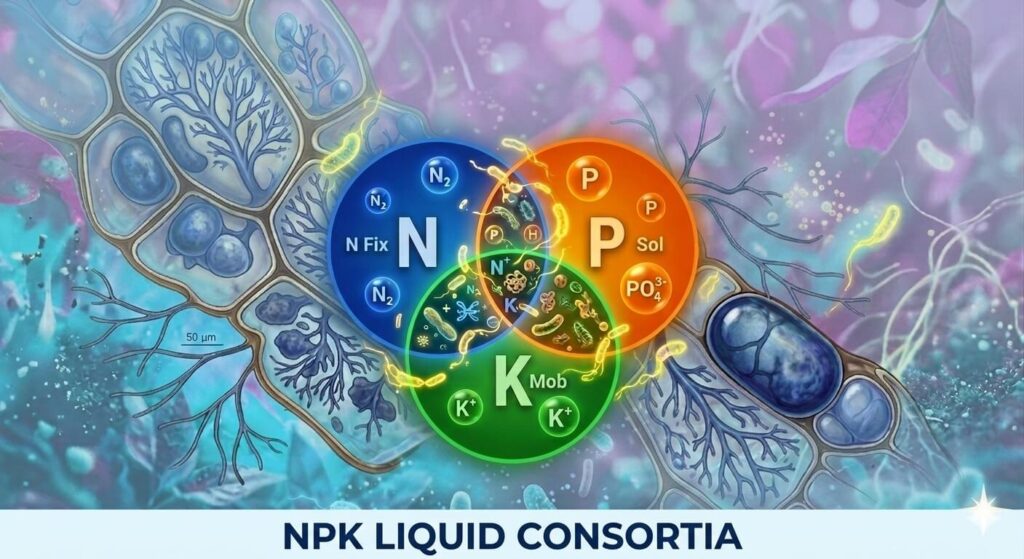
For most of agricultural history, feeding a crop meant reaching for three separate bags of chemical fertilizer — one for nitrogen, one for phosphorus, and one for potassium — tearing them open, and hoping for the best. It was effective, expensive, and about as subtle as hitting the soil with a nutrient hammer. Then someone had the rather brilliant idea of asking whether nature had already figured out a more elegant solution, and the answer, as it turns out, was sitting in the soil the entire time. NPK Liquid Consortia is that solution — a carefully assembled team of beneficial microorganisms that work together to deliver all three major nutrients to crops naturally, efficiently, and without a chemical bag in sight.
NPK Liquid Consortia is a microbial consortium, which simply means it is not a single organism but a deliberate combination of several different beneficial microbes packaged together in a liquid formulation. The key members of this consortium include nitrogen-fixing bacteria such as Rhizobium, Azotobacter, and Acetobacter, alongside phosphorus-solubilizing bacteria like Pseudomonas, and potassium-solubilizing bacteria. Each member of this team has a specific and well-defined role, and together they cover the entire spectrum of the three nutrients that crops need most — nitrogen, phosphorus, and potassium.
The nitrogen-fixing members of the consortium are Rhizobium, Azotobacter, and Acetobacter. Rhizobium forms nodules on legume roots and fixes nitrogen within them, Azotobacter works freely in the soil fixing nitrogen independently, and Acetobacter operates from within plant tissue in sugar-rich crops. Together, these three organisms ensure that atmospheric nitrogen is continuously captured and converted into ammonia and other plant-usable nitrogen compounds, feeding the crop from above without any synthetic urea being required.
The phosphorus-solubilizing bacteria, particularly Pseudomonas strains, tackle one of the most persistent problems in soil nutrition — the fact that most phosphorus in the soil exists in insoluble, chemically bound forms that plant roots simply cannot absorb. These bacteria release organic acids and enzymes that chemically attack the mineral compounds locking phosphorus in place, breaking them apart and releasing free phosphorus ions into the soil solution. This directly available phosphorus is then absorbed by plant roots and used for energy transfer, root development, and flowering — all processes that are critically dependent on adequate phosphorus supply.
The potassium-solubilizing bacteria complete the trio by targeting potassium locked inside silicate minerals like feldspar and mica. Through a combination of organic acid secretion and enzymatic action, they break down these tough mineral structures and release potassium ions into the soil water, making them accessible to plant roots. Potassium plays a vital role in regulating water movement within the plant, activating enzymes, and improving the quality and size of fruits and grains.
What makes NPK Liquid Consortia genuinely powerful is not just the individual contributions of each member but the synergy that emerges when they all work together in the same soil environment. The organic acids produced by phosphorus and potassium solubilizers create a slightly acidic microenvironment that actually supports the activity of nitrogen fixers. The improved root development driven by growth hormones secreted by Azotobacter creates a larger and more active rhizosphere, which in turn supports higher populations of all the consortium members. The result is a self-reinforcing cycle of biological activity that continuously improves nutrient availability throughout the growing season.
Application of NPK Liquid Consortia leads to not only yield improvements but also meaningful reductions in the chemical fertilizer particularly urea, DAP, and MOP. Beyond yield, regular use of the consortia improves overall soil microbial diversity and long-term soil health, building a more fertile and biologically active soil with every passing season.
In a world increasingly aware of the environmental damage caused by chemical fertilizer overuse — from water pollution to greenhouse gas emissions to soil degradation — NPK Liquid Consortia represents a practical, proven, and accessible step toward a more sustainable and balanced approach to crop nutrition.