
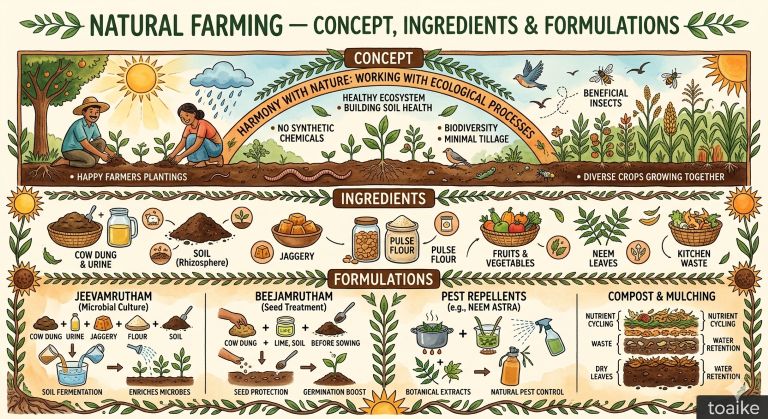
Natural farming — concept, ingredients & formulations

Natural farming — concept, ingredients & formulations

Concept of Natural Farming

Natural farming is a holistic system of agriculture that avoids synthetic chemicals and instead uses locally available biological inputs. It emphasises harmony with nature, relying on cow-based products, microbial inoculants, plant extracts, and natural substances to nourish crops, control pests, and enrich soil health. The approach reduces external inputs, enhances biodiversity, and strengthens resilience in the agroecosystem.

The effectiveness of natural farming lies in its ingredients. Each component contributes unique bioactive compounds and microbial activity. Preparation follows a deliberate sequence: first the fermentation base, then spices and condiments, and finally medicinal leaves. Together, they create potent concoctions for soil biology, insect management, and disease management.

Ingredient Roles and Active Compounds

Fermentation Base

Cow Dung
CompoundsBeneficial microbes
RoleSupports fermentation, nutrient cycling
Cow Urine
CompoundsUrea, phenols, volatile fatty acids
RoleAntiseptic; microbial activator
Virgin Soil (Native)
CompoundsNative microbial consortia
RoleInoculates mixture with diverse microflora
Cane Jaggery
CompoundsSucrose, glucose, fructose
RoleCarbon source for microbes; accelerates fermentation
Pulse Flour
CompoundsProteins, amino acids
RoleNitrogen source for microbial growth
Sour Buttermilk
CompoundsLactic acid bacteria, organic acids
RoleControls fungi; reported antiviral effect

Spices & Condiments

Turmeric
CompoundsCurcumin, turmerone
RoleAntifungal, antibacterial
Asafoetida
CompoundsFerulic acid, sulphur compounds
RoleRepels insects; antibacterial
Ginger (Fresh & Dry)
CompoundsGingerols, shogaols, zingerone
RoleAntimicrobial, insect deterrent; antifungal when dry
Tobacco
CompoundsNicotine, anabasine
RoleNeurotoxic to insects
Green Chilli
CompoundsCapsaicin
RoleIrritant to chewing insects
Garlic
CompoundsAllicin, sulphur compounds
RoleRepels aphids/jassids; antifungal

Medicinal Leaves

Neem
CompoundsAzadirachtin, nimbin, salannin
RoleInsect growth regulator
Karanj (Pongamia)
CompoundsKaranjin, pongamol
RoleAntifungal, insecticidal
Castor
CompoundsRicin, ricinoleic acid
RoleRepels leaf-eating insects
Sitaphal (Custard Apple)
CompoundsAcetogenins
RoleToxic to caterpillars and borers
Bael
CompoundsMarmelosin, coumarins
RoleAntimicrobial; strengthens plant immunity
Marigold
CompoundsAlpha-terthienyl, limonene
RoleNematicidal
Tulsi (Holy Basil)
CompoundsEugenol, ursolic acid
RoleAntibacterial, antifungal
Dhatura (Jimsonweed)
CompoundsTropane alkaloids
RoleToxic to chewing insects
Mango
CompoundsMangiferin, tannins
RoleAntimicrobial; resistance booster
Aak (Calotropis)
CompoundsCardiac glycosides, latex
RoleToxic latex deters caterpillars and sucking pests

Sprouted Grains (Saptdhanyankur Ark)

Sesame (Til)
CompoundsSesamin, sesamolin, fatty acids
RoleOilseed component; contributes fatty acids and proteins
Moong, Urad, Cowpea, Moth, Gram
CompoundsAmino acids, soluble proteins, plant hormones
RoleNitrogen-rich; release growth hormones on sprouting
Wheat
CompoundsCytokinins, gibberellins, starch, proteins
RoleContributes growth hormones that promote grain filling

Dairy & Other Inputs

Desi Cow Milk
CompoundsProteins, calcium, lactic acid, growth factors
RoleAntifungal carrier medium; used in Sonthastra
Copper Piece
CompoundsCopper ions (Cu²⁺)
RoleAntimicrobial; enhances antifungal and antiviral activity in Khatti Lassi spray

Concoctions for Active Soil Biology

Beejamrit
Seed dressing / seedling root dip — protects against soil-borne and seed-borne pathogens; enhances germination and vigour
Ingredients5 kg fresh desi cow dung · 5 L desi cow urine · 50–100 g virgin soil · 50 g calcium chloride · 20 L water
PreparationStir all ingredients thoroughly. Ferment 24 hours. Coat seeds and dry in shade before sowing, or dip seedling roots before transplanting.
ApplicationSeed dressing or seedling root dip · Use fresh
Jeevamrit
Fermented microbial culture — improves soil microbial activity, nutrient cycling and root development
Ingredients200 L water · 10 kg fresh desi cow dung · 10 L aged desi cow urine · 1.5 kg cane jaggery · 1.5 kg pulse flour · 50–100 g virgin soil
PreparationMix all in clean large container. Cover with jute sack in shade. Stir clockwise with wooden stick twice daily. Ferment 48 hrs (3–4 days summer; 6–7 days winter).
Application200–600 L/acre with irrigation water, twice a month. Foliar: 5–10% spray every 20–25 days.
Ghanajeevamrit
Solid form of Jeevamrit — dry soil amendment with same biological benefits; easy to store and apply
Ingredients100 kg dry cow dung · 10 L prepared jeevamrit
PreparationSpread dry cow dung in thin layer. Sprinkle jeevamrit uniformly. Mix with spade. Heap and cover with jute bag. Dry 16 hrs in sunlight. Pound to powder and store in jute bags.
Application800–1000 kg/acre as basal dose or top dressing. Store up to 6 months.

Botanical Concoctions for Insect Management

Agniastra
Controls leaf roller, stem borer, fruit borer, pod borer
Ingredients20 L desi cow urine · 500 g tobacco powder · 500 g green chilli · 250 g garlic · 5 kg neem leaves
PreparationAdd all ingredients to cow urine. Stir well. Boil. Cool. Ferment 48 hours. Filter with cloth.
Application6–8 L per 200 L water per acre. Spray every 15 days or monthly. Use within 3 months.
Brahmastra
Controls sucking pests, fruit borer, pod borer
Ingredients10 L desi cow urine · 2 kg each: neem, karanj, custard apple, castor, dhatura leaves
PreparationCrush leaves to paste. Add to cow urine. Boil until frothing. Filter. Ferment 48 hrs in shade. Stir twice daily.
Application6–8 L per 200 L water per acre. Spray every 15 days or monthly. Use within 1 month.
Neemastra
Controls sucking pests and leaf-eating caterpillars
Ingredients100 L water · 5 L desi cow urine · 1 kg fresh cow dung · 5 kg neem leaf paste
PreparationMix all in water. Ferment 48–96 hours. Stir twice daily. Filter with cloth.
ApplicationReady as prepared — sufficient for one acre. Use fresh.
Dashparni Ark
Controls borers, maggots, caterpillars
Ingredients200 L water · 20 L cow urine · 2 kg cow dung · 2 kg each of 10 leaves (neem, karanj, castor, sitaphal, bael, marigold, tulsi, dhatura, mango, aak) · 500 g turmeric · 10 g asafoetida · 500 g ginger · 200 g dry ginger · 1 kg tobacco · 1 kg green chilli · 1 kg garlic
Preparation1. Dissolve dung + urine in water; rest 2 hrs. 2. Add turmeric, ginger, asafoetida; rest 24 hrs. 3. Add dry ginger, tobacco, chilli, garlic; rest 24 hrs. 4. Crush and press leaves in. 5. Cover with gunny bag; ferment 30–40 days; stir 2–3 min morning and evening.
Application6–8 L per 200 L water per acre. Spray every 15 days or monthly. Use within 3 months.

Botanical Concoctions for Disease Management

Sonthastra
Control of fungal diseases
Ingredients200 g dry ginger · 5 L desi cow milk · 200 L water
PreparationBoil ginger in 2 L water till 1 L remains; cool. Boil milk once; cool; remove cream. Sieve both through cloth. Mix into 200 L water.
ApplicationSpray on one acre. Use fresh.
Khatti Lassi
Controls fungal diseases; reported virus killer
Ingredients100 L water · 5 L khatti lassi (3–5 days old) · 50 g turmeric · 1 small copper piece
PreparationDip copper piece in lassi for 3–5 days. Dissolve turmeric in water. Mix copper-treated lassi into turmeric water.
ApplicationSpray on one acre. Use fresh.
Cow Urine Spray
Controls soil-borne, seed-borne, wilt, canopy, bacterial and fungal diseases
Ingredients30–40 L cow urine (pre-sowing) or 10–20% solution (foliar)
PreparationDilute in water as required. No fermentation needed.
Application30–40 L with pre-sowing irrigation. 10–20% foliar spray for canopy diseases. 10% in pit for fruit crops.
Saptdhanyankur Ark
Increases grain shine and weight; reduces flower and fruit drop. Use at milk stage of grains, infancy of fruit, and bud stage of flower crops.
Ingredients100 g each of sesame, moong, urad, cowpea, moth, gram, wheat · 10 L cow urine · seed-soak water · 200 L water
PreparationDay 1: Soak sesame. Day 2: Add all seeds; soak overnight. Day 3: Tie in cloth; hang to sprout. Grind sprouted seeds to paste. Mix water + urine + soak water + paste. Rest 2 hrs. Filter.
ApplicationMix in 200 L water; filter before spraying. Use within 48 hours.

Finally

Natural farming formulations are built on the synergy of these ingredients. The fermentation base activates microbial communities; spices add antimicrobial and insecticidal strength; and medicinal leaves contribute alkaloids, glycosides, and phenolics that directly target pests and diseases. Concoctions for soil biology form the foundation, while botanical concoctions for insect and disease management protect crops through concentrated plant chemistry and fermented extracts. Together, they create eco-friendly, multi-functional solutions that protect crops, enrich soil, and strengthen plant immunity.

Note

This information has been collected from various sources, including the Technical Manual on Natural Farming, Department of Agriculture & Farmers Welfare, Government of India (10.03.2025) and agricultural research. It is intended to help readers understand the ingredients used in natural farming. Some ingredients may have been left out, and many of them may have additional benefits beyond what is listed here. Readers are encouraged to explore further readings to deepen their knowledge of this subject..

References

Additional Reads

Scroll to Top