
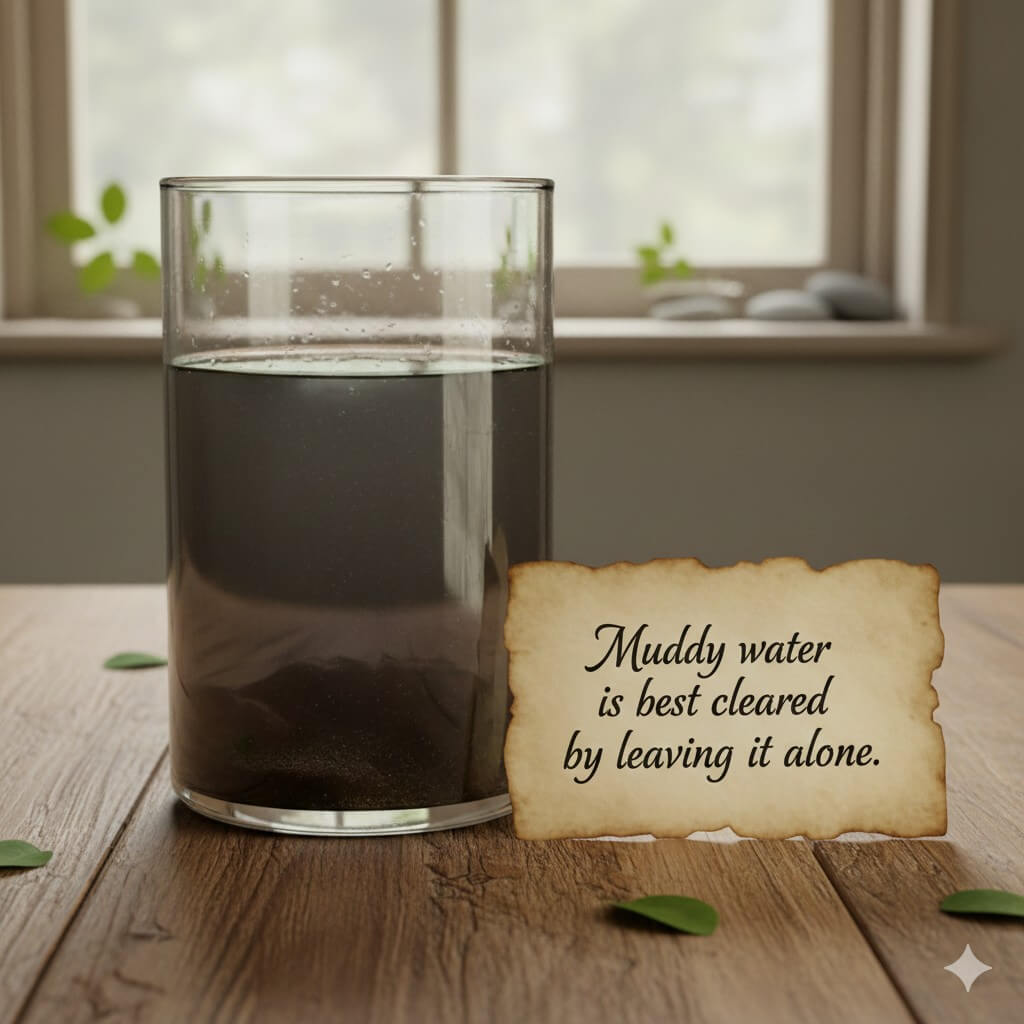
The saying “Muddy water is best cleared by leaving it alone” may sound like something meant for quiet moments, but it carries wisdom that can guide us in everyday life. It teaches us that not every problem needs an immediate reaction and not every situation should be handled in the heat of emotion. Sometimes, stepping back and allowing things to settle brings more clarity than trying to fix everything instantly. Just like real muddy water becomes clear when it is left undisturbed, our thoughts and emotions also settle when we stop reacting impulsively.
In the world we live in today, we are surrounded by speed. We make quick decisions, send quick messages, and expect quick answers. When something goes wrong, the pressure to respond immediately is even stronger. But quick reactions often come from a confused or emotional mind. When our thoughts are disturbed, our reactions become clumsy, and the situation becomes even more complicated. The more we stir the “mud,” the cloudier things get.
This is true even in small moments of daily life. Sometimes we argue, defend ourselves, or explain too much, only to realise later that none of it was necessary. Silence and distance are often more powerful than long explanations. Giving space is not running away from a problem; it is allowing clarity to return.
Imagine a simple situation at home. You are working on something important—an office task, a school assignment, or a personal project. You are already stressed when someone in your family makes a sharp or careless comment. You feel hurt, and your first instinct is to answer back or defend yourself. But if you reply immediately, your frustration mixes with their irritation, and a small moment turns into a big argument.
In such a situation, the idea of “leaving the muddy water alone” fits perfectly. If you pause, take a breath, and say nothing for the moment, you allow the emotional dust to settle. After a while, you may realise that you were simply tired and they were not thinking clearly. The issue fades on its own. Had you reacted instantly, the peace at home would have been disturbed over something that was never a real problem. By doing nothing for a moment, you end up protecting both your peace and your relationships.
This approach can also be seen in the larger context of India’s recent history. There have been moments when emotions in the country ran high and people demanded immediate or drastic action. But wise leadership has often understood the value of pausing and choosing calm over chaos. A good contemporary example is how India handled the Doklam standoff in 2017. When tensions rose at the India–China border, there was huge public pressure for a strong military response. The atmosphere was filled with fear, anger, and uncertainty—truly a moment of “muddy water.”
But India recognised that reacting aggressively could trigger unnecessary conflict. Instead of escalating the situation, the government followed a patient and measured approach. For weeks, quiet diplomatic discussions continued behind the scenes. By giving the situation time rather than reacting in haste, the standoff was resolved without war. This pause allowed clarity to return and prevented a temporary tension from turning into a long-lasting disaster. It showed that even in moments of national anxiety, patience can lead to wiser and safer outcomes.
On the global stage too, the same idea repeats itself. International events are often full of tension, pressure, and demands for immediate decisions. Yet one of the strongest modern examples of patience helping prevent escalation came during the early Russia–Ukraine tensions in 2022. As troop movements increased and fear spread in Europe, there was enormous pressure on countries to react quickly. The situation was like global “muddy water,” with rumours, anger, and uncertainty everywhere.
Instead of taking drastic steps straight away, several European nations and the United States spent weeks trying diplomacy and negotiation. They held repeated talks, delayed extreme decisions, and tried to calm the situation through dialogue. Although the conflict eventually broke out due to many complex reasons, that initial period of restraint prevented the crisis from expanding even faster or involving more countries. It showed that in global politics, patience—though not always enough—can prevent unnecessary explosions.
Another example is the way many nations have handled tensions in the South China Sea over the last few years. Multiple countries could have reacted aggressively, but instead, they chose negotiation, quiet diplomacy, and international discussions. Their patience prevented a volatile region from turning into a warzone. These examples show that even today, calm decision-making can create peace where panic might create conflict.
Why does “leaving things alone” work so well? Because when we are emotional, our judgement becomes cloudy. Anger, fear, and stress disturb our inner clarity. Any decision made during such a time is likely to be rushed, exaggerated, or regretted later. But when we pause, emotions settle and the mind becomes clearer. Suddenly, what felt huge becomes manageable, and what felt urgent doesn’t feel so urgent anymore.
There is also another truth: some problems do not need solving—they need space. Many misunderstandings fade with time. Many people calm down when given silence. Many issues sort themselves out when we stop poking at them. Nature itself follows this rule. Forests heal when they are left alone. Rivers clear when pollution stops entering them. Time is a gentle healer, but only when we allow it to work.
Of course, leaving things alone does not mean avoiding responsibility. It does not mean ignoring important problems. The real wisdom lies in knowing when to wait and when to act. If emotions are high, waiting helps. If the situation is urgent or harmful, action becomes necessary. The art of life is finding the right balance between patience and action.
In our personal lives, this simple idea can save us from unnecessary stress. When we feel angry, we can pause before speaking. When confused, we can rest before deciding. When hurt, we can allow time to softens things. When overwhelmed, we can step back before moving ahead. These small acts of patience create big differences.
The saying “Muddy water is best cleared by leaving it alone” gives us a calm and hopeful message. It reminds us that clarity comes from stillness. Peace comes from patience. Understanding grows when we give space. Life becomes simpler and kinder when we learn to pause instead of react.
In the end, when we allow things to settle, clarity always returns. And with clarity comes the strength to move forward with peace, confidence, and wisdom.
