
Liquid vs WP Biofertilizers
What's the Difference and Which One Should You Use?
If you’ve been farming for a while or just getting started with sustainable agriculture, you’ve probably come across the term “biofertilizers.” But what exactly are they? Simply put, biofertilizers are products that contain tiny living organisms — microbes — that, when applied to soil or crops, help plants absorb nutrients more effectively. Think of them as a natural boost that works alongside your plants rather than just feeding them chemicals.
Now, these biofertilizers come in two main forms: liquid and wettable powder (WP). Both do the same job at the end of the day — they get helpful microbes to your crops — but the way they’re made, stored, and used can be quite different. Let’s break it all down in a way that actually makes sense.
1. Liquid Biofertilizers
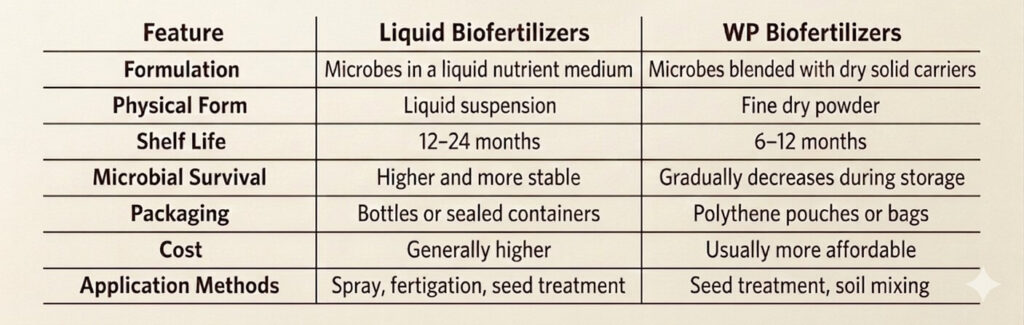
Imagine the microbes in a liquid biofertilizer as tiny workers swimming around in a protective liquid environment. This liquid isn’t just plain water — it usually contains things like glycerol, humic substances, polymers, and nutrients that help keep those microbes alive and active for a long time.
Because these microbes are suspended in a liquid medium, they remain metabolically active — meaning they’re actually doing their job even before you apply them to your fields.
How are they packaged and applied? Liquid biofertilizers come in sealed bottles or containers. You can apply them in several flexible ways — by spraying directly on crops, soaking seeds before planting (seed treatment), mixing into irrigation water (fertigation), or drenching the soil around plant roots. This flexibility makes them quite popular among modern farmers.
How long do they last? One of the biggest advantages of liquid biofertilizers is their shelf life — typically around 12 to 24 months. The liquid medium acts like a protective shield for the microbes, keeping them viable even when temperatures fluctuate.
What are the benefits?
- They last longer than powder formulations
- The microbial population stays higher and more stable throughout storage
- They can handle changes in temperature better
- When applied, they spread more evenly across soil and plants
- Risk of contamination is low when the container is properly sealed
Any downsides?
- They tend to cost more than WP formulations
- You need to store them carefully to keep the microbes alive
- The liquid packaging can be bulkier and heavier to transport
2. WP (Wettable Powder) Biofertilizers
Now, WP biofertilizers work a bit differently. Here, the microbes are mixed with dry carrier materials — things like talc, peat, lignite, or clay. The result is a fine dry powder that you can mix with water to form a suspension, which is then applied to your crops or soil.
A helpful way to understand the concentration: a 1% WP formulation means that only 1% of the product is the actual microbial culture. The remaining 99% is made up of carriers and additives that help the product disperse properly when mixed with water. So while it may look like a lot of product, the active microbial content is relatively small.
How are they packaged and applied? WP biofertilizers usually come in polythene pouches or bags, making them lightweight and easy to store. You can use them for seed treatment, direct soil application, or mixing with compost and manure before applying to fields.
How long do they last? The shelf life of WP biofertilizers is generally shorter — around 6 to 12 months. Over time, the dry carrier material doesn’t protect the microbes as well as a liquid medium does, so the microbial population gradually declines during storage.
What are the benefits?
- They’re more affordable to produce, so they’re cheaper for farmers
- Lightweight and easy to store and transport
- Work well with traditional farming practices
- Widely used in government and commercial agricultural programs
Any downsides?
- Shorter shelf life compared to liquid forms
- Microbial count can drop significantly over time
- Can create dust during handling, which requires care
- Needs proper mixing before use to ensure even application
Side-by-Side Comparison
Which Microorganisms Are Used in Both Forms?
Whether liquid or WP, both formulations commonly use the same types of beneficial microorganisms, including:
- Rhizobium — fixes atmospheric nitrogen in legume crops
- Azotobacter — fixes nitrogen in non-legume crops
- Azospirillum — promotes root development and nitrogen fixation
- Phosphate Solubilizing Bacteria (PSB) — helps unlock phosphorus in the soil
- Potassium Solubilizing Bacteria (KSB) — improves potassium availability
- Trichoderma viride — a fungal species that protects plant roots from disease
All of these organisms, regardless of the formulation they come in, work to improve nutrient availability, support root growth, and make farming more sustainable in the long run.
So, Which One Should You Choose?
The honest answer is — it depends on your situation. If you have good storage facilities and can invest a little more upfront, liquid biofertilizers offer better microbial survival and a longer shelf life, making them a reliable choice for precision farming. On the other hand, if cost and ease of transport are your main concerns — especially in rural or remote areas — WP biofertilizers are a practical and widely trusted option that has been used successfully in agriculture programs around the world.
At the end of the day, both forms deliver the same core benefit: getting the right microbes to your soil to support healthier, more productive crops naturally.