
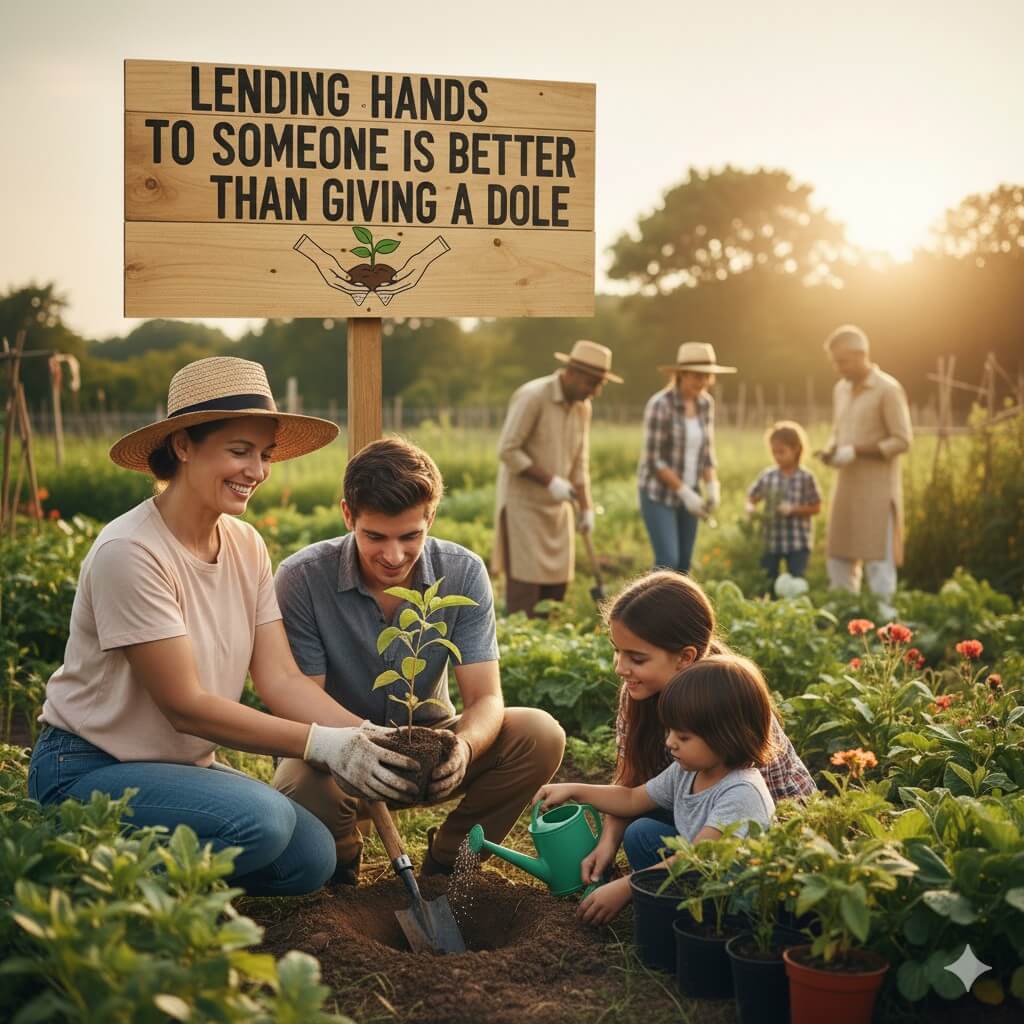
The saying “Lending hands to someone is better than giving a dole” expresses a timeless truth about the nature of genuine help and progress. It reminds us that real assistance goes beyond offering temporary relief—it is about enabling people to build self-reliance and dignity through empowerment. Across cultures and centuries, societies have grappled with the balance between charity and empowerment, shaping both social thought and policy. In an age marked by fast change and growing uncertainty, this wisdom feels especially relevant.
At its heart, the proverb contrasts two very different ways of helping others. “Giving a dole” refers to immediate or short-term support—food, money, or goods—that may ease distress for a while. While such charity is valuable in moments of crisis, it rarely solves the deeper problems that cause poverty or dependence. “Lending hands,” on the other hand, means helping people gain the tools, knowledge, and opportunities they need to improve their own lives. Charity may bring comfort for a moment; empowerment builds capacity for a lifetime. One treats the symptoms, the other addresses the cause.
Placing empowerment at the centre of social progress benefits both individuals and society. When people acquire skills and confidence, they gain control over their futures and develop a sense of purpose and belonging. This empowerment strengthens communities as well—those who have been supported often go on to support others, creating a cycle of growth and shared responsibility. By contrast, constant dependence on aid can unintentionally weaken initiative and trap people in cycles of need.
Even so, charity has an essential and honorable role. In times of natural disaster, pandemic, or conflict, immediate assistance is critical for survival. Food, shelter, and financial help can save lives when circumstances are beyond human control. But once the immediate crisis passes, attention must turn toward rebuilding livelihoods and capacities. Sustainable development depends on this shift—from short-term relief to long-term resilience. Effective public policy, therefore, should include both compassion for emergencies and commitment to empowerment.
This balance is particularly important in developing countries such as India. Despite significant economic progress, millions still lack access to quality education, healthcare, and stable employment. Government programs that provide direct financial support serve as safety nets, but these must be paired with measures that promote entrepreneurship, skill development, and innovation. Real development is not achieved through endless aid—it comes from expanding opportunities and enabling people to participate meaningfully in the nation’s growth.
A clear example of empowerment in practice can be seen in the National Rural Livelihoods Mission (NRLM). This initiative strengthens rural livelihoods, particularly for women, by forming self-help groups and connecting them with credit, training, and market opportunities. Instead of providing unconditional aid, NRLM encourages self-employment, collaboration, and enterprise. The results go beyond income: participants gain self-confidence, financial independence, and social respect. Such models illustrate how investing in people’s abilities produces lasting change that charity alone cannot achieve.
Globally, too, the preference for empowerment over charity guides modern development strategies. International agencies now emphasize education, capacity building, and technology transfer as the foundations for inclusive growth. The COVID-19 pandemic exposed the vulnerability of informal workers, but it also highlighted the need for digital literacy and adaptable skills. While emergency aid offered relief, true recovery depended on human development—showing that empowerment is not only ethical but also economically essential.
Empowerment, however, requires patience and consistent effort. Education and training programs may take years to show results, yet they create resilient individuals capable of contributing to society in lasting ways. At the same time, welfare systems must continue to protect those unable to work—the elderly, the differently abled, and the chronically ill. A balanced approach ensures that short-term aid does not turn into lifelong dependence but instead becomes a bridge to independence.
Ultimately, the idea of “lending hands rather than giving a dole” extends beyond policies or institutions—it reflects a moral vision of human responsibility. It calls upon individuals, communities, and governments to go beyond generosity and invest in the long-term well-being of others. Empowerment upholds human dignity, strengthens societies, and builds a shared culture of mutual growth.
In conclusion, charity can ease suffering, but empowerment changes lives. The true mark of a compassionate and progressive society lies not in how much it gives, but in how effectively it helps others stand on their own. When we choose empowerment as the foundation of development, we move from acts of kindness to acts of transformation—creating a future defined by dignity, opportunity, and hope for all.
Additional Reads
Disclaimer: This write-up is a collection of facts and insights compiled purely for educational purposes. Readers are encouraged to explore further information and references through independent online research.
