
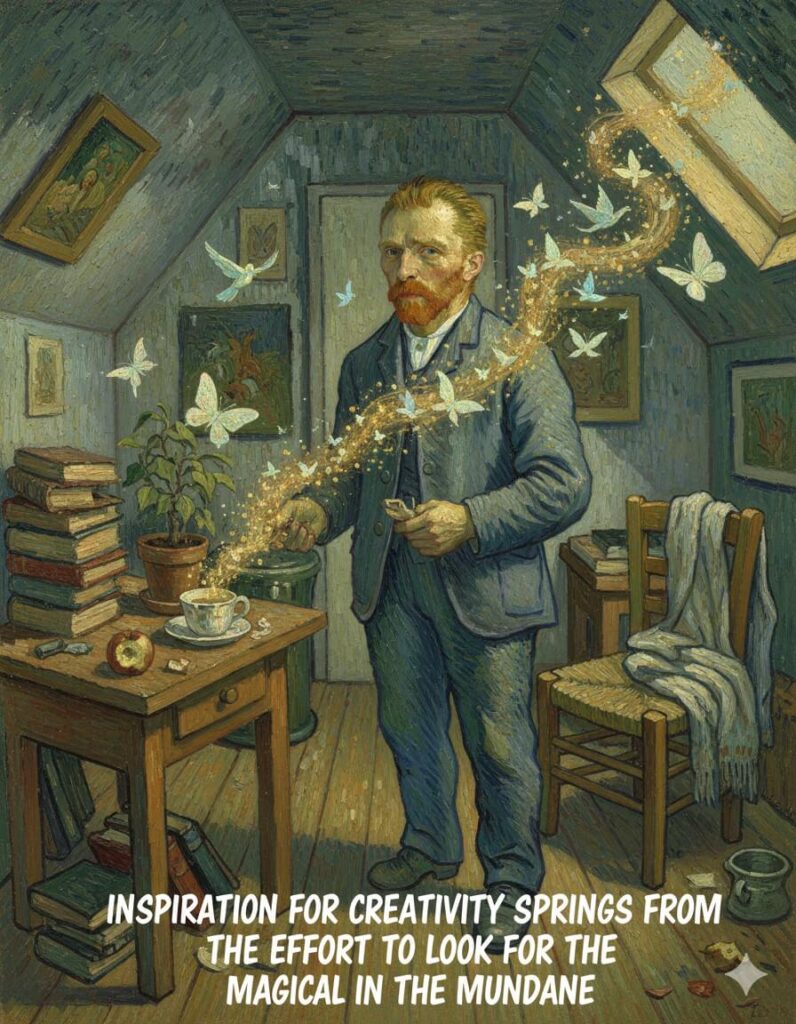
Inspiration for creativity often feels like something rare — like a gift only a few lucky people have. We imagine creativity coming from big moments, dramatic experiences, or brilliant minds. We picture someone writing a poem while looking at a beautiful mountain or suddenly getting a great idea while staring at the stars. But the truth is much simpler and more wonderful. Creativity usually begins in our everyday lives.
The word mundane means ordinary — the daily routines, the simple objects, and the familiar surroundings we see all the time. We often stop noticing them because they feel too common. But when someone tries to find beauty or meaning in these normal moments, something magical happens. When we look closely and think deeply about what is already around us, creativity slowly starts to grow. Inspiration is not far away or hidden in special places — it appears when we find magic within the ordinary.
Creativity begins with curiosity. A curious person does not let routine make life boring. They keep asking questions like: Why does this happen? What if it could be different? How else can this be used? A child watching raindrops sliding down a window might imagine them as tiny racers competing in a game. But an adult may simply complain about the rain. The difference is in how they look at the same moment. Curiosity makes us notice the little things others ignore. When we keep our minds open and curious, even the simplest situation can become the start of a story, a picture, a song, or even an invention.
How we look at things — our perspective — also plays a big role in creativity. A boring thing can become interesting when seen differently. For example, a leaf lying on the ground may seem useless. But if we look closely, we might notice its beautiful shape, bright colors, and tiny veins like rivers flowing across it. Then a leaf is no longer just a leaf — it becomes a small piece of nature’s art. Creativity teaches us to pause and rethink what we see every day. By changing our point of view, we make room for new ideas.
History shows us many examples of creativity born from simple, ordinary moments. J.K. Rowling thought of the magical world of Harry Potter while riding a train. Isaac Newton started developing the idea of gravity after watching an apple fall from a tree. Vincent van Gogh painted everyday objects like chairs, rooms, and sunflowers — and turned them into famous art loved across the world. All these show that amazing ideas often start in simple moments. The secret is noticing what others do not.
But today, people are often too busy to notice anything. We run from one task to another, always checking our phones or worrying about what comes next. This rushing steals our ability to observe small wonders. Creativity grows when we slow down and pay attention. When we sit quietly in a park, we may notice how sunlight dances through leaves, how birds communicate, or how strangers smile at one another. Even in a café, we can find inspiration in the smell of coffee, the clinking of cups, or the expressions of people around us. Being mindful helps us see everyday beauty — and those tiny details can spark big ideas.
Routine doesn’t have to be boring. It can actually encourage creativity. Children show us how — they turn a cardboard box into a spaceship, a spoon into a magic wand, and a blanket into a secret cave. They do not worry about rules or what makes sense — their imagination leads them. As we grow older, we often lose this playful thinking because we get busy with responsibilities. But if we let ourselves think freely — while cooking, walking, or cleaning — we can bring imagination back into our everyday life. When we do that, ordinary things suddenly feel special again.
Our everyday world is also full of emotions. A cup of tea, an old toy, or a certain song may remind us of happy or sad moments. Creativity often comes from these feelings. Poets write about sunsets — something that happens every day — yet they make it sound magical. Movies show stories about family, friendship, and love — feelings everyone knows. When ordinary emotions are expressed in a creative way, they touch hearts and feel powerful. They show that even the simplest human moments are full of meaning.
Creativity also solves problems. Many inventions were made because someone noticed a small annoyance. Velcro was invented because the creator noticed burrs sticking to his clothes while walking his dog. People have invented new kitchen tools to save cooking time and new bags to carry things more easily. Instead of complaining, creative people look for solutions. They turn everyday problems into new and helpful ideas.
Of course, creativity is not only about ideas. It also needs hard work. Even when inspiration comes from an ordinary moment, turning that idea into something real takes time and effort. Writers rewrite their stories many times. Artists try different colors and styles. Musicians practice every day, even when they feel tired. The hard work in these ordinary moments is what makes the final result shine. This shows that creativity has both magic and effort working together.
In the end, creativity is not just a talent. It is a way of living. When we learn to look for magic in ordinary things, life becomes more joyful. We begin to appreciate things we once ignored — the sound of footsteps, the shape of a cloud, the smell of food cooking at home, or the laughter shared with friends. Every moment can inspire us if we allow ourselves to notice it. Creativity reminds us that beauty is everywhere — not only in special places or grand events, but in the simple world around us.
To conclude, inspiration for creativity does not always come from big events or extraordinary surroundings. It often comes from observing, imagining, and appreciating what we already have. The mundane — our ordinary routines and daily objects — holds countless little wonders waiting to be found. When we choose to look deeper and think differently, creativity begins to grow. The magical is always around us — we just need open eyes, open minds, and open hearts to see it.
