
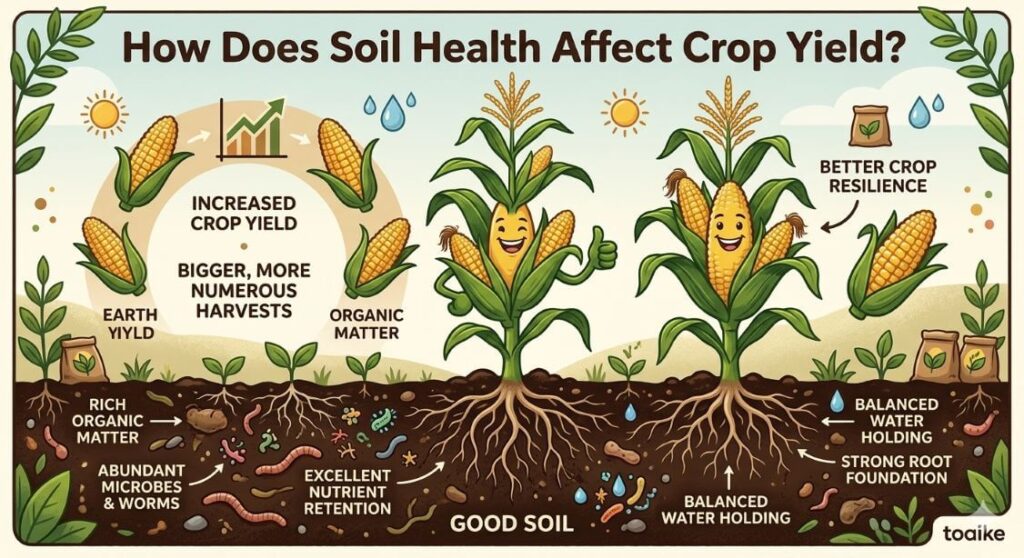
Every season, we invest in the best seeds money can buy. We follow the fertilizer schedule. We irrigate on time. We do everything by the book — and yet, when harvest arrives, the numbers disappoint.
We look at the weather. We question the seed company. We wonder if we used enough fertilizer. But the one place most of us never look — the one variable we consistently overlook — is the soil our crops are growing in.
So how exactly does soil health affect crop yield? The answer touches every single stage of a crop’s life — from the moment a seed germinates to the day we bring in the harvest.
What Is Soil Health — And What Does It Actually Include?
Soil health is not determined by a single factor. It is the result of three dimensions working together in balance.
Chemical Health covers soil pH, organic carbon, available Nitrogen, Phosphorus, Potassium, micronutrients like Zinc, Iron and Boron, salinity levels, and the presence of toxic heavy metals. When our soil’s chemistry is out of balance, our crops cannot access what they need — regardless of how much we apply.
Physical Health covers soil structure, compaction, water holding capacity, infiltration rate, drainage, erosion, and topsoil depth. A physically healthy soil gives roots room to grow, water space to move, and air the ability to circulate. A physically degraded soil blocks all three — and no chemical treatment can fully compensate for structural collapse.
Biological Health covers the living community within our soil — bacteria, fungi, earthworms, and countless other organisms that drive nutrient cycling, decompose organic matter, suppress disease, and maintain soil structure. When this community thrives, our soil works for us around the clock. When it collapses, we lose the most productive and most undervalued workforce on our farm.
When all three dimensions function well, our crops reach their full yield potential. When any one breaks down, the effects ripple across the entire system — and our harvest reflects it.
Knowing that these three dimensions exist is the first step. But to act on them, we need measurement — and that is precisely what India’s Soil Health Card scheme was designed to provide. By testing our soil across 12 parameters, it gives us a concrete, actionable picture of where our soil stands and what it needs. The scheme focuses primarily on chemical health, which is the most directly measurable dimension, while recommending that physical and biological assessment be carried out alongside it.
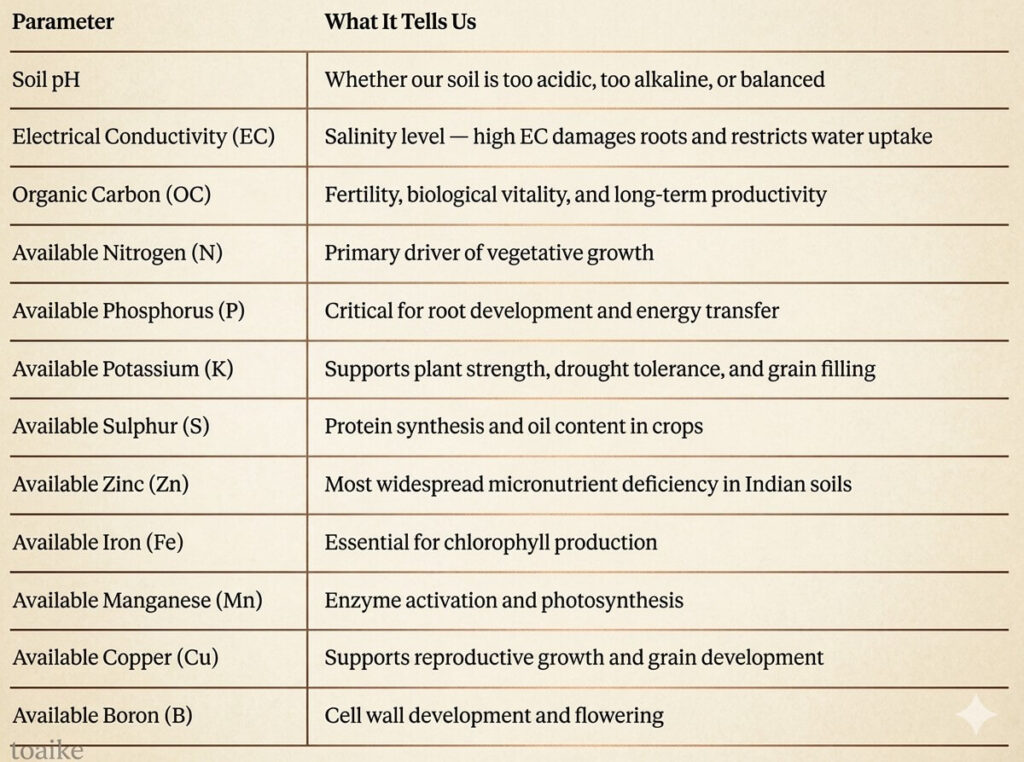
(Source: Draft Teacher’s Manual on Soil Health, National Soil Health Card Programme)
Each of these parameters, when outside its optimal range, directly reduces crop yield — often in ways we cannot see until harvest time. Among them, Organic Carbon deserves particular attention. It is the single parameter most closely linked to overall soil health across all three dimensions — chemical, physical, and biological. The Soil Health Card programme classifies it as follows:
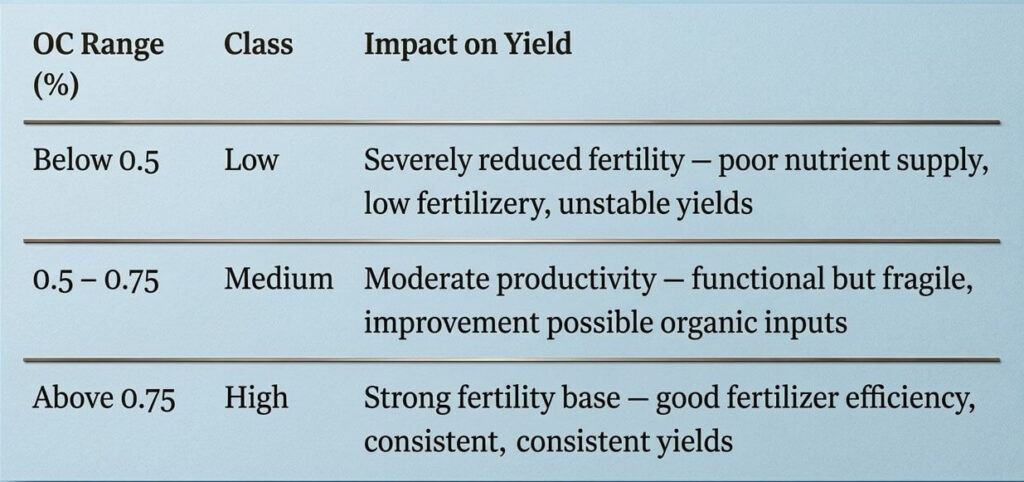
(Source: Draft Teacher’s Manual on Soil Health, National Soil Health Card Programme)
Understanding where our soil sits on this scale helps explain a great deal about why our harvests behave the way they do. With this foundation in place, we can now look more closely at how each of the three dimensions of soil health — chemical, physical, and biological — affects our yield in practice.
How Each Dimension of Soil Health Affects Our Yield
1. Chemical Health — Are Our Crops Getting What We Are Giving Them?
A chemically healthy soil acts as a slow-release nutrient bank — supplying nitrogen, phosphorus, potassium, and micronutrients steadily throughout the growing season in forms the crop can actually absorb.
When chemical health breaks down — through pH extremes, nutrient depletion, or salinity — nutrients may be physically present in the soil but chemically unavailable to plants. We apply fertilizer and see little response. We increase the dose and still the crop underperforms.
Organic carbon sits at the centre of chemical health. As the table above shows, soils with organic carbon below 0.5 percent suffer from severely reduced fertility, poor nutrient supply, and unstable yields. Soils in the medium range of 0.5 to 0.75 percent are functional but fragile. Soils above 0.75 percent represent a strong fertility base where nutrient cycling is active and yields are more consistent. Research confirms that as organic carbon levels improve, fertilizer efficiency improves alongside it — meaning the same fertilizer investment produces measurably better results in a chemically healthy soil than in a depleted one.
Micronutrient deficiencies — particularly Zinc — are also silent yield reducers. A crop can appear outwardly healthy while losing 15 to 20 percent of its yield potential to an undetected deficiency. Regular soil testing is the only way to catch and correct these invisible losses.
2. Physical Health — Can Our Roots Grow Where They Need To?
A crop’s yield potential is largely determined in the root zone in the first weeks after germination. Roots that grow deep and wide access more nutrients and more water than shallow roots ever can.
Healthy, well-structured soil gives roots the freedom to grow without resistance. Water infiltrates quickly, drains evenly, and is held at levels plant roots can reach between irrigation cycles. Air circulates freely, supporting both root respiration and microbial activity.
Compacted, structurally degraded soil blocks all of this. Roots stay shallow. Water pools or runs off. Oxygen-starved zones develop. A plant growing in compacted soil is weaker from its very first week — and that weakness shows up at harvest.
Research consistently shows that moderate compaction reduces crop yields by 5 to 40 percent. Severe compaction can push yield losses beyond 50 percent — on the same land, with the same seed and the same fertilizer.
Erosion is equally damaging. Every centimetre of topsoil lost to wind or water represents years of accumulated fertility. Fields that have lost significant topsoil often produce 30 to 50 percent less than undegraded land on the same farm.
3. Biological Health — Is the Soil Working for Us or Against Us?
A biologically active soil is home to billions of organisms performing work that no purchased input can replicate. Bacteria fix atmospheric nitrogen. Mycorrhizal fungi extend root systems many times their natural reach, improving phosphorus and water uptake. Earthworms create channels that improve drainage and aeration. Beneficial organisms suppress soil-borne diseases that would otherwise cause serious crop losses.
When biological health collapses — through pesticide overuse, organic matter depletion, or repeated tillage — we must compensate for every lost function with a purchased input. Pesticides replace the disease control that beneficial organisms once provided. Fertilizers replace the nitrogen that bacteria once fixed. Irrigation compensates for the water that mycorrhizal networks once helped roots access.
The biological dimension of soil health is also the most sensitive to our management choices — and the slowest to recover once lost. Prevention is always more effective and less costly than restoration.
The Hidden Cost We Never Calculate
When we calculate farming costs, we count seeds, fertilizers, labour, and water. What we almost never count is the cost of degraded soil — the extra fertilizer we buy because our soil can no longer supply what it once did naturally, and the yield losses we absorb season after season.
Soil degradation is the most expensive silent cost on our farm. Most of us have been paying it for years without ever seeing it clearly on a budget sheet.
What We Can Do, Starting This Season
Test our soil regularly across all three dimensions. Our Soil Health Card covers 12 chemical parameters. We should complement it with physical checks — infiltration, compaction observation — and biological checks — earthworm counts and soil smell. Together, these give us a complete picture.
Return organic matter every season. Compost, Farm Yard Manure, green manures, and crop residue incorporation rebuild organic carbon — the parameter most closely linked to overall soil health across all three dimensions.
Reduce unnecessary tillage. Minimum and no-till practices preserve physical structure, protect biological communities, and slow organic matter breakdown simultaneously.
Rotate our crops. Legume rotations restore nitrogen. Diverse rotations break pest and disease cycles and allow the biological community to recover.
Correct chemical imbalances before adding more inputs. Adjusting pH, addressing micronutrient deficiencies, and managing salinity — guided by our soil test — ensures that every fertilizer rupee we spend actually reaches our crop.
Finally -It Was Always About the Soil
Soil health affects every aspect of crop yield. The nutrients our crop can access depends on our soil’s chemical health. The water it draws on between irrigation cycles depends on its physical health. The natural disease protection it receives and the biological processes that sustain its nutrition depend on its biological health.
Soil health is not one factor among many that drives yield. It is the underlying condition — chemical, physical, and biological — that determines how well every other factor performs.
Healthy soil does not just support a good harvest. It makes a good harvest possible in the first place.
References
- FAO Soils Bulletin 80 — The Importance of Soil Organic Matter. Food and Agriculture Organization of the United Nations, Rome. Available at: https://www.fao.org/4/a0100e/a0100e.pdf
- Draft Teacher’s Manual on Soil Health. National Soil Health Card Programme, Department of Agriculture & Cooperation, India. Available at: https://soilhealth.dac.gov.in/files/Manual/140723DraftTeacherManual_PDF.pdf