
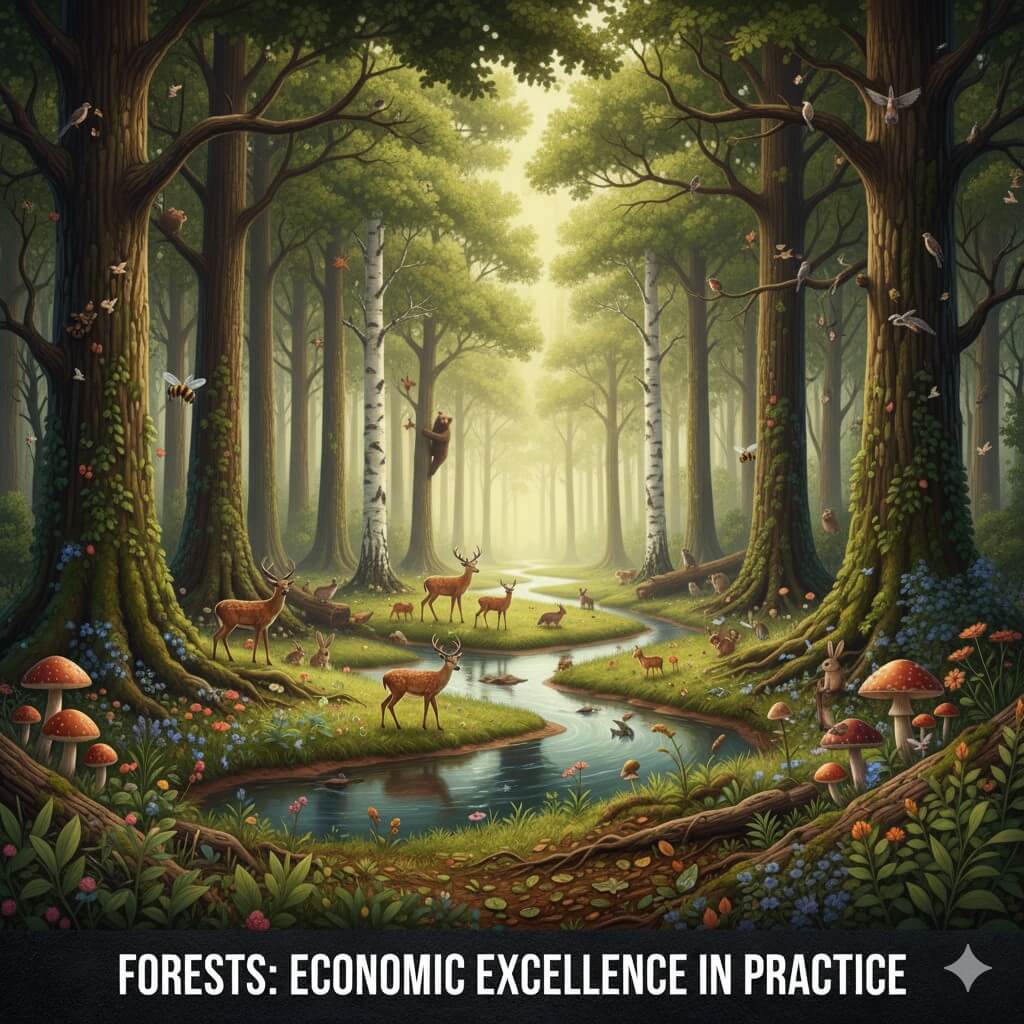
“Forests are the best case studies for economic excellence” may sound like a poetic idea, but when we look closely, forests truly behave like the smartest economic systems on Earth. They are not just groups of trees; they are living networks that have survived for millions of years. They face storms, droughts, diseases, and fires, yet continue to renew themselves with quiet strength. When we start seeing forests not just as natural spaces but as teachers of economic wisdom, we realise they have mastered ideas that humans are still learning to apply.
One of the first lessons forests teach is how to manage risk. A healthy forest never depends on one kind of plant or animal. It has layers—tall trees catching sunlight, shrubs filling the middle, grasses, fungi, insects, birds, and animals all playing their part. This diversity forms a web where each part supports the other. If one species suffers, others keep the system alive. Economies work in exactly the same way. Countries relying on a single industry or export become fragile, while those with multiple sources of income stay stronger. India is a good example. With agriculture supporting millions, manufacturing producing everything from steel to medicines, and a booming services sector, our economy has survived global shocks that could have crushed less diverse nations. Like forests, we benefit from spreading our risks.
In contrast, some of the poorest nations rely heavily on a single resource such as oil, minerals, or one dominant crop. Their economies are like a forest with only one species of tree. If prices fall or if nature acts harshly, the entire structure collapses. One pest, one drought, or one sudden drop in demand is enough to bring everything down. Mature forests show us that true stability comes from variety across species and layers, not from dependence on a single source.
Forests also reveal the wisdom of turning waste into wealth. Inside a forest, nothing is useless. A fallen tree becomes a home for insects, a sponge for moisture, and later rich soil for seedlings. Dry leaves decompose and feed the earth. Even animal waste enriches the ground. Energy and nutrients keep circling through the ecosystem. This is the idea behind the modern circular economy, where industries reuse or recycle materials instead of throwing them away. One factory’s waste can become another factory’s raw material. Heat from one industrial process can power another. Forests have practiced this long before humans put a name to it.
Forests also rely on the constant interaction between living and non-living elements. Plants, animals, soil, water, air, and sunlight form one connected system. Each part depends on the other. Similarly, macroeconomic policies—government spending, interest rates, inflation management—work together with micro-level decisions made by consumers, workers, and businesses. A healthy economy, like a healthy forest, needs both levels to function smoothly.
Another important lesson is about competition and protection. In natural ecosystems, invasive species can enter and destroy the balance. They grow too fast, crowd out native plants, or release chemicals that stop others from thriving. This is similar to what happens in economies when foreign companies dump extremely cheap products in a market. These products do not follow fair rules; they are priced deliberately low to eliminate local competition. Once local industries die, the invader gains monopoly control. Forests suffering from invasives remind us why economies need fair-trade laws and anti-dumping policies.
Forests also teach us patience. Nothing in a forest grows with the goal of immediate profit. Trees take decades to mature. They send roots deep into the ground, slowly securing water, storing nutrients, and building strength. Older trees support younger ones through underground fungal networks that share resources. Everything in a forest is built with the future in mind. This is very different from businesses that chase quarterly profits and sacrifice long-term stability. Sustainable forestry shows us that careful, slow growth brings greater rewards. A responsibly managed forest can give timber, medicinal plants, tourism revenue, and ecological benefits year after year, while clear-cutting produces quick profit followed by long-term damage.
The economic value of forests goes far beyond timber or tangible products. Forests filter water, regulate climate, prevent soil erosion, store carbon, and support biodiversity. For a long time, these benefits were invisible in economic calculations because they did not come with a price tag. But now forest economics recognises these contributions as “ecosystem services.” A forest that prevents floods is worth far more than the short-term value of cutting down its trees. Carbon credits now allow forests to earn money simply by absorbing carbon dioxide. This teaches us about externalities, the hidden costs and benefits that traditional economic systems often ignore.
Technology, too, ties forests and economies together. India’s Green Revolution proved how science and technology could transform agriculture and lift millions out of hunger. Today, technology is helping forest conservation with satellite monitoring, better fire detection systems, and more effective restoration techniques. Chemistry is shifting from simply making products to designing processes that recycle materials or turn waste into useful resources. The same innovations that drive modern economies are now helping us protect nature.
Ultimately, the greatest lesson forests offer is balance. Forests survive because they maintain a steady flow of energy and resources. They use only what they need and recycle what remains. Economies must do the same—grow without destroying their foundations. Economic progress is essential to reduce poverty, improve quality of life, and create opportunities. But if growth damages the environment, the very base of the economy crumbles. Forests show us how to balance present needs with future survival.
Looking at forests as economic teachers is more than a creative comparison; it is a guide for building stronger, more sustainable societies. Forests have operated their own versions of economies for millions of years, adapting to change, rebuilding after disasters, and supporting countless species. If we are wise enough to learn from these ancient systems, we can build human economies that grow, renew, and endure—just like the forests that have been teaching us all along.
