
Finding Balance: Why Companies Need Both Hard Work and Human Care
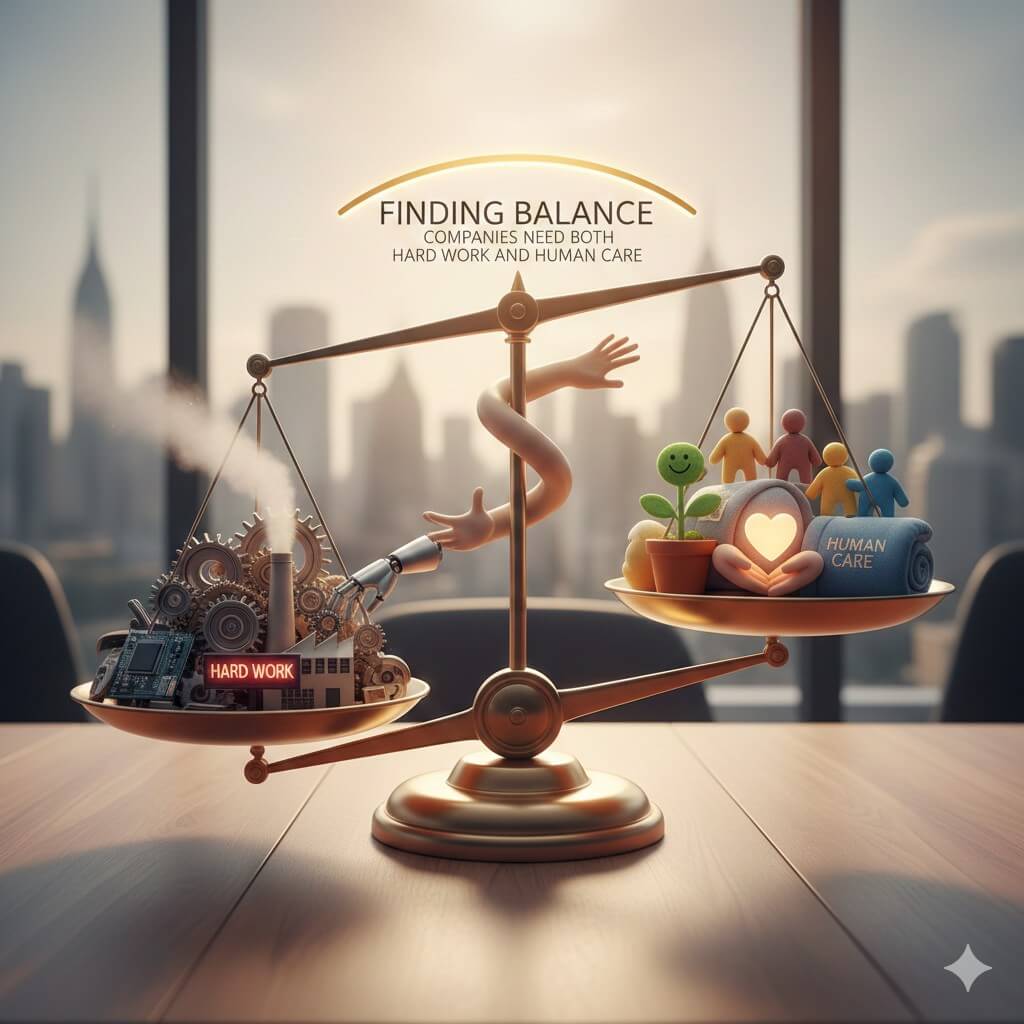
Every workplace wrestles with a fundamental question that rarely gets asked out loud: how much pressure is necessary, and when does it become too much? How hard should people be pushed to deliver results, and how much freedom is healthy before discipline starts slipping? Somewhere between constant pressure and constant comfort lies a narrow path. Miss it, and organizations pay a heavy price.
When work begins to dominate everything, the damage often shows up slowly. Late nights blur into weekends. Meals are skipped. Messages arrive at all hours. What starts as a temporary sprint becomes a permanent rhythm. For many, this isn’t an unusually bad week—it becomes everyday life.
Companies that celebrate constant hustle often believe they are driving productivity. In reality, they’re eroding it. Exhausted people don’t think clearly; they stop caring deeply about outcomes. Work gets done, but the quality suffers. Tired programmers introduce errors. Overloaded designers rush decisions. Creativity dries up when people are running on empty. Eventually, the most capable employees leave, taking experience and institutional knowledge with them—and often discouraging others from joining.
Some organizations have learned this lesson in very visible ways. In 2010, Foxconn, a major electronics manufacturer producing devices for global brands, drew global attention after installing suicide nets at its facilities following multiple worker deaths linked to extreme pressure. These moments forced uncomfortable conversations about how far productivity should be pushed before human costs become impossible to ignore.
Similar concerns emerged in the logistics and retail sector. Amazon, headquartered in Seattle and operating at massive global scale, saw its warehouse workforce become a symbol of modern workplace stress. Accounts surfaced of employees working under intense time pressure with minimal breaks, contributing to high injury rates and rapid burnout. Turnover reportedly reached exceptionally high levels at some facilities, requiring constant replacement of staff. The situation drew sustained public attention and debate, highlighting how relentless efficiency, when taken too far, can strain both people and systems.
Another recent example of the costs of over-optimization comes from the airline industry. In December 2025, India’s largest airline, IndiGo, experienced widespread flight cancellations and delays affecting thousands of passengers after it faced a shortfall of just over 120 pilots amid evolving rostering rules and a busy travel season. Despite operating around 2,200 flights daily, the imbalance between crew availability and scheduled flying highlighted how lean staffing strategies and intense operational pressure can leave systems vulnerable to stress, especially when regulatory changes or unexpected demand shifts occur. The resulting disruptions triggered prolonged delays across major airports, significant inconvenience for travellers, and public scrutiny of the airline’s planning processes, illustrating how pushing operational efficiency too far without adequate buffers can create cascading problems.
Yet swinging too far in the opposite direction brings its own risks. Some workplaces lean heavily into comfort and perks—free food, relaxed deadlines, games in common areas, and a culture focused more on enjoyment than execution. At first, this feels liberating. Over time, however, accountability weakens. Deadlines stretch. Standards soften. Difficult conversations are postponed. A pleasant atmosphere alone does not guarantee progress.
When culture becomes disconnected from fundamentals, problems don’t always appear immediately. They surface slowly, often when external conditions change or growth slows. Comfort without clarity can quietly drain momentum, leaving organizations unprepared for tougher moments that demand focus and discipline.
What’s striking is that both extremes fail for similar reasons. Cultures built entirely around work believe they are being serious and professional but end up wasting human potential. Cultures built entirely around comfort believe they are being progressive but overlook the realities of sustaining a business. Both misunderstand people and misjudge what actually drives long-term performance.
Humans are not machines that can produce endlessly by working longer hours. Push too hard, and performance collapses. At the same time, people are not fulfilled by comfort alone. Without challenge, responsibility, and purpose, motivation fades just as surely. Removing pressure entirely doesn’t create engagement—it creates drift.
The answer isn’t choosing one extreme over the other. It’s rejecting the false choice altogether.
Some organizations have shown that balance is not only possible, but powerful. Reliance Industries in India demonstrates how investing in people while maintaining operational discipline can support long-term growth. Alongside structured performance expectations, the company has built extensive employee-support systems that focus on health, safety, and family well-being. These include wellness initiatives, parental support, and the Reliance Employee & Family Emergency Response Service (REFERS), which provides 24/7 assistance during medical or personal emergencies. By pairing human care with scale and execution, Reliance has shown that looking after people can strengthen—not weaken—organizational resilience.
Microsoft offers another clear example. When Satya Nadella became CEO, the company had spent years stuck in place. The turnaround didn’t come from pushing people harder. It came from changing how people worked—removing toxic internal competition, encouraging learning, improving work-life balance, and still holding teams to high standards. The result demonstrated that empathy and performance are not opposites, but partners.
Google has managed a similar balance across multiple technology cycles. The company combines strong operational discipline with policies designed to support long-term employee sustainability. Its hybrid work model allows most employees to work from home two days a week, along with designated “work from anywhere” weeks each year. Generous leave policies cover vacation, sick leave, bereavement, and extended parental leave for both primary and non-primary caregivers. For employees relocating, Google offers structured support ranging from temporary housing and logistics assistance to cash alternatives. Together, these practices have helped the company scale across search, advertising, cloud computing, and artificial intelligence without draining the energy of its workforce.
In the end, long-term success requires both heart and spine. Heart, to recognize that employees are people with limits, families, and lives beyond work. Treating them well isn’t charity—it’s sound judgment. Spine, to maintain standards, make difficult decisions, and stay grounded in reality.
Kindness doesn’t mean lowering expectations, and discipline doesn’t require cruelty. The strongest organizations manage to hold both at once. There is no universal formula, and every workplace must find its own balance. But one truth remains clear: extremes don’t work. Too much work doesn’t produce excellence—it produces exhaustion. Too much comfort doesn’t sustain innovation—it quietly weakens foundations.
The future belongs to organizations willing to build something better—places where people can do meaningful work without losing themselves, and where business success and human well-being move forward together, not in opposition.
