
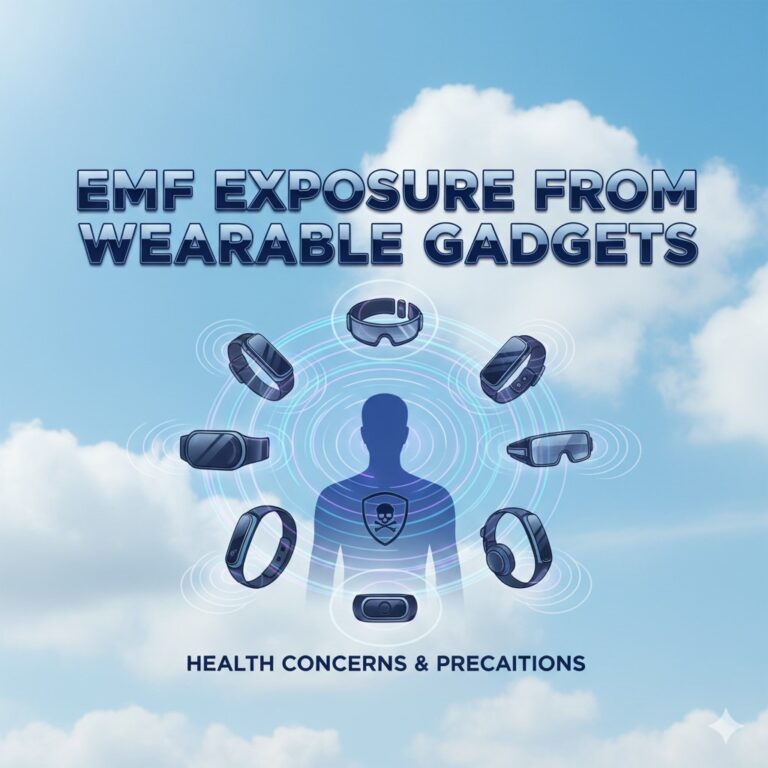
Why Talk About EMF Exposure from Wearables?
Why Money-Saving Often Feel Miserable
“Ever feel like your smartwatch is judging your steps while quietly radiating a tiny invisible force field at you? Or that your earbuds are whispering not just music, but electromagnetic secrets to your brain? Don’t worry—you’re not in a sci-fi movie. Welcome to the age of EMF Exposure, where your gadgets are friendly but slightly electrifying companions.”
Wearable devices—smartwatches, fitness trackers, wireless earbuds—are now indispensable. They monitor steps, track sleep, and even remind us to breathe when stress hits. But these devices continuously emit electromagnetic fields (EMFs) to communicate wirelessly. This naturally raises the question: Are these gadgets truly safe, or are we walking around with mini radiation machines on our bodies?
This article dives deep into EMF Exposure from wearables, global and Indian safety standards, practical dos and don’ts, and the latest research findings. By the end, you’ll know exactly how to enjoy your tech without unnecessary worry.
Contents
What is EMF Exposure?

Electromagnetic Field (EMF) Exposure refers to the absorption of electromagnetic energy by the human body when near electronic devices. EMFs are invisible energy waves generated whenever electricity flows.
Wearables emit low-level RF (radiofrequency) EMFs, which are orders of magnitude lower than mobile phones. Understanding this exposure is key to assessing potential health risks.
Types of EMFs and Their Sources
EMFs vary by frequency (measured in hertz, Hz, or cycles per second):
Low-Frequency EMFs:
Household appliances and power lines.
Radiofrequency (RF) EMFs:
Wireless communications including Bluetooth, Wi-Fi, 4G, and 5G. Wearables typically operate at 2.4 GHz, which is considered safe.
Daily frequency EMFs:
Mobile phones, laptops, Wi-Fi routers, smartwatches, wireless earbuds.
Fun fact: 1 GHz equals 1 billion wave cycles per second. So a smartwatch at 2.4 GHz emits 2.4 billion tiny wave cycles every second—but the energy is so low that your wrist won’t feel a thing.
How Wearable Gadgets Emit EMFs
Wearable devices rely on constant wireless connectivity to perform their smart functions, which means they emit continuous low-power electromagnetic fields (EMFs). Every notification, step count update, or heart rate measurement requires a tiny transmission of energy—but don’t worry, it’s more like a polite little whisper than a screaming alarm.
Smartwatches & Fitness Trackers:
These gadgets sync data with smartphones via Bluetooth, typically around 2.4 GHz. They track activity, sleep, and heart rate in real time. Even though they’re constantly sending data, the EMF output is so low that your wrist won’t feel a thing—no “wrist-cooked steak” here!
Wireless earbuds:
Sitting snugly in your ear canal, they beam music, calls, and voice commands wirelessly. While close to your head, the power output is extremely low, far below mobile phones. Think of it as a gentle nudge to your eardrum, not a laser blast.
Smart Rings or Clothing:
Next-gen wearable tech embeds sensors into rings, bracelets, or fabrics. They quietly chat with phones or smart hubs using low-power wireless protocols. Even in constant contact with your body, EMF levels are minimal—safe enough that you can wear your smart socks without worry!
Despite all these EMF emissions, wearable devices operate thousands of times below mobile phone output. In everyday life, this means negligible exposure—so you can happily track your steps, monitor your heart rate, and listen to music, all without imagining your smartwatch plotting world domination.
Do Wearables Pose Health Risks?
This is where the science comes in, separating fact from fear regarding EMF Exposure from wearables:
Short-term effects of EMF Exposure
At very high power levels, EMFs can heat human tissue—think of it like a microwave oven warming food. This is why regulatory limits exist to prevent harmful heating. Wearable devices, however, emit extremely low-power EMFs, far below levels that could cause any temperature rise in tissues. In practical terms, your smartwatch or earbuds won’t turn your wrist or ears into a hotplate anytime soon.
Long-term effects:
While short-term exposure is well understood and considered safe, scientists are still studying the potential effects of chronic low-level EMF Exposure over years or decades. Research explores whether prolonged exposure might subtly influence sleep, stress hormone regulation, or cellular activity. So far, the evidence doesn’t suggest major risks—but if your smartwatch starts nagging about your posture AND your life choices, that’s probably just the app, not EMFs!
Current scientific consensus:
Based on available data, wearable devices are considered safe for regular use, as long as they comply with international and national safety standards. Organizations like WHO, ICNIRP, FCC, and India’s DoT monitor exposure levels, ensuring that devices emit EMFs far below harmful thresholds. Continued research is recommended, primarily to track long-term effects and update guidelines if needed.
Bottom line: Science says enjoy your wearable tech—but don’t worry, your smartwatch isn’t secretly plotting to cook you like a microwaved burrito!
Global Safety Standards for EMF Exposure
WHO (World Health Organization)
The WHO International EMF Project, launched in 1996, monitors global research on the health effects of electromagnetic fields (EMFs) and provides guidance to ensure safe usage of consumer devices.
Current Guidance:
“Low-level EMF exposure from consumer devices has no confirmed harmful effects, though long-term monitoring continues.”
International Commission on Non-Ionizing Radiation Protection (ICNIRP) 2020 Guidelines
The ICNIRP 2020 guidelines define global reference levels for EMF exposure across a wide frequency range.
Scope: 100 kHz to 300 GHz, covering technologies such as Wi-Fi, Bluetooth, and 5G.
Basis of Limits: Derived from scientifically proven thresholds of adverse biological effects, with built-in safety margins.
Measurement Parameters:
SAR (Specific Absorption Rate, W/kg): Measures energy absorbed per kilogram of tissue; used for frequencies below 6 GHz.
Sab (Absorbed Power Density, W/m²): Used for frequencies above 6 GHz; measures energy absorbed at the surface of tissues.
Exposure Limits for the General Public:
Whole-body average SAR: 0.08 W/kg
Local head/torso SAR: 2 W/kg
Local limbs SAR: 4 W/kg
Local absorbed power density (>6 GHz): 20 W/m²
Thermal Effects: While very high EMFs can heat tissues, wearable devices operate far below levels that could cause harm.
Federal Communications Commission (FCC, USA)
The FCC regulates radiofrequency (RF) emissions from consumer electronics in the U.S., including wearables, to protect human health.
SAR Limit: 1.6 W/kg, averaged over 1 gram of tissue. SAR measures how much RF energy is absorbed by the body during device use. This ensures that smartwatches, wireless earbuds, and fitness trackers cannot generate enough energy to cause harmful tissue heating.
Focus on Safety: FCC guidelines specifically aim to prevent tissue heating from RF exposure. Wearable devices emit RF at levels well below these thresholds, making them safe for daily use.
Compliance & Monitoring: Devices must undergo rigorous testing in lab conditions that simulate real-world usage, confirming they meet FCC safety standards and keeping consumer exposure minimal.
India's EMF Guidelines for Wearable Devices
- In India, the Telecommunication Engineering Centre (TEC) under the Department of Telecommunications (DoT) has issued comprehensive guidelines to ensure wearable devices emitting EMFs are safe for public use. India’s limits are generally stricter than international standards, reflecting a strong commitment to public health.
General Public SAR Limits in India:
Localized SAR (Head): 1.6 W/kg, averaged over 1 gram of tissue
Localized SAR (Body): 1.6 W/kg, averaged over 1 gram of tissue
Localized SAR (Limbs and Extremities): 4 W/kg, averaged over 10 grams of tissue
Whole Body Average SAR: 0.08 W/kg
These limits are designed to minimize thermal effects and ensure safety even during prolonged use of wearable devices.
India’s EMF guidelines for wearable devices rank among the strictest globally, prioritizing public health while allowing safe use of modern technology.
How Safe Are Wearables Compared to Standards?
When it comes to EMF Exposure, wearable devices such as smartwatches, fitness trackers, and wireless earbuds are significantly safer than many people imagine. Let’s break it down:
Low Power Emission:
SAR Comparison:
Real-world Analogy:
You can safely track your steps, monitor your heart rate, or receive notifications all day long without worrying about EMF exposure exceeding safe limits. These devices are engineered with built-in safety margins, making them suitable for prolonged, everyday use.
Wearing a smartwatch won’t turn your wrist into a miniature charging pad for aliens—so go ahead and enjoy your tech guilt-free!
Practical Implication:
You can safely track your steps, monitor your heart rate, or receive notifications all day long without worrying about EMF exposure exceeding safe limits. These devices are engineered with built-in safety margins, making them suitable for prolonged, everyday use.
Wearing a smartwatch won’t turn your wrist into a miniature charging pad for aliens – so go ahead and enjoy your tech guilt-free..!
Dos and Don’ts to Minimize EMF Exposure
Even though wearable devices are generally safe, following a few simple dos and don’ts can further reduce EMF Exposure and promote healthy usage habits.
Dos :
Take Breaks:
Remove wearables while sleeping or during extended periods of inactivity. Giving your body a rest from close-range EMF exposure not only reduces cumulative exposure but also allows your skin and wrist to breathe.
Turn Off Wireless When Not Needed:
Use airplane mode or disable Bluetooth/Wi-Fi when your wearable isn’t actively syncing data. This reduces unnecessary RF emissions and also helps save battery life.
Wear Loosely:
Avoid overly tight straps that keep devices pressed firmly against the skin. Looser wear allows better air circulation and slightly increases the distance between the EMF source and your body, reducing exposure intensity.
Keep Devices Updated:
Install the latest firmware updates. Manufacturers often optimize wireless communication protocols in updates, reducing power consumption and minimizing unnecessary RF emissions.
Prefer Low-Power Modes:
Many wearables come with power-saving or low-energy modes, which use intermittent data transmission rather than continuous syncing. Activating these modes lowers EMF emission without compromising functionality.
Use External Accessories:
Don'ts :
Don’t Wear 24/7:
Avoid constant exposure without breaks. Continuous usage may be convenient, but even low-power EMFs accumulate over time, and taking regular breaks is a simple precaution.
Don’t Ignore Manufacturer Warnings:
Every device has its own SAR limit and usage instructions. Follow these carefully to stay within safety margins and avoid unnecessary exposure.
Don’t Place Devices Directly on Sensitive Skin for Long Hours:
This is especially important for children or people with delicate skin. Prolonged close contact can increase localized exposure, even if overall EMF levels remain low.
Don’t Rely on Myths or Fear-Based Advice:
Stick to scientifically backed evidence rather than sensationalized claims. EMF exposure from wearables is far below harmful limits when used correctly.
Don’t Forget Context:
EMF exposure is cumulative from all sources, including mobile phones, Wi-Fi, and routers. Being mindful of total exposure helps you maintain a healthy balance.
So, Should You Worry About Wearables?
Not really — as long as you follow simple safety habits. Science shows EMF levels from wearables are well below limits, and global agencies keep monitoring long-term effects.
Here’s the takeaway: use airplane mode when you sleep, take short breaks, and remove wearables at night. Small steps, big peace of mind.
Now it’s your turn: Do you use wearables daily? Will you try any of these tips? — and if you found this helpful, explore our other guides on Blue light from devices!
This post is shared to inspire curiosity and deepen understanding.
Additional Reads
References:
Disclaimer: This article is for informational purposes only and does not replace professional medical advice. Always consult a qualified expert for guidance.
