
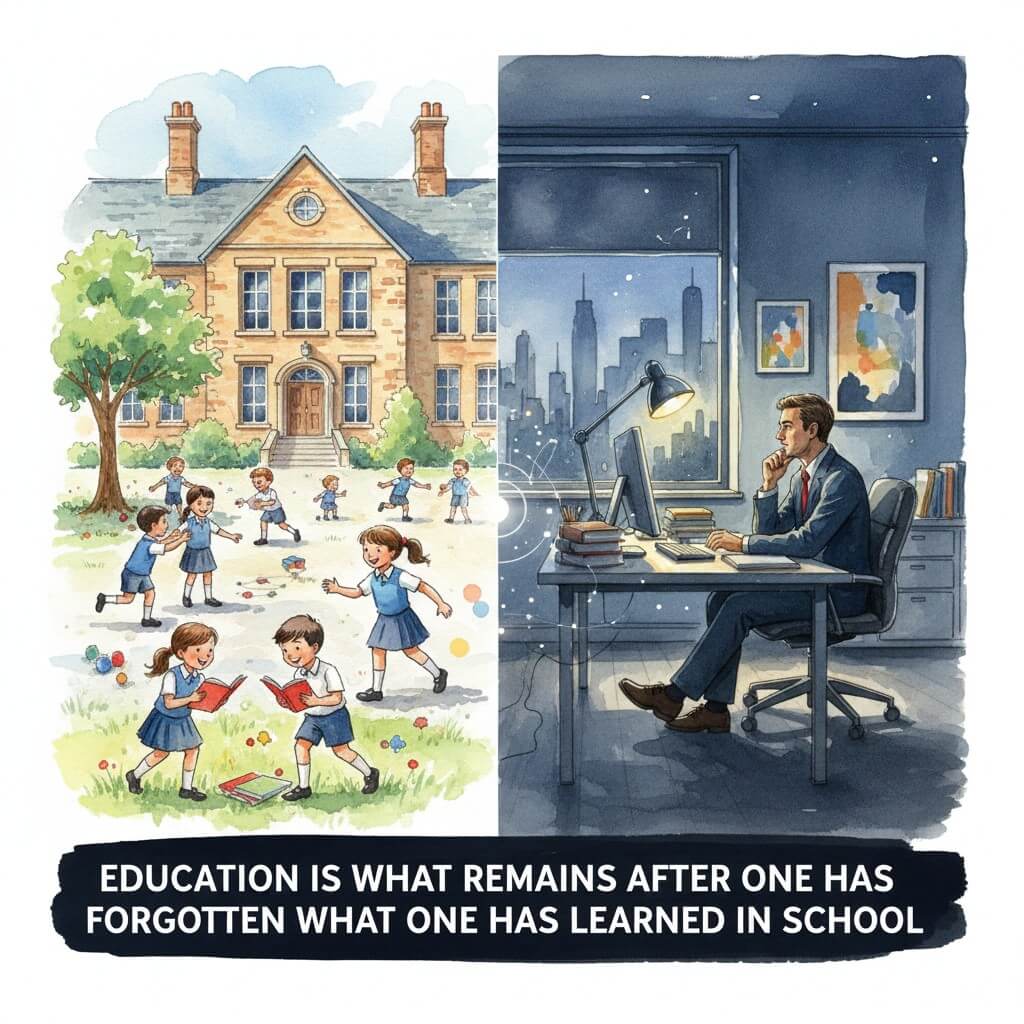
There is a popular saying, often linked to Albert Einstein, that goes: “Education is what remains after one has forgotten what one has learned in school.” At first, this line feels confusing. We spend so many years memorizing lessons, practicing formulas, and preparing for exams. If most of that eventually slips from our memory, then why do we spend so much time learning? But as we grow older and pay attention to life, the true meaning behind this saying becomes more clear. It doesn’t suggest that school is meaningless. It simply reminds us that real education is deeper and longer-lasting than the facts we memorize.
Let us think about our own school days. How many history dates do we remember now? How many math theorems or chemical formulas stay fresh in our minds? For many of us, the answer is very few. Time quietly erases those details. Yet something else continues to live within us—something much more important. What stays is our ability to think through problems, understand situations, ask questions, and keep learning whenever needed. We hold on to habits such as curiosity, teamwork, patience, discipline, and creativity. We may forget the exact lessons that taught us these things, but the skills remain. True education is not just the information we once memorized — it’s the lasting change in how we think, behave, and understand the world.
It is like learning to swim or ride a bicycle. We might not remember the instructions our teacher gave step by step, but our body remembers how to balance, how to float, how to move. The knowledge becomes a part of who we are.
Take the example of the Indian Administrative Service exam, known as one of the toughest in the world. Aspirants spend years absorbing huge amounts of information. But after they join service, only a small part of this learning remains word-for-word. Yet they succeed as officers. Why? Because preparing for the exam develops something deeper — the ability to analyze, make decisions, remain calm in crises, and view problems from many angles. When a district faces floods or when a pandemic strikes, an officer does not open textbooks to check what to do. They rely on reasoning, leadership, ethical judgment, and the strength they built through years of learning. The facts may fade, but the mental framework continues to guide them.
Dr. APJ Abdul Kalam’s journey is another powerful example. He often spoke with love about the teachers who shaped him. They did not just make him repeat formulas or definitions — they awakened curiosity in him. His mathematics teacher taught him discipline and precision in thinking. His science teacher took him to the beach to explain the science behind birds flying — not through a diagram in a book, but through real observation. These experiences lit a spark in him. Years later, when he worked on India’s missile and space programs, he wasn’t simply recalling old engineering lessons. He was using his imagination, scientific attitude, and problem-solving nature — the deeper education he carried from school.
The formulas he once memorized may have faded, but the courage to try new ideas, the patience to face failure, and the hope to turn dreams into reality stayed with him forever. That is what true education looks like.
The story of Verghese Kurien, the Father of the White Revolution, also teaches us this truth. He studied dairy engineering even though he had little interest in it at first. He probably forgot many technical lessons from those textbooks later in life. Yet he transformed India into the world’s largest milk producer and gave us the Amul cooperative movement. This achievement didn’t come only from remembering dairy science. It required understanding human behavior, economic fairness, teamwork, and leadership — skills far beyond academic subjects. Kurien’s success came from the deeper abilities his education nurtured: the capacity to observe, organize, plan, and improve lives. That is what remained long after the classroom learning had faded.
In the professional world today, almost every career demands new learning all the time. Technologies keep changing. Problems grow more complex. The answers are not already printed in a chapter somewhere. So what helps us grow at work is not the memory of old lessons but the ability to learn fast, question assumptions, communicate ideas, and handle challenges with confidence. An engineer may forget specific programming languages they studied long ago, but if education has built logical thinking and problem-solving skills, they can learn any new system.
A truly educated society is not one where people can recite facts like a machine. It is a society where people think independently, understand different viewpoints, and make informed decisions. Every day, we come across news, opinions, and information from many sources. Without critical thinking, misunderstandings spread easily. Education trains us to ask — “Is this true? What is the evidence? Are there other sides to this issue?” These thinking habits make a society stronger and more responsible.
Even in our personal lives, we often draw from the education that goes beyond books. The ability to communicate respectfully, to understand what others feel, to cooperate, to be patient — none of these qualities come from memorizing a textbook chapter. They come from interacting with classmates, teachers, and diverse people. They stay with us when we handle disagreements at home or support a friend in need. This emotional intelligence is one of the most precious parts of our education.
Understanding the deeper meaning of education also changes how we view schools and teachers. Schools are not just exam preparation centers. They are spaces where minds and personalities take shape. The best teachers are not those whose students score the highest alone — but those who inspire a love for learning, encourage curiosity, treat mistakes as lessons, and help students discover their own strengths. Success is not measured only by marks, but by how well students grow into confident, thoughtful human beings.
Years later, when we leave the classroom behind, we may not remember the exact content we once studied. But if we look closely, we find that our education lives within our actions and perspectives. It hides in the way we write an email at work, manage our time, resolve problems, or think creatively. It appears whenever we learn something new or adapt to change.
The facts we memorized may fade — but the transformation in our mind remains. That is what makes education powerful. It doesn’t simply fill our heads; it shapes our souls. It stays with us not as pages of memory, but as habits of thinking, qualities of character, and skills for life.
Real education is not just about remembering lessons — it is about becoming better at living. And that is something we carry with us long after the final exam is over.
