
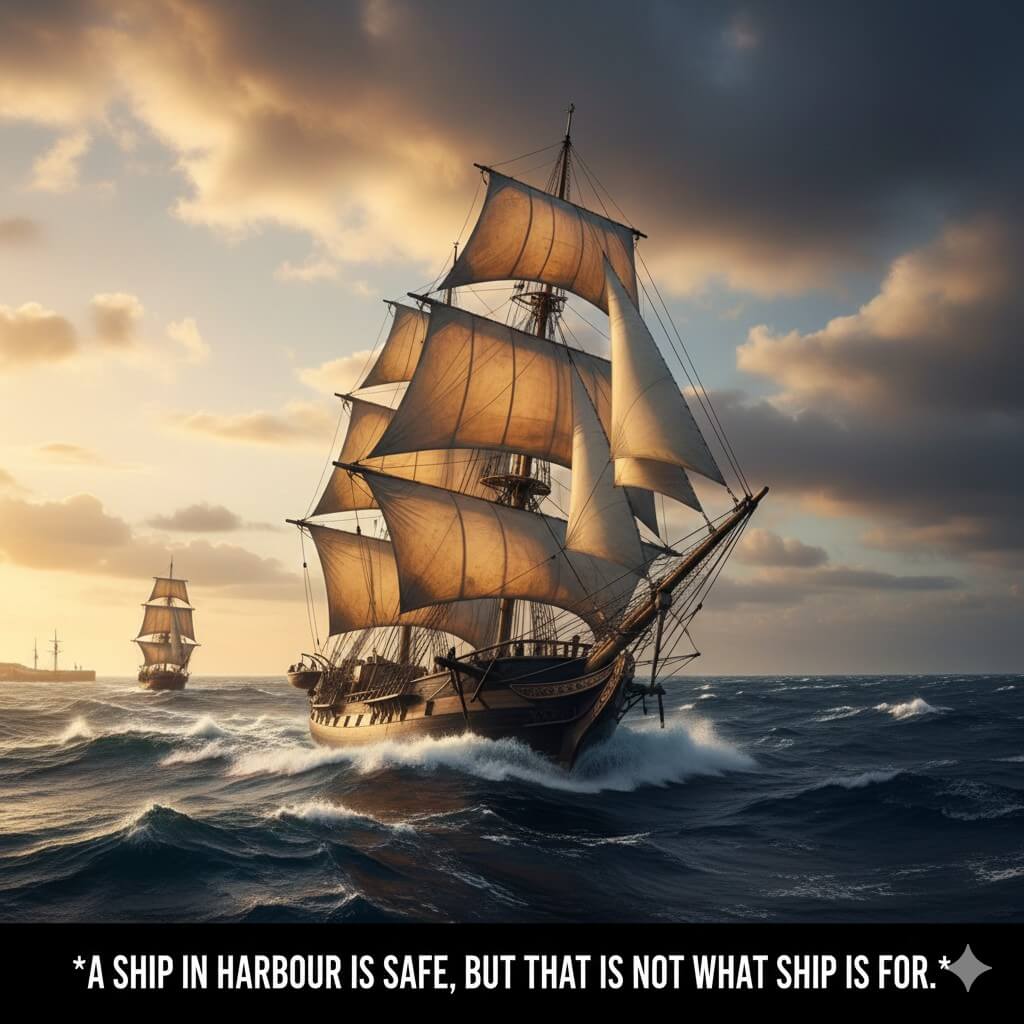
A ship in the harbour is safe, but that is not what ships are made for. This sentence tells us something important about life. The idea is simple: we are the ships, our comfort zones are the harbour, and the ocean represents the challenges, opportunities, and purpose waiting for us. It’s natural to want safety, but a life spent only in comfort never shows what we’re truly capable of. The real question isn’t whether storms will come—it’s whether we are ready to leave the shore at all. True growth begins when staying the same starts to feel costlier than taking that first step forward.
Staying in one place feels safe and easy. The harbour gives protection, calm, and a sense of control. But if we make safety our permanent home, it can quietly harm us. A ship that never leaves the dock slowly falls apart. Its metal rusts, its ropes weaken, and its sails stiffen. A vessel meant to move slowly loses its purpose. The same happens to us. When we cling to comfort too long, our skills weaken, our dreams fade, and we stop growing. The real loss is not in trying and failing—it’s in standing still and never discovering what we could have been.
Think of the many people who stay in jobs they don’t enjoy, relationships that drain them, or routines that feel safe but empty. They sense something is missing, yet fear keeps them anchored. Questions like What will people say?, What if I fail?, or What if I lose everything? hold them back. Many wait for the “perfect moment,” believing that doubts will disappear someday and the path will become clear. But perfect moments rarely come, and “someday” often never arrives. Avoiding risk comes at a quiet cost—in regret, longing, and the endless “what ifs.” Life moves on whether we act or not, and some opportunities may never return.
Ships are made for the sea, not for stillness. They have strong hulls for waves, sails to catch the wind, and wheels to steer through rough waters. Similarly, we have talents, interests, and inner strengths meant to be used. Potential is just potential until it’s tested in the real world. A medical student must treat real patients eventually. An artist must share work beyond a sketchbook. A dreamer must take action. Growth comes from trying, practicing, and facing real challenges. Every small step outside the comfort zone builds confidence and clarity.
History reminds us of this truth through those who left their safe zones. Mahatma Gandhi could have lived a comfortable life as a lawyer in South Africa. Instead, he returned to India and led the struggle for independence through nonviolence. He faced prison, criticism, and enormous pressure. There were no guarantees of success. Yet he knew staying silent and safe would betray his purpose. His choice changed not only India, but inspired movements worldwide. Gandhi’s life shows that meaningful journeys start with courage, not certainty, and even one person’s choice can shift history.
Another inspiring example is E. Sreedharan, known as the “Metro Man.” After decades in Indian Railways and completing the challenging Konkan Railway project, he could have retired comfortably. Most would have stayed in the harbour of rest. But Sreedharan saw retirement as a new beginning. At an age when most relax, he took on the Delhi Metro project, transforming urban transport in India and completing it ahead of schedule and under budget. Even after retiring, he continued helping metro projects in other cities. His story proves that purpose does not retire, and our most important contributions often come when we refuse to settle for comfort.
Every meaningful pursuit carries some risk. Starting a job, learning something new, building relationships, or launching a business—all involve uncertainty. But these challenges give life meaning. Innovation comes when we step beyond the known. Science advances when people explore the unfamiliar. Art becomes unforgettable when artists share deeply personal work. Social progress happens when individuals challenge injustice. The storms we face are not obstacles—they help us discover our purpose. Challenges make us stronger, adaptable, and more aware of what we can do.
Of course, courage doesn’t mean rushing in blindly. Ships prepare in the harbour—they gather tools, check their structure, train the crew, and study their path. We too prepare by learning, planning, and seeking advice from those who have sailed before. The harbour is important as a place to rest and get ready. The mistake is turning it into a permanent home. Preparation matters, but overthinking and waiting endlessly can quietly become another kind of fear.
Today, this lesson feels especially true. Modern life is more comfortable than ever, yet many people feel anxious and unfulfilled. Social media shows perfect lives, making ordinary struggles seem like personal failure. Many delay big decisions, waiting for certainty that may never come. The pandemic reminded us how little control we truly have, but it also showed that humans can rebuild, adapt, and find purpose even in uncertainty.
Ironically, chasing total safety often brings the unhappiness we try to avoid. Research shows that people regret chances they never took far more than mistakes they made. Projects never started, ideas never acted on, and feelings never expressed—these weigh heavily later. Looking back, we are likely to wish we had been bolder, kinder, more open, and willing to take chances. A life lived too cautiously becomes a collection of missed possibilities instead of a story of growth.
So what does this mean for us? It means examining our own “harbours.” What habits or situations do we cling to because they feel safe? What dreams have we shelved? Which version of ourselves are we avoiding because it requires effort or risk? Growth often comes with discomfort. Uncertainty is part of every meaningful journey. Courage isn’t the absence of fear—it’s moving forward despite it. Even small steps create momentum, and momentum leads to transformation.
Ships are made to travel, to carry stories across oceans, to discover new lands, and to connect people. Their purpose is fulfilled not by avoiding danger, but by moving through it. We too are made for more than safety. We are made to explore our abilities, share our gifts, connect with others, and give something meaningful to the world. The harbour will always be there when we need rest, but the open sea is where life truly happens. That is where our real journey begins.
