
What is Singha Durbar? It is Nepal’s most iconic government palace, located in the heart of Kathmandu. On September 9, 2025, it was thrust into global attention when flames engulfed parts of the complex amid nationwide protests led by Generation Z. These protests were triggered by the sudden government ban on 26 social media platforms and allegations of widespread corruption. Demonstrators targeted major government offices housed within the complex, including the Prime Minister’s Office and several ministries, underscoring deep-rooted political unrest in the country (WSJ, Reuters).
Historical Significance of Singha Durbar in Nepal’s Governance
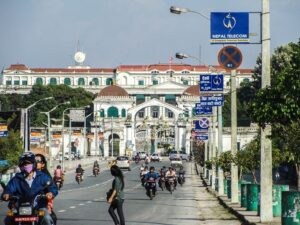
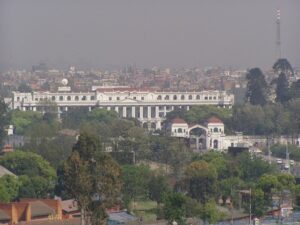
Constructed in 1908, Singha Durbar has served as a powerful symbol of Nepalese state authority for over a century. Initially designed with more than 1,000 rooms, expansive courtyards, and ornate halls, the palace represented both luxury and centralized power. Following the fall of the Rana regime in 1951, Singha Durbar was repurposed as the official seat of the Prime Minister’s Office and subsequently housed the Council of Ministers as well as both houses of Parliament. Throughout the decades, its architectural grandeur has mirrored Nepal’s political ambitions, while its walls have witnessed power struggles, the devastating fire of 1973, the Gorkha earthquake of 2015, and repeated reforms that highlight the resilience of both the structure and the state (Wikipedia, Kathmandu Post).
Origins and Construction: A Rana-Era Vision
Commissioned in 1908 by Prime Minister Chandra Shumsher Jang Bahadur Rana, Singha Durbar was envisioned as both a private residence and a political statement of Rana dominance. The design, executed by architects Kumar Narsingh Rana and Kishor Narsingh Rana, blended European neoclassical, Baroque, and Palladian styles with traditional Nepali craftsmanship (Alluring World). Historical records suggest that the government later acquired the property for 20 million Nepali rupees—an astronomical sum at the time (Wikipedia, IMNepal). Adjusted for modern values, this cost would translate to billions, reflecting its immense cultural and financial significance.
Disasters and Reconstructions Through History
The history of Singha Durbar is punctuated by recurring natural and human-made disasters. The fire of 1973 destroyed most of the complex, sparing only the front courtyard (Kathmandu Post). In 2015, the Gorkha earthquake once again caused severe structural damage, necessitating a major reconstruction project by the National Reconstruction Authority, which included retrofitting at an expense of over Rs 870 million (Nepali Janta).
The cycle of destruction repeated in 2025 when flames—fueled by political unrest—ravaged significant sections of the palace. These repeated disasters have destroyed priceless archives and artifacts (Kathmandu Post). Yet, each episode of destruction has been followed by a determined effort to rebuild, making Singha Durbar a living testament to Nepal’s resilience and its commitment to preserving cultural heritage.
Contemporary Role: A Government and Administrative Hub
oday, Singha Durbar no longer serves as a royal residence but functions exclusively as a government complex. It houses the Prime Minister’s Office and the Council of Ministers, as well as nearly 20 ministries, including Finance and Home Affairs. It also accommodates Nepal’s bicameral legislature—the Pratinidhi Sabha (House of Representatives) and the Rastriya Sabha (National Assembly). Furthermore, state broadcasters such as Radio Nepal and Nepal Television continue to operate within its premises (Wikipedia, ABS-CBN).
From Opulence to Survival
At its peak, Singha Durbar contained more than 1,700 rooms, lavishly decorated with imported chandeliers, European furniture, and magnificent artworks. This unique synthesis of architectural styles positioned it as one of Asia’s grandest palaces of its era (IMNepal). However, the palace’s legacy is equally defined by its survival through repeated calamities. The fires of 1973 and 2025, together with the 2015 earthquake, destroyed much of its original grandeur. Yet, despite these losses, the palace continues to symbolize the adaptability and endurance of the Nepali state.
Symbol of Power and Protest
Beyond its architectural significance, Singha Durbar has always functioned as a powerful political symbol. Under the Rana regime, it embodied elite authority and exclusivity. In the democratic era, it has come to represent governance, accountability, and national aspiration. Its burning in 2025 revealed the intensity of public disillusionment with government institutions, underscoring how closely the palace remains tied to the political consciousness of Nepali citizens. Thus, Singha Durbar is not merely a physical structure but a contested space that reflects both pride and protest in Nepal’s political narrative.
Tourism, Heritage, and Future Prospects
Despite its role as a functioning government hub, Singha Durbar continues to attract historians, researchers, and journalists interested in its turbulent past. There have been recurring proposals to preserve sections of the palace as a heritage museum, displaying surviving artifacts, photographs, and historical documents. If restored thoughtfully after the 2025 fire, the complex could serve not only as a functioning seat of power but also as a cultural monument symbolizing resilience and continuity.
Legacy of Singha Durbar
The trajectory of Singha Durbar is inseparable from the broader history of Nepal. From its Rana-era opulence to its role in modern governance, the palace embodies both the grandeur and vulnerability of the state. The 2025 fire was not only a physical catastrophe but also a symbolic act of public anger, reflecting deep dissatisfaction with governance. Yet, its repeated reconstruction demonstrates an enduring will to rebuild and renew. Singha Durbar thus stands as a testament to Nepal’s turbulent political history and its ongoing search for stability and democratic resilience.
Nepal’s Political Transition Post-2025
The aftermath of the 2025 protests ushered in a new political chapter for Nepal. On September 12, 2025, Sushila Karki, former Chief Justice of the Supreme Court, was appointed as the country’s interim prime minister, making her Nepal’s first female leader at the age of 73. Her appointment followed the resignation of Khadga Prasad Sharma Oli amid widespread unrest. Known for her anti-corruption stance, Karki pledged to lead a transitional government until parliamentary elections scheduled for March 5, 2026 (Reuters).
Finally
Singha Durbar is more than a government building; it is a national symbol of Nepal’s resilience, struggles, and evolving political aspirations. Its history of grandeur, destruction, and renewal mirrors the country’s broader journey from autocracy to democracy. The 2025 fire underscored both its vulnerability and its enduring centrality in the Nepali imagination. As Nepal moves toward new political horizons, Singha Durbar remains an enduring reminder of the nation’s turbulent past and its hopeful yet uncertain future.
This post is shared to inspire curiosity and deepen understanding.