
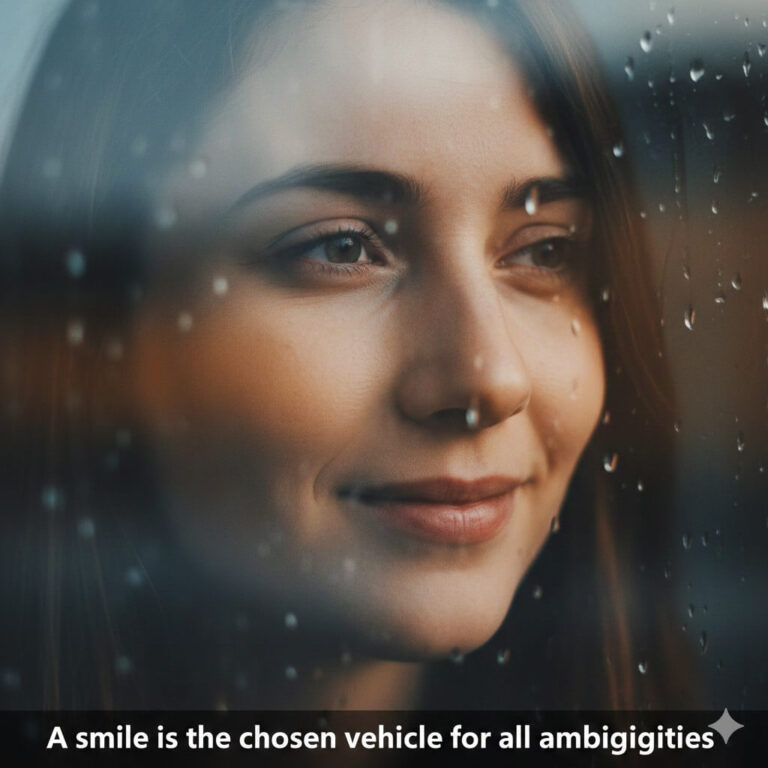
A smile is the chosen vehicle for all ambiguities, and that is why it feels both familiar and mysterious at the same time. Think of moments in daily life—a person smiling through tears at a funeral, or someone offering a polite grin during a tense discussion. In these situations, the smile carries meanings that are not always simple. It can express warmth, politeness, nervousness, or hesitation, and sometimes all of these at once. We instantly recognize a smile, yet we do not always know what it is trying to say. Beneath its gentle shape lies a mix of emotions, intentions, and unspoken thoughts. This expression becomes a way to move through feelings that are too complicated to explain. It helps us connect with others while also allowing us to protect our private emotions.
To understand this complexity, it helps to look at the origins of the smile. Smiling is not something we learn only from our surroundings—it appears even before language. Babies smile long before they understand speech, and people in every culture respond to this gesture. Yet even at this basic level, not all smiles are the same. Psychologists describe two main types: the Duchenne smile, which involves both the mouth and eyes, and the social smile, which mainly lifts the lips. This difference shows that our bodies are built to express both genuine feeling and polite performance. We smile because we feel happy, and we also smile to create the appearance of happiness. This ability may have helped humans survive, as appearing friendly can reduce conflict. A flexible expression offered protection in uncertain situations.
In personal life, this ambiguity becomes even more visible. Many people use a smile as a soft cover for difficult emotions. We smile when we are stressed, unsure, or tired—not because it solves anything, but because it helps us move through the moment. There are times when we say “I’m okay” with a smile even though we know we are not. The smile becomes a small shield, allowing us to hold ourselves together while we sort through our feelings. It also protects others from our internal struggles when we feel they may not have the time or energy to listen. In this sense, a smile becomes a simple way to say “I need space” without explaining the entire story.
This subtle use of the smile appears in everyday interactions as well. When something feels awkward or uncomfortable, we often smile to soften the tension. We smile when we are confused but do not want to interrupt. We smile when we disagree but want to avoid hurting someone. At work, we may smile politely even when we think an idea is impractical. At family gatherings, we smile through moments that test our patience. On the street, we smile at strangers to signal harmlessness. These gestures are not dishonest; they are part of how we maintain ease in social situations. The smile becomes a bridge that prevents minor tensions from turning into conflict.
On a larger scale, societies rely on smiles to maintain harmony. Many cultures encourage smiling as a sign of friendliness and respect. Some expect people to smile often, while others prefer more reserved expressions, yet the basic idea remains the same: a smile makes interactions gentler. This expectation is especially strong in professional environments. Workers in customer service, airlines, retail, hospitality, and reception roles are expected to smile continuously. These smiles create a welcoming atmosphere, even when the person may be tired or upset. Although they may not always reflect true feelings, they shape the customer’s experience.
Women often face added pressure to smile. They are judged more harshly when they do not, and may be called unfriendly or cold even when they are simply neutral. This expectation becomes a form of emotional labour—work done silently, often without recognition. Men do not face the same constant requirement, revealing how uneven these expectations can be. In such cases, the smile becomes something people must offer, sometimes more as a duty than a choice.
Smiles also play a significant role in public life and leadership. Politicians, business leaders, and diplomats use smiles as strategic tools. A leader may smile while delivering difficult news to calm the audience. A CEO might smile during a press conference about financial problems to show confidence. Diplomats smile during intense meetings, signalling cooperation even when disagreements run deep. In these moments, the smile communicates reassurance and control. It becomes part of the message, shaping how it is received.
In close relationships, the smile carries even more delicate meanings. It can build closeness, showing affection and comfort, but it can also create confusion. In romantic situations, a simple smile can make someone wonder whether the person is interested or simply being polite. In friendships, people smile to show support even when they are secretly hurt. In families, we often smile to comfort others while hiding our own worries. These smiles are acts of kindness, but they also show how emotional truth is sometimes softened for the sake of harmony. They maintain bonds, even when those bonds are complicated.
Art has long explored the mysterious nature of the smile. The Mona Lisa’s smile remains one of the most discussed expressions in history because it refuses to give a clear message. Is it happiness? Calmness? Distance? Something else entirely? The power of the painting lies in this ambiguity. Literature and films also use smiles as symbols—the secretive smile, the sad smile, the smile that hides fear. These portrayals remind us that a smile carries layers far beyond its surface appearance.
The strength of the smile lies in its dual nature. A smile can be genuine, and it can also be practiced. A real smile makes us feel welcome; a forced smile makes us cautious. Even though people are generally skilled at reading emotions, smiles continue to confuse because they allow different interpretations. They create space for reading between the lines.
This ambiguity is not a flaw. It is a useful part of human communication. Smiles help us avoid conflict, smooth difficult moments, and stay connected without revealing everything. If every emotion had to be spoken directly, life would become overwhelming. Smiles provide a gentle way to move through complex feelings.
In the end, the smile holds many truths at once. It can express joy or fear, calmness or worry. It is familiar yet complex, open yet protective. This complexity is part of what makes the smile human. Life is full of mixed emotions and delicate relationships. The smile helps us move through all of this with grace. A smile is the chosen vehicle for all ambiguities because life itself is uncertain, and we need expressions that can hold more than one meaning at a time. Sometimes it is enough to accept that a smile carries more than one truth—and that this layered expression is part of what makes human communication beautiful.