
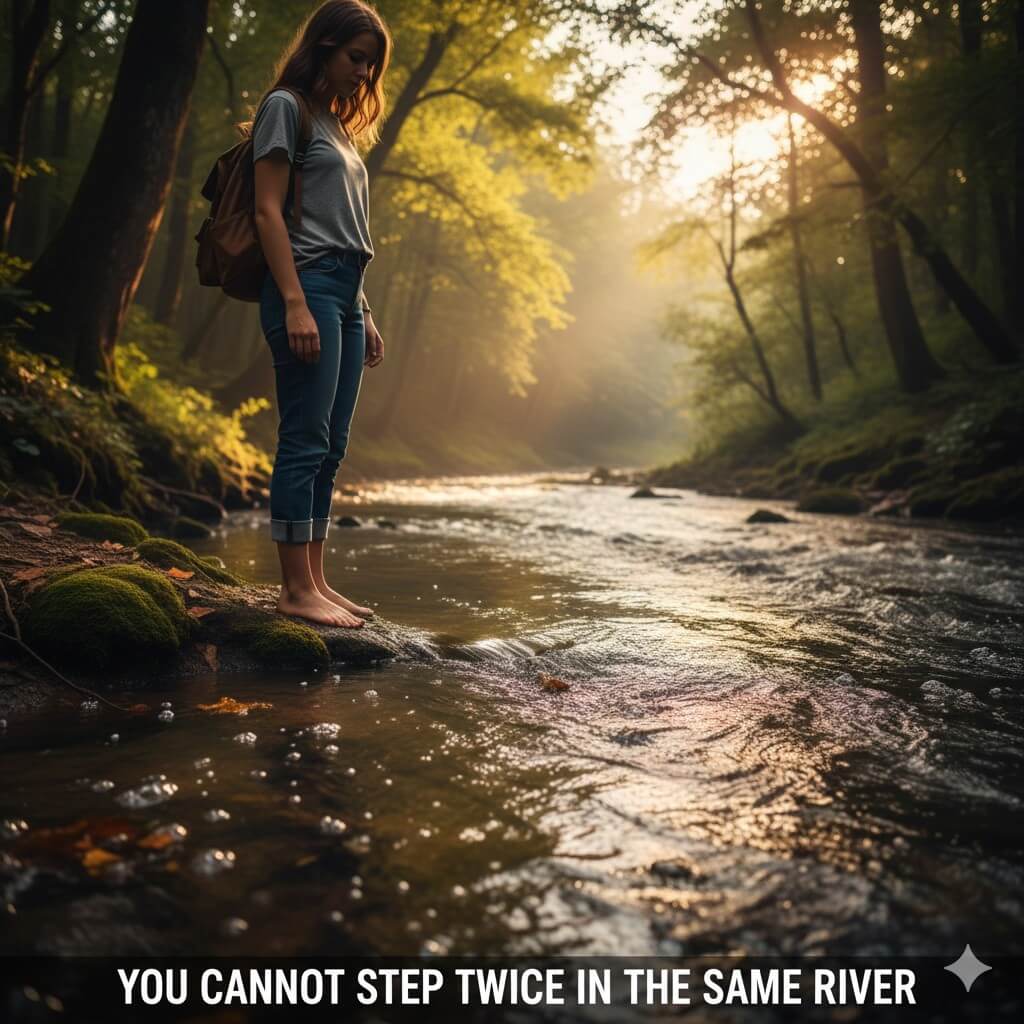
The saying “You cannot step twice in the same river” looks simple, but it carries a deep truth that applies to every part of life. The idea is that by the time we lift our foot and put it back down, new water has already replaced the old. The river has changed. At the same time, we have changed too. We are a moment older, our thoughts have shifted, and our body has moved forward in time. Neither the river nor the person stepping into it is ever exactly the same as before.
Change is the only constant in life, yet many of us behave as if things will stay the same forever. We wake up expecting the day to look exactly like the one before it, but the world is always moving. Seasons change slowly but surely. Children grow in ways that surprise us. Friendships shift as people take new paths. Cities expand, buildings rise or disappear, and familiar places transform. Even mountains, which seem solid and unshakeable, are slowly worn down over thousands of years. Trees that were tiny plants in our grandparents’ time now stand tall in the same grounds. The restaurant we loved as kids may no longer exist or may serve something very different. Our own bodies are constantly renewing themselves, with most of our cells being replaced every seven to ten years. The child we once were shares our memories but not our physical self.
The river is an effective metaphor for this ongoing change because water is always in motion. It moves because of gravity, the landscape, the rocks, and the obstacles in its path. Sometimes it flows fast, and sometimes it moves slowly, but it never stays still unless frozen. Rivers can carve deep canyons over long periods. They change their course after storms, shrink during dry seasons, and rise during heavy rains. They begin in mountains and end in oceans, and throughout this journey, they are never the same river twice. Writers and thinkers throughout history have used rivers to represent time, life’s journey, and the fact that we cannot go backward. Watching a river is like watching time move: constant motion, constant change, constant renewal.
When this idea is applied to personal life, it can feel both freeing and unsettling. Personal growth is impossible without accepting that we cannot remain the way we were before. Events that once felt overwhelming, such as heartbreak, failure, or loss, shaped us, but we are no longer the same people who faced those moments. The job that ended, the opportunity we could not take, or the mistake we made—these are all upstream now. They belong to earlier parts of our journey. Trying to hold on to earlier versions of ourselves is like trying to hold water in our hands. No matter how tightly we hold on, it will slip away. Growth requires letting go of old habits, beliefs, and identities that no longer fit. Each stage of life replaces the one before it, just as flowing water replaces the previous stream. The student becomes a worker, the single person becomes a partner, the carefree youth becomes someone with responsibilities. Each change requires releasing the past version and accepting the new one.
Letting go becomes even harder when it comes to relationships and society. The people around us are changing too. A close friend may develop different interests and drift away. Parents grow older and eventually need support instead of giving it. Children grow into adults with their own thoughts and views. Romantic partners evolve over time, sometimes in ways that strengthen relationships and sometimes in ways that lead people apart. These changes often feel painful when we expect people to stay the same forever. But every person is like their own river, shaped by their own experiences and flowing at their own pace.
Society also changes in ways that can be fast and confusing. Technology alters how we communicate and live. People who once wrote letters now send messages instantly. Phone calls turn into video chats. Norms and values also shift. What one generation considers shocking becomes ordinary for the next. What was seen as acceptable in the past may later be rejected. Politics, economies, and industries change rapidly. Entire types of jobs disappear, and new ones appear. The world that existed for our grandparents was very different from ours, and future generations will also live in a world different from today’s. Some people try to resist these shifts, holding tightly to the past. Others adjust to new situations more easily and move with the current rather than against it.
Our understanding of the world changes as well. Ideas we once thought were permanent truths are sometimes replaced by new discoveries. Medical treatments once considered normal may be seen as harmful later. Scientific theories evolve as new evidence appears. Experts who guide thinking today may be corrected by future research. Even history changes as new facts come to light and new viewpoints emerge. This constant evolution in knowledge should encourage us to remain open to learning. Refusing to update our thinking leaves us stuck in old waters, disconnected from the new flow of information. The person who insists that past knowledge is enough eventually struggles to understand the present.
Knowing that change is unavoidable does not make it easier to accept. Humans prefer stability and predictability. We want to feel safe and to believe that tomorrow will look similar to today. When unexpected change occurs—through loss, illness, failure, or sudden transitions—our instinct is often to resist. We try to hold onto what is disappearing. This reaction is normal. But psychologists explain that acceptance allows us to move forward more effectively. Resilience is not the absence of discomfort; it is the ability to stay flexible and adapt while keeping a sense of direction.
We can build this flexibility through simple practices. Staying curious makes change feel less threatening. When we approach new situations with interest rather than fear, the unknown becomes easier to handle. Learning a range of skills and building varied relationships gives us multiple sources of identity and support, so that a single change does not overwhelm us. Mindfulness helps us stay grounded in the present instead of getting stuck in the past or worrying about the future. A light, flexible attitude toward life’s surprises can reduce stress. Most importantly, seeing change as a natural process rather than as a disruption helps us move with life’s flow instead of resisting it.
The core truth behind the old saying is that resisting change is resisting reality. The river will move whether we want it to or not. Time will pass, people will change, circumstances will shift, and we ourselves will become different. We can waste energy trying to stop what is unavoidable, or we can learn to move with the flow. Change brings both losses and new possibilities. The water that leaves carries the old with it, but the water that arrives brings opportunities. Every moment is a new river. Each step forward is a chance to meet life as it is, not as we hope it will remain. Accepting this is not surrender; it is understanding. It is the calm recognition that life is movement, and movement is life.