
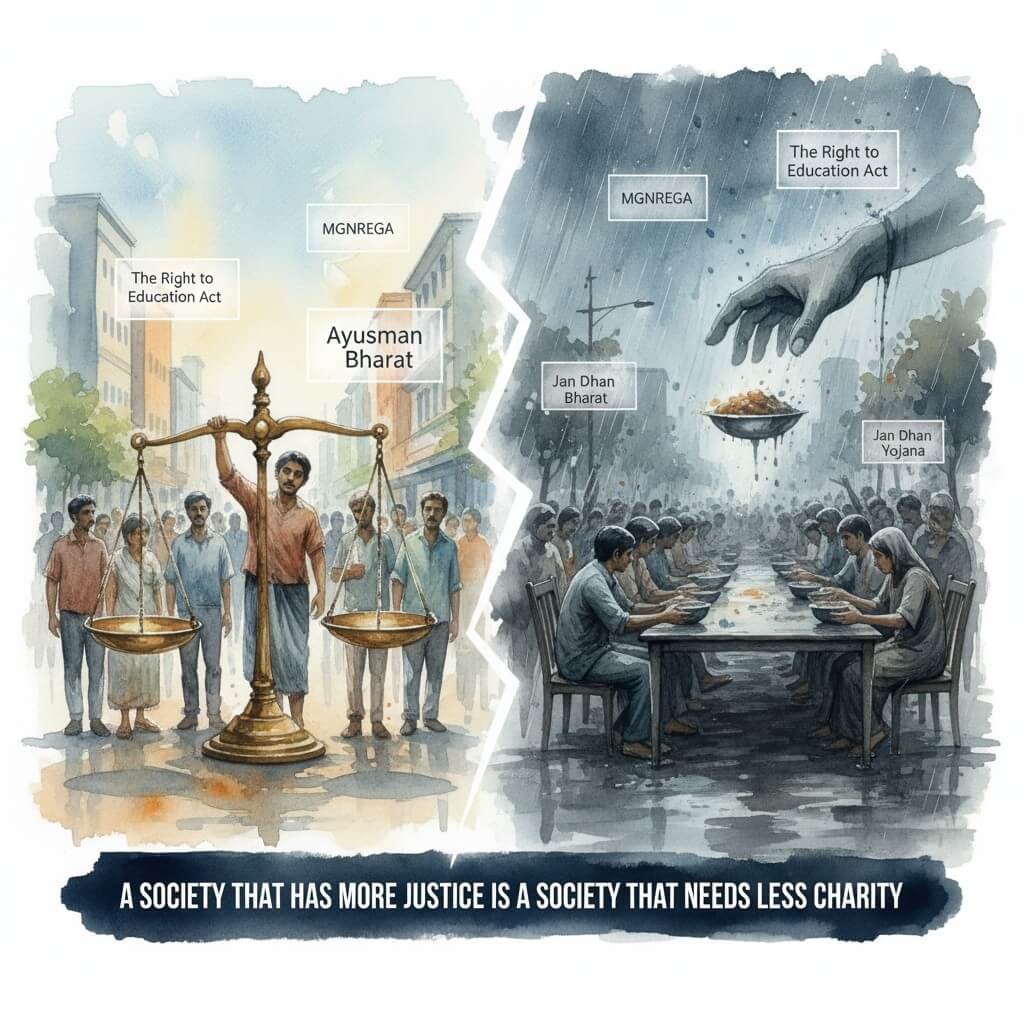
A society that has more justice is a society that needs less charity, because when fairness, equality, and opportunity are guaranteed for all, people are empowered to lead dignified lives without depending on the goodwill of others. In every society, justice and charity coexist, but they serve very different purposes. Charity provides immediate relief and comfort to those in need, while justice builds the foundation for long-term fairness and equal access to resources. While acts of charity are important during emergencies and crises, they cannot replace systemic justice. A society that prioritizes justice creates structures that empower citizens, reduce inequality, and naturally lessen the need for charity, ensuring that relief becomes a gesture of kindness rather than a lifeline for survival.
Justice is more than just a legal concept; it is the framework that guarantees equal opportunities, fair treatment, and protection of rights. It ensures that no one is deprived of basic necessities due to circumstances beyond their control. Charity, though noble, often addresses only the immediate effects of inequality and hardship. Giving food, clothing, or temporary shelter helps in the short term, but it does not resolve the underlying causes of poverty, illiteracy, or unemployment. For a society to thrive sustainably, justice must be the foundation, while charity should support it, not replace it.
One of the clearest examples of justice in action is MGNREGA, the Mahatma Gandhi National Rural Employment Guarantee Act. This program guarantees employment to rural households, ensuring that people can earn a dignified income. Unlike food distribution programs, which provide temporary relief, MGNREGA empowers citizens to sustain themselves through their own work. It addresses the root cause of poverty—lack of income and opportunity—rather than merely offering temporary comfort. When individuals have secure employment, they are less dependent on the goodwill of others, and the need for charity naturally diminishes.
Similarly, the Right to Education (RTE) Act demonstrates how justice can transform lives. Education is a fundamental right, and when the state ensures that every child can access quality schooling, it prevents the cycle of poverty from continuing across generations. Charity-based educational initiatives, such as scholarships or donations to individual students, are helpful, but they cannot meet the needs of an entire society. A justice-oriented approach like the RTE Act ensures that education becomes a guaranteed right, giving children the skills and opportunities to lead self-sufficient lives.
Healthcare is another domain where justice dramatically reduces the need for charity. Programs like Ayushman Bharat, which provides health insurance coverage to millions of citizens, ensure that people can access medical care without fear of financial ruin. In contrast, medical charity camps, though well-intentioned, are temporary and limited in reach. Justice guarantees systematic, ongoing support for healthcare, protecting individuals from preventable hardship. When people can access doctors, medicines, and hospital care as a right, they do not have to rely on occasional charitable acts for survival.
Financial inclusion is yet another pillar of justice that reduces dependency on charity. The Jan Dhan Yojana has opened millions of bank accounts for previously unbanked citizens, allowing them to receive direct benefit transfers and manage their own finances. When people have control over financial resources, they gain independence and security. In contrast, charity often creates a power imbalance, where the recipient depends on the giver’s generosity. Justice-based systems like Jan Dhan Yojana empower citizens and ensure that aid serves as support for self-reliance rather than fostering dependency.
Affirmative action policies, such as reservation in education and employment, also demonstrate how justice reduces the need for charity. Historically marginalized communities face systemic barriers that limit access to opportunities. Reservation policies ensure that these communities have equitable access to education, jobs, and professional growth. This systemic justice addresses the roots of inequality, whereas charitable initiatives often provide only sporadic help to a few individuals. By creating equal opportunities, society empowers those who might otherwise rely on charity to build meaningful lives.
Justice also protects human dignity. While charity can relieve suffering, it often comes with the implicit message that the recipient is dependent or unable to help themselves. A society that ensures justice, on the other hand, allows every individual to live independently, make choices, and contribute to the community. When people are treated fairly and have access to education, healthcare, and employment, they retain self-respect and agency. Justice restores dignity; charity, however well-intentioned, cannot achieve the same level of empowerment.
The economic impact of justice is equally significant. Societies that focus on equitable distribution of resources and rights often experience more stable and sustainable growth. When citizens are empowered through fair wages, education, and access to healthcare, productivity increases, and social unrest decreases. In contrast, heavy reliance on charity can indicate structural failures, where the state or system has not addressed basic needs. Justice strengthens both individual lives and national development, reducing dependence on charitable aid and creating a more robust, resilient society.
From a moral and ethical standpoint, justice represents collective responsibility, whereas charity is an individual act of compassion. Justice ensures that poverty, inequality, and discrimination are addressed as societal issues, not personal failings. Charity can temporarily alleviate suffering, but justice prevents it from occurring in the first place. By focusing on systemic fairness, societies create a framework where every citizen has a chance to thrive independently. In this sense, justice is not just a legal concept; it is a moral imperative.
It is important to recognize that charity still has a role, especially during emergencies such as natural disasters, pandemics, or sudden crises. However, charity should complement justice-based systems rather than replace them. For instance, a flood victim may need immediate relief through food, shelter, and medicine, but long-term protection comes from justice-oriented policies like disaster management systems, insurance, and rehabilitation programs. In a just society, charity becomes a gesture of empathy and solidarity, not a lifeline for survival.
In conclusion, justice and charity are both vital components of society, but they operate on fundamentally different levels. Charity addresses immediate needs, providing relief and comfort, while justice addresses systemic inequalities, empowering individuals to live independently. Programs such as MGNREGA, the Right to Education Act, Ayushman Bharat, Jan Dhan Yojana, and reservation policies illustrate how justice can reduce reliance on charity by providing fair access to employment, education, healthcare, and financial resources. A society that focuses on justice strengthens dignity, equality, and economic stability. While charity will always reflect human compassion, it cannot replace justice. Ultimately, when fairness, opportunity, and rights are embedded in the systems of society, the need for charity naturally diminishes, leaving acts of giving as gestures of kindness rather than survival.