
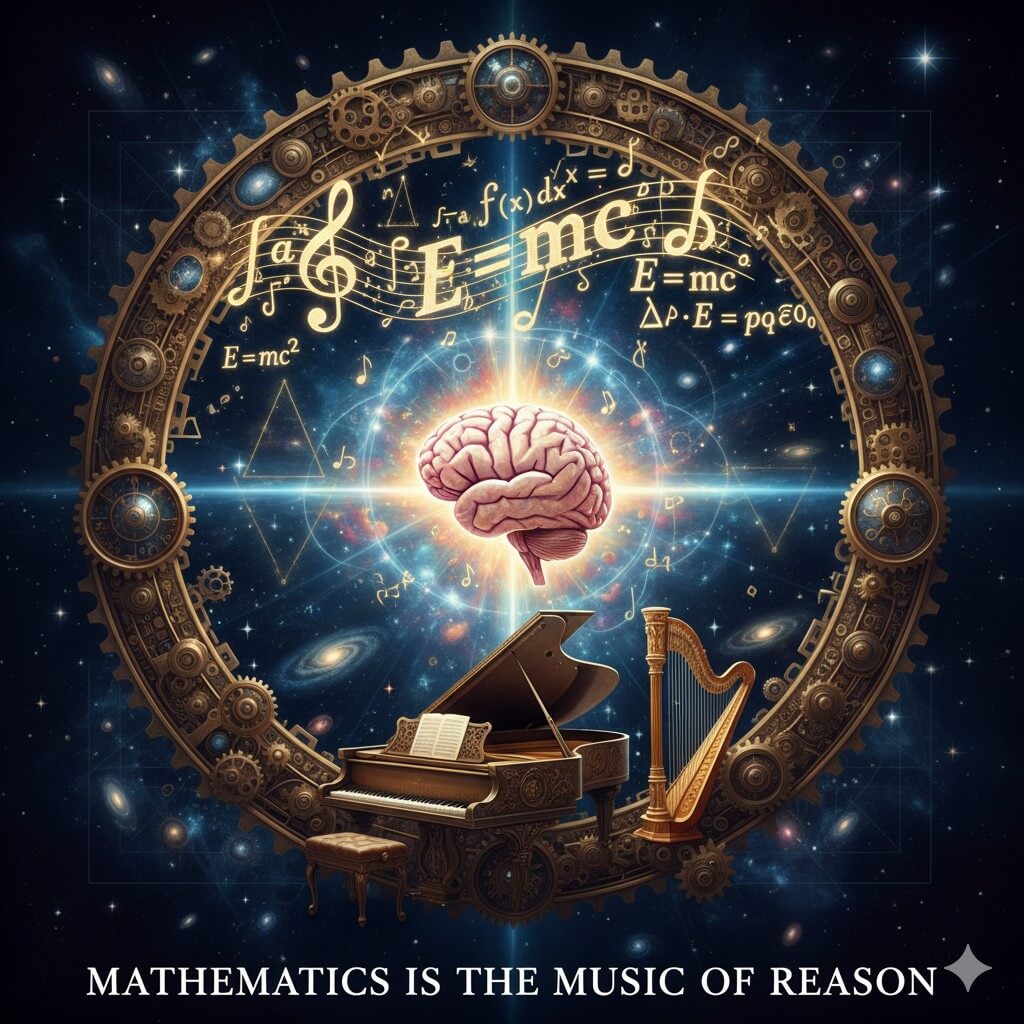
There is a beautiful expression: “Mathematics is the music of reason.” At first, it may seem poetic and surprising. Music touches our emotions and dances with rhythm, while mathematics appears strict with numbers, formulas, and rules. But when we look closely, we discover a deep connection between them. Music takes sounds and turns them into harmony. Mathematics takes ideas and turns them into logic. Both create patterns that satisfy the mind and the heart. Math is not just a school subject—it is the gentle melody that moves life forward, even when we do not notice.
Mathematics begins shaping our lives at a very personal level. When we receive our salary or pocket money, we calculate how to use it wisely. We think about rent, groceries, travel expenses, and savings—all of this is mathematics in action. Without basic arithmetic skills, we might end up with empty pockets by the end of the month. Understanding numbers gives us confidence to plan ahead and secure our future.
Even simple daily chores involve math. Cooking a meal means measuring ingredients, adjusting quantity based on the number of people, and managing time so everything is ready together. When we go shopping, we compare prices, check discounts, and balance our budget. When we travel, we estimate travel time, calculate distances, and look at fuel usage. Math is like an invisible helper guiding us through every small decision. We may not always realize the presence of numbers, but they are always working quietly—like background music in a movie scene.
In entertainment too, mathematics plays a role. The favorite mobile game we enjoy, the music we stream, or the movie we watch online—everything depends on algorithms and data, which come from mathematics. Even the steps we count on a fitness app involve calculations that help us live healthier lives. In all these everyday experiences, math gives life structure and keeps us organized.
But mathematics goes far beyond individual activities. It also plays a key role in shaping a society. To track the progress of people, governments use statistics like literacy rates, life expectancy, and population growth. These numbers help us understand how well people are living and what support they need. The Human Development Index (HDI) tells us whether people are educated, healthy, and financially stable. Without mathematics, these measures would not be possible, and planning for human welfare would become blind guesswork.
On a global level, mathematics helps us monitor and achieve the United Nations’ Sustainable Development Goals (SDGs). These goals—like reducing poverty, ensuring clean water, and promoting gender equality—are tracked using data. If literacy improves from 70% to 85%, or poverty reduces by 10%, it shows that we are moving toward a better future. Mathematics gives us a way to measure progress and understand whether the steps we take are effective.
Economists rely on mathematics to study a country’s growth. Concepts like GDP, inflation rates, employment statistics, and national budgets are all mathematical tools. A small miscalculation may lead to the wrong policy, affecting millions of citizens. Proper economic analysis helps governments decide how much to spend on education, healthcare, defense, and welfare. In this way, mathematics acts like the rhythm that keeps a nation’s development steady and balanced.
Infrastructure—roads, bridges, railways, and buildings—stands strong because of mathematics. Engineers use geometry and mathematical analysis to ensure safety and durability. They calculate angles, weight distribution, and material strength before construction begins. Just as one wrong note can spoil a musical performance, one wrong number can ruin a bridge. Mathematics ensures that our cities and transportation systems are safe and reliable.
Technology too is built on mathematics. Computers operate using binary numbers. Artificial intelligence learns from data driven by complex mathematical models. Social media platforms show us the right posts using algorithms based on probability and statistics. Cybersecurity, which keeps our online payments and personal information safe, is based on mathematical encryption. Without math, the digital world we rely on would come crashing down—like an orchestra without sheet music.
Nature itself follows mathematical patterns. Flowers often bloom in numbers that match the Fibonacci sequence. Honeybees build hexagonal honeycombs because that shape saves maximum space and material. The spiral of a galaxy and the formation of snowflakes follow geometric rules. From the shape of a seashell to the movement of planets, numbers guide the universe like a silent symphony. When we observe nature closely, we see that mathematics is the composer behind its beauty.
Mathematics also trains our minds. It teaches us to think clearly and logically. When solving a problem, we learn to break it into steps, find patterns, and test solutions. These thinking skills help us far beyond classrooms—whether planning a business, solving a personal conflict, or making daily decisions. Math builds patience and discipline, just as learning music requires repeated practice until the tune becomes perfect.
Another wonderful feature of mathematics is its universality. No matter where people live, mathematical truths remain the same. “2 + 2 = 4” holds true in every country, every language, every culture. This makes mathematics a shared language of humans across the world. Scientists in different countries can collaborate because math connects them, even when their spoken languages differ. It acts like a universal rhythm that everyone can follow.
Some people believe mathematics is emotionless. But those who love math know how it can excite and inspire. Solving a difficult equation gives the same happiness that comes from completing a song or finishing a beautiful painting. Great mathematicians like Ramanujan and Euler described numbers with passion and joy. For them, mathematics was not mechanical—it was art. It was music expressed through symbols instead of sounds.
In conclusion, mathematics truly deserves the name “the music of reason.” It helps us manage our personal lives, supports our daily tasks, and drives smart decision-making. It measures human progress, strengthens national development, and builds a safe and modern world with technology and infrastructure. It shapes the natural world and sharpens our ability to think logically. Just as music brings harmony to the heart, mathematics brings harmony to the mind.
When we begin to see the melody in numbers and the rhythm in patterns, mathematics becomes far more than a subject—it becomes a way to understand life. The next time we solve a problem or check a bill, let us remember: we are not just doing math, we are listening to the silent music that keeps our world in tune.