
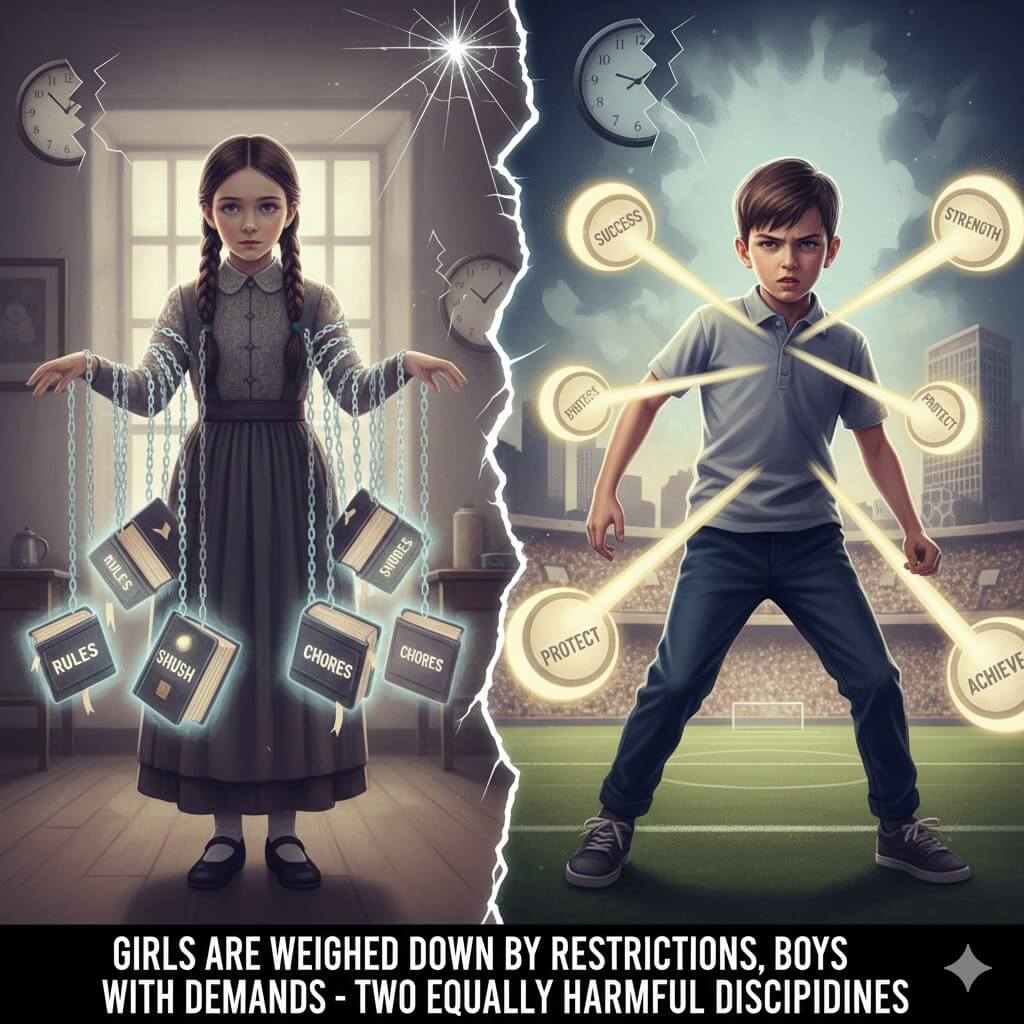
Girls Are Weighed Down by Restrictions, Boys with Demands – Two Equally Harmful Disciplines is more than just a statement—it is the quiet truth of how we raise our children. There is a soft kind of harm in our parenting that doesn’t look like punishment at all. It comes wrapped in care, spoken through lines like “It’s for your own good.” We tell girls what they must not do, where they must not go, and how they must behave. We tell boys what they must become, how they must hide feelings, and how they must always be strong. In the process, we cage one gender with fear and crush the other with expectations, pretending that this is love.
Look closely at any Indian home, neighborhood, or college, and the pattern is impossible to miss. A girl dreams of being an architect but is told it involves outdoor work—too unsafe for women. A boy who loves books is forced into engineering because “arts has no future.” These things happen so often that we barely notice how damaging they are. They become part of everyday life.
For girls, the restrictions begin when they are very young. They hear rules about how to sit, how to talk, how to laugh, how to behave. These rules build up slowly until they form invisible chains. She may study, but not far from home. She may work, but only in “suitable” fields. She may have friends, but only the right ones, in the right places, at the right time. Her freedom always depends on someone else’s approval.
Soon, she learns to limit her own dreams. Maybe she quits sports because people say it isn’t “feminine.” Maybe she chooses a nearby college to calm her parents’ fears. Maybe she delays her goals because marriage must come first. When she is taught again and again that her value lies in being “good” and “adjusting,” she stops wanting too much. She tries to take up less space in the world. And we justify all this by calling it protection. But what we are really doing is teaching her that she must be cautious, obedient, and grateful for whatever little she gets. That the world doesn’t fully belong to her.
Meanwhile, boys are trapped too—just in a different cage. If girls are told all the things they can’t do, boys are told everything they must do. “Be tough.” “Don’t cry.” “A real man never shows weakness.” These ideas take away their right to feel. As they grow, fear turns into anger, sadness turns into silence, and softness turns into shame. A boy’s worth is linked to his career and income. If he dares to choose dance, cooking, or any passion that doesn’t pay big, he is judged. His dreams matter only if they fit society’s plan. And when he struggles under this pressure—as any human would—he learns to hide it. Seeking help is labeled weak. So he suffers quietly, even when he is breaking inside. The rising mental health issues and suicide rates among men are proof of how heavy this burden is.
Here’s the hidden truth: the system that restricts girls feeds the system that demands from boys. Girls are told to be protected, so boys must become protectors. Boys are told they must provide, so girls must stay dependent. Everyone follows rules they did not create. In many families, a brother controls his sister’s clothes and freedom, not because he is powerful, but because he is forced to take responsibility for her “honor.” A father refuses his daughter’s choices yet carries the pressure of securing her future. Mothers often repeat these rules because they were once controlled in the same way. All become both victims of the expectations and protectors of the system.
And this system hurts us everywhere. Parents don’t know their children’s real selves because children learn to hide them. Marriages become places where gender roles matter more than love or understanding. Friendships between boys and girls are judged quickly, always seen with suspicion. Workplaces lose talent because we still think men and women belong in different types of jobs. Sometimes, the pressure explodes into violence or emotional breakdowns. But even then, we rarely blame the gender rules that caused it.
Imagine a different world—one where we do not swap burdens, but remove them. A world where girls are taught that their freedom is their right, not a privilege. Their bodies and dreams belong to them, not to society. They deserve the same space, the same confidence, and the same opportunities as boys.
And boys too deserve freedom—not from safety, but from pressure. They should know that their worth is not their salary, that emotions are human, and that asking for help is a sign of strength. They should be allowed to choose what makes them happy, whether or not it fits the stereotype of a “man’s job.”
This future is not just imagination. Change has already begun. More girls are questioning curfews and refusing to limit ambitions. More boys are choosing therapy, speaking openly about their feelings, and selecting careers that match their interests. Some parents are finally learning to listen, allowing their children to lead their own lives. The progress is slow and uneven, but it is real.
We must understand one thing clearly: restrictions do not make girls safe—they make them small. Demands do not make boys strong—they make them breakable. Both are forms of emotional violence that look like love from the outside. Real love does not control. Real love gives space to grow.
Every child—girl or boy—deserves a life where they can discover who they are without fear or pressure. A life where they are valued for their humanity, not limited or pushed because of their gender. If we continue to challenge old rules and choose empathy over judgment, we may finally raise a generation that is freer, kinder, and more complete.
A world where no one is weighed down by gender expectations is possible. And it begins with how we raise our children today.