
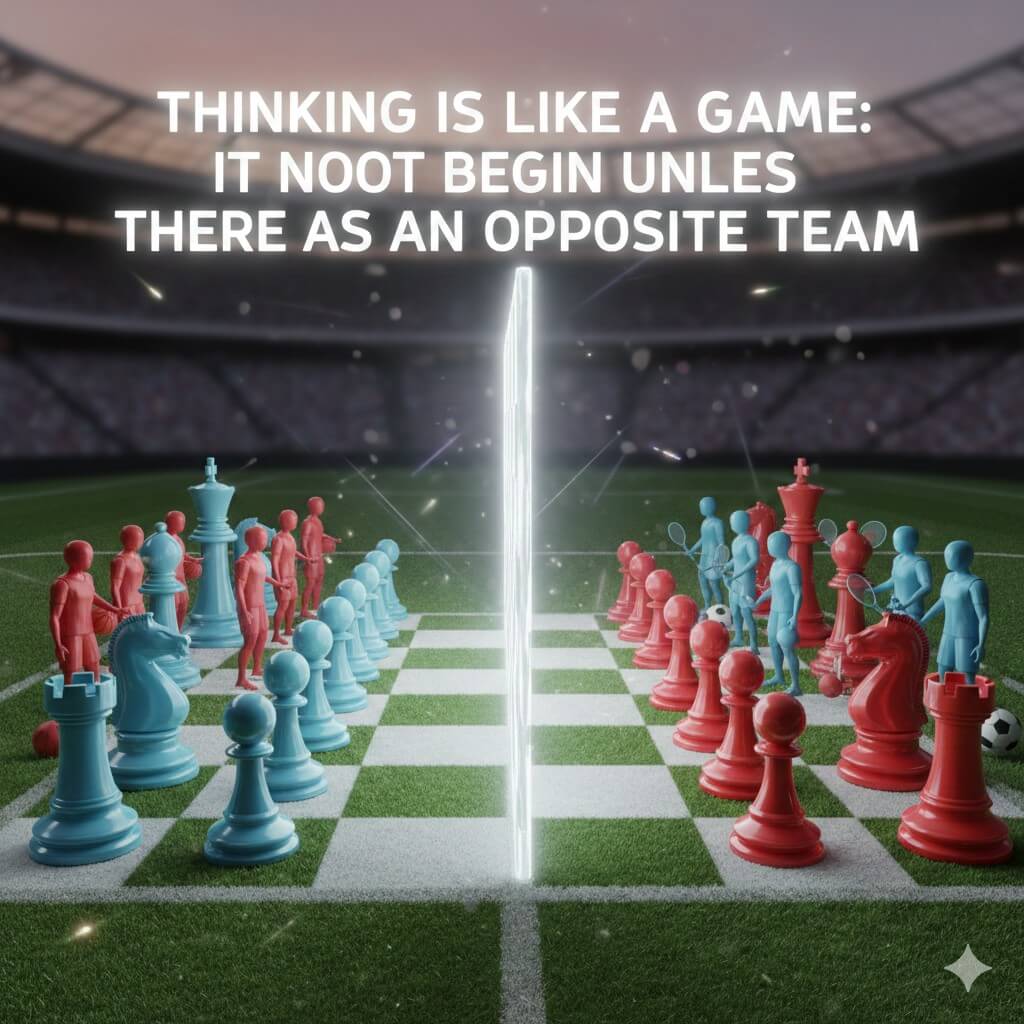
We often imagine a thinker as someone sitting quietly, maybe under a tree or at a desk, lost in deep thought. It’s a peaceful picture, but it leaves out an important truth: real thinking almost never happens alone. Just like a game of cricket or chess needs an opponent, thinking needs something that pushes back—an obstacle, a question, a challenge. Without this resistance, our mind simply follows the same easy paths again and again. True thinking is not silent dreaming; it is a lively struggle with ideas that disagree or collide with each other—whether these challenges come from other people or from our own doubts.
There’s a big difference between having thoughts and actually thinking. It’s like owning a cricket bat versus playing a real match. You can swing the bat all day in your backyard, but the real game begins only when a bowler is trying to get you out. In the same way, we may hold many opinions, but until someone questions us—“Why do you think that?” or “What if you’re wrong?”—we never test them. This friction may feel uncomfortable, but it’s what wakes up our mind and forces us to think harder.
Indian philosophical traditions understood this long ago. The practice of shastrartha—deep, formal debates—was not just a display of intelligence. It came from the belief that truth becomes clear only when ideas are challenged again and again. When Adi Shankaracharya traveled across India debating scholars from different schools of thought, he wasn’t simply trying to win. Each debate helped him sharpen his arguments, discover weaknesses, and improve his understanding. His opponents were not enemies; they were essential partners in his search for truth.
This is why passive learning—accepting whatever we hear or read—makes our thinking weak. When we only listen to people who agree with us or read things that support our views, we are not thinking at all. We’re just collecting ideas the way someone collects stamps. Then, the moment someone challenges us, we realize we cannot defend our opinions because we never questioned them ourselves. It’s like swinging a bat alone and suddenly being asked to face a real bowler—you quickly see how unprepared you are.
The strongest kind of opposition often comes from inside us. Skilled thinkers learn to question their own ideas before anyone else does. They ask themselves: “What would a critic say about this?” “Is there something I’m ignoring?” “What evidence goes against my belief?” This inner debate—where you become your own opponent—is one of the most powerful skills a person can develop.
Dr. B.R. Ambedkar did exactly this when he challenged the idea of caste hierarchy. He didn’t reject caste simply because it felt unfair. He carefully studied every argument used to defend it. He read the same texts that supported caste discrimination and pointed out their contradictions. He thought from his opponents’ point of view, identified their strongest arguments, and then addressed each one. His strength as a thinker came from understanding both sides of the debate—not just his own.
But this internal struggle is hard. It takes mental energy and honesty. It is far easier to hold on to our beliefs without questioning them. When we stop challenging ourselves, our thinking stops growing. We begin to treat our opinions as absolute truths simply because we’ve believed them for a long time. This is how even smart people can fall into foolish ideas—not because they lack intelligence, but because they have avoided the inner opponent who keeps their thinking sharp.
External opposition—talking to people who disagree with us—adds another layer. When we speak to someone with different experiences or values, they show us things we never noticed. They point out assumptions we didn’t know we had. They ask questions we didn’t think to ask. These moments can feel uncomfortable, but they are often the most valuable.
The real magic happens when we stop seeing disagreements as fights and start seeing them as teamwork. The person who challenges your idea is helping you test it. If your idea collapses, you learn something important. If it survives, it becomes stronger and clearer. Either way, you grow.
Some of the greatest discoveries in history came from this kind of productive challenge. The entire scientific method is built on it. A scientific idea is considered strong only after many people try to prove it wrong. Research papers are checked by experts who look for mistakes. Experiments are repeated by other scientists to confirm results. This isn’t because scientists enjoy criticizing each other; it’s because only through such testing do we uncover reliable truths.
Of course, not all opposition is useful. Sometimes debates become performances where people argue only to win, not to learn. Sometimes critics aim only to destroy, not to understand. And sometimes false debates are created—for example, pretending there are “two sides” to whether the Earth is round, even though the evidence is overwhelming. Not all disagreement leads to better thinking. Productive opposition requires honesty, curiosity, and respect for facts.
Today, finding real opposition has become even harder. With social media and algorithms, it’s easy to surround ourselves with people who think exactly like we do. This creates a comfortable bubble, but it slowly weakens our mind. If we never face challenges, our thinking becomes soft and lazy.
So, if we want to think well, we must actively seek out challenges. We should read writers who hold different opinions, talk to people with different backgrounds, and question our own ideas regularly. When someone says, “I’m not sure you’re right,” instead of reacting with anger or defensiveness, we can treat it as a chance to grow. Their question is not an attack—it’s an invitation to think better.
Thinking, like a game, needs two sides. Without an opposing team, we are only practicing in an empty field. With one, our mind becomes alert, engaged, and alive. The game of thinking has no final score, but it becomes meaningful and exciting only when someone—or some part of ourselves—pushes us to do better.