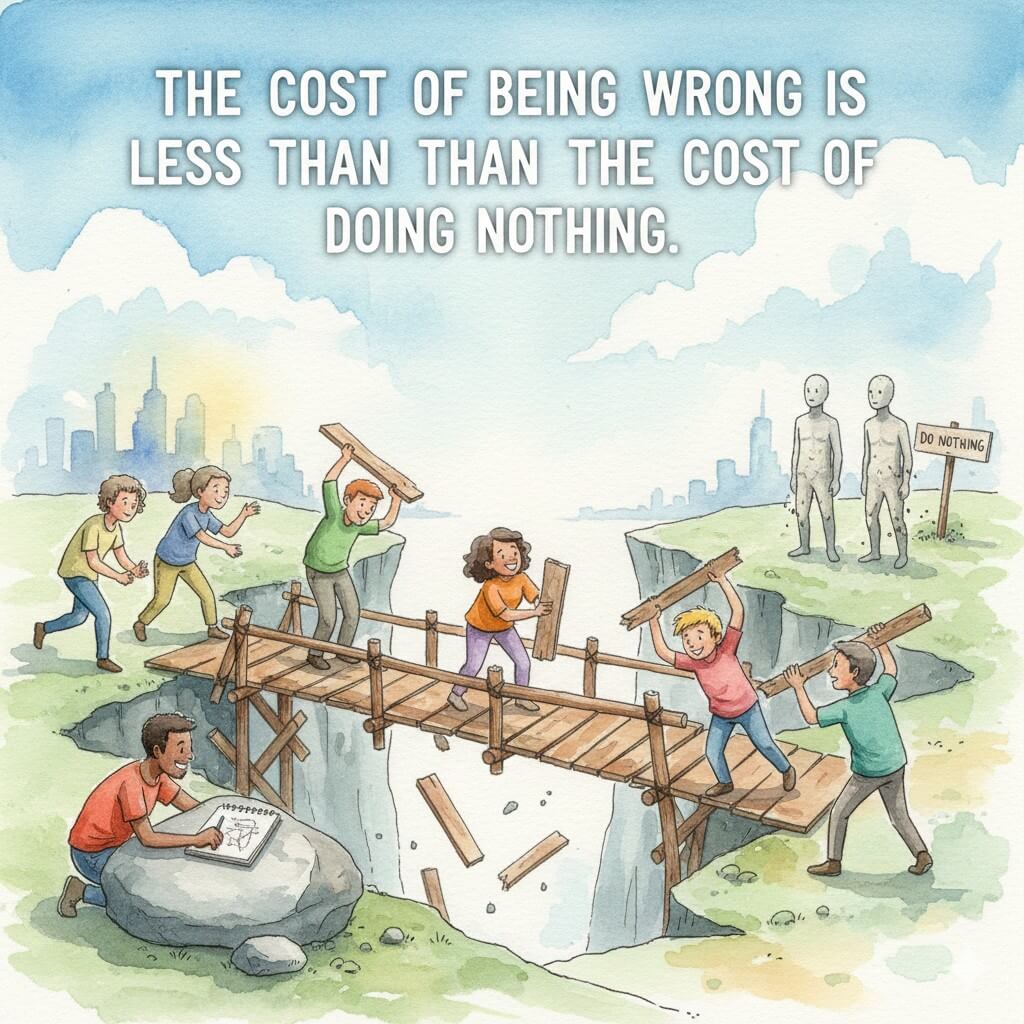
The idea that “the cost of being wrong is less than the cost of doing nothing” carries a deep truth that many of us understand only later in life. We grow up in a world that teaches us to avoid mistakes at all costs. From childhood into adulthood, we hear the same warnings—be careful, don’t mess up, think twice before you act. Because of this, we start believing that being wrong is dangerous. We fear embarrassment, failure, and judgment so much that it often stops us from taking even the smallest step forward. But when we look back honestly, we realise something painful: the things we did wrong rarely haunt us forever. It is the things we never tried, the chances we didn’t take, the words we left unsaid—those are the regrets that stay with us the longest.
Psychology helps explain why this happens. Researchers like Daniel Kahneman and Amos Tversky discovered that we humans are naturally more afraid of losses than excited by gains. Losing something feels almost twice as painful as gaining the same thing feels good. If we lose a hundred rupees, the sting is much stronger than the happiness of finding a hundred rupees. This built-in fear, called loss aversion, makes us avoid situations where we might lose something—money, pride, reputation, comfort—even when the possible benefit is greater. Because being wrong often involves some kind of loss, our mind treats it as a threat. The fear becomes so loud that it freezes us. We stop moving, stop trying, stop deciding. In trying to protect ourselves from loss, we often end up losing even more.
This fear becomes worse when we ignore opportunity cost—the hidden price we pay for not taking action. When we choose not to start a new project, not to send that message, not to take that risk, we are still making a choice. We’re giving up whatever good things might have come from that action. But because these benefits exist only in the future and not in front of our eyes, we don’t feel their weight. We overestimate the risks of acting and underestimate the risks of staying still.
Imagine one of us dreaming of becoming an entrepreneur. We have a promising idea, some savings, and the enthusiasm to try. But we also have fear. What if we fail? What if we lose our savings? What will people think? These worries are real. Starting something new always involves risk. So we wait. We keep planning, keep researching, keep trying to feel “ready.” Slowly, years pass. Life becomes busier. Responsibilities grow. By the time we look back, the moment has slipped away. We may have protected ourselves from losing money or facing embarrassment. But the cost of doing nothing—living with that quiet “what if”—is far heavier. Losing money is temporary. Missing out on a dream is permanent.
The same pattern shows up in relationships. One of us may deeply care for a friend but stays silent because we’re scared of being wrong about how the other person feels. We don’t want to face rejection. We fear ruining the friendship. So we hold back. Years later, we learn that the feelings were mutual, but the timing is gone. Life has taken both people in different directions. Even if we had been wrong and faced rejection, that pain would have healed. But the regret of never expressing our feelings quietly stays with us. Rejection fades. Wondering “what might have been” does not.
Career decisions work the same way. Many of us want to shift to a field we actually enjoy, but fear stops us. What if we’re not good enough? What if we fail? What if we can’t return to our old job? Because of these doubts, we stay in the same place year after year, even though it leaves us frustrated and unfulfilled. Switching fields might have been difficult. It might have required starting over. But it could also have brought us a more meaningful life. The cost of being wrong would have been tough but survivable. The cost of doing nothing slowly eats away at our spirit.
Research on regret consistently shows this. When people at the end of their lives are asked what they regret most, they rarely talk about mistakes or failed attempts. They talk about the things they never dared to try. The business they didn’t start. The person they didn’t confess their feelings to. The chances they didn’t take. These regrets of inaction hurt more and last longer because there is no closure. When we act and fail, at least we know we tried. But when we remain frozen, that unanswered question follows us forever.
It’s also important to recognise the difference between being wrong through action and being wrong through inaction. When we take action and something doesn’t work out, the cost is usually limited. We might lose money, time, or comfort. We might feel embarrassed. But these hurts have an end. Life moves forward. We learn. We grow. But when we choose to do nothing, the cost keeps increasing over time. Every day we stay stuck is another day of lost potential, another day taken away from growth, joy, success, or love. Inaction doesn’t take something from us all at once—it drains us slowly, silently, and continuously.
There is also a hidden advantage to taking action even when we might be wrong: we learn something valuable. Every attempt gives us information. If we fail, we discover what doesn’t work. That knowledge becomes the foundation for the next step. Thomas Edison famously said that each of his failed attempts at making a lightbulb was simply a discovery of how not to make one. Every mistake moved him closer to success. When we choose not to act, we stay at the same level of uncertainty.
Think of anyone we admire—an entrepreneur, a writer, an athlete, a scientist. Almost all of them have been wrong many times. They have failed repeatedly. The reason they succeeded isn’t because they made perfect decisions. It’s because they kept acting despite the risk of being wrong. They understood that failure is temporary but regret is forever.
Life is unpredictable. If we wait for perfect certainty before we act, we will spend our whole lives waiting. Being wrong hurts for a while, but doing nothing hurts for a lifetime. The cost of action is usually a moment of discomfort. The cost of inaction is a lifetime of wondering. So when we face a choice—take a risk or play it safe—we must remember the bigger picture. Being wrong might cost us something now. Doing nothing will cost us far more in the long run. Let us try, experiment, speak up, and take chances. A few mistakes won’t ruin our lives. But avoiding them might.